
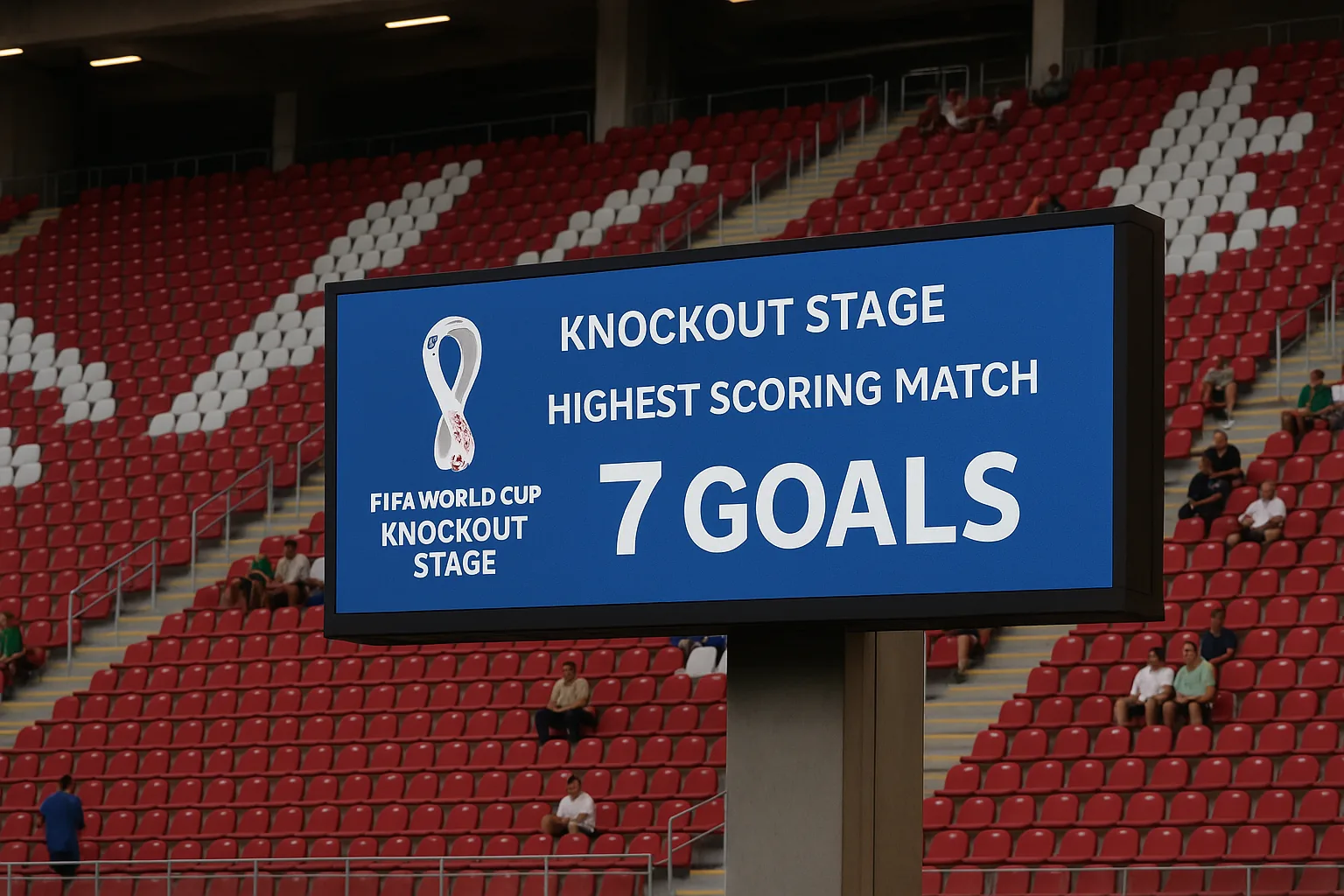
The conclusion of the 2026 FIFA World Cup's Round of 32 has prompted traders to scale back expectations for a record-breaking goal-fest in the tournament’s knockout stage. With the current high-water mark set by France's thrilling 4-3 victory over Argentina, contracts on a U.S.-regulated prediction market saw a broad-based decline in the probability of a future match surpassing that seven-goal total.
The market shift, which occurred in the session ending July 03, 2026, reflects a recalibration based on realized results and a shrinking schedule. As the tournament advances to the Round of 16, the volume-weighted consensus suggests a lower probability for an outlier high-scoring game. Contracts predicting the highest-scoring match will have "6+ goals" fell 14.0 percentage points to 31%, trading on significant volume. This move indicates a growing belief that the tournament's peak offensive output may have already been witnessed.
Distribution Analysis
| Outcome | Current Prob | Change | Volume |
|---|---|---|---|
| 5+ goals | 98% | -2.0pp | 1,403 |
| 4+ goals | 91% | ~0pp | 33 |
| 6+ goals | 31% | -14.0pp | 851 |
| 8+ goals | 18% | +16.0pp | 74 |
| 7+ goals | 15% | -46.0pp | 8 |
| 9+ goals | 2% | ~0pp | 10 |
| 10+ goals | 2% | +1.0pp | 110 |
| 11+ goals | 2% | ~0pp | 5 |
| 12+ goals | 2% | ~0pp | 15 |
Net: The dominant signal saw contracts for "5+", "6+", and "7+" goals decline on a combined 2,262 in 24-hour volume, shifting implied expectations toward a lower peak goal count for the tournament.
What's Driving the Shift
The repricing appears linked to several factors as the World Cup knockout bracket takes shape:
- A New Benchmark is Set: France's 4-3 win over Argentina establishes a concrete seven-goal total that subsequent matches must exceed. With each of the 16 Round of 32 matches now complete, and none surpassing this figure, the statistical likelihood of it holding as the tournament's highest score increases.
- Shrinking Calendar: The progression of the tournament means fewer opportunities for a high-scoring anomaly. With 16 games concluded, only 15 knockout matches remain (Round of 16, Quarter-finals, Semi-finals, and the Final). This reduction in the number of potential "at-bats" naturally lowers the probability of an extreme outlier.
- Anomalous Price Action: The contract for "7+ goals" saw the largest percentage-point drop but on exceptionally thin volume, suggesting the move may not reflect broad market conviction. Conversely, the 16.0-point gain for "8+ goals" also occurred on relatively low volume. The most telling data point is the decline in the "6+ goals" contract, which saw a significant probability drop on high volume, reinforcing the narrative of lowered expectations.
Market Context
While a seven-goal match is a modern classic, it falls well short of the all-time World Cup record. The highest scoring match ever remains the 12-goal quarter-final between Austria and Switzerland in 1954, which ended 7-5.
More recent major tournaments have also featured higher-scoring knockout games. At UEFA Euro 2020, Spain defeated Croatia 5-3 after extra time in an eight-goal thriller. In club football, the UEFA Champions League has seen even more extreme results, including Bayern Munich's 8-2 demolition of Barcelona in a 2020 quarter-final and a record-breaking nine-goal semifinal between Paris Saint-Germain and Bayern Munich in 2026.
This historical context frames the current market pricing: while a new record is not impossible, traders are increasingly pricing the 2026 tournament's peak as being more in line with recent high-scoring games rather than a historic, double-digit goal outlier.
What to Watch
The primary catalyst for future movement will be the outcomes of the Round of 16 matches, scheduled to run from July 4 to July 7. A single high-scoring game, particularly one featuring eight or more goals, would cause a dramatic and immediate repricing across the board. The market, which trades on the Kalshi platform, is set to resolve based on official data from FIFA and ESPN after the tournament concludes, with the contract closing on August 3, 2026.
