
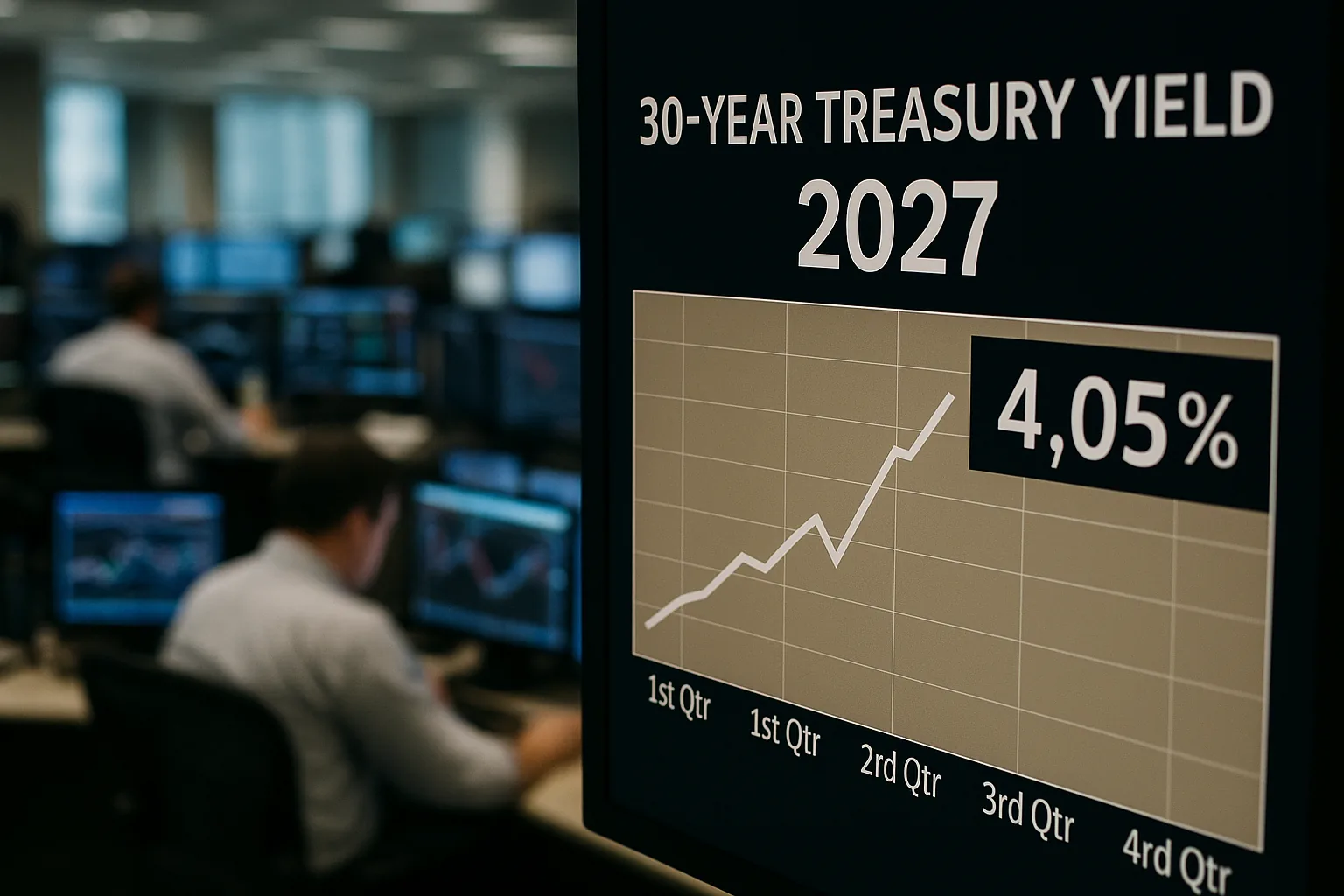
A confluence of persistent inflation concerns, heavy government debt issuance, and hawkish analyst commentary has triggered a significant repricing in contracts betting on the 30-year U.S. Treasury yield for year-end 2027. In a sharp move during the session on Thursday, October 22, 2026, the implied probability of the 30-year yield being "4.75% or above" on December 31, 2027, surged to 90% from just 23%. This 75-percentage-point spike on the Kalshi prediction market signals that traders are increasingly positioning for a scenario where long-term interest rates remain structurally higher than previously anticipated.
The move reflects a broader shift toward higher yield expectations across the market's distribution. Of the 23 available contracts, 12 saw their probabilities rise on higher aggregate volume than the 9 contracts that declined. This indicates a strong consensus is forming around the idea that the "higher-for-longer" rate environment will extend well into the coming year, challenging more dovish forecasts that predict a significant decline in yields from their current levels. The current 30-year Treasury yield stands at approximately 5.29% as of October 22, 2026.
Distribution Analysis
The table below details the probability shifts across all available outcomes for the 30-year U.S. Treasury yield on December 31, 2027. The data shows a decisive reallocation of probability toward higher rate brackets.
| Outcome | Current Prob | Change | Volume |
|---|---|---|---|
| 2% or above | 99% | +1.0pp | 1,470 |
| 2.25% or above | 94% | -49.0pp | 1,509 |
| 4.75% or above | 90% | +75.0pp | 1,439 |
| 5.75% or above | 79% | -39.0pp | 932 |
| 6.25% or above | 79% | ~0pp | 38 |
| 6.75% or above | 75% | +38.0pp | 877 |
| 5% or above | 74% | -16.0pp | 112 |
| 7.5% or above | 74% | -3.0pp | 1,094 |
| 3.25% or above | 73% | -18.0pp | 903 |
| 2.75% or above | 64% | +19.0pp | 3,481 |
| 3.5% or above | 61% | +50.0pp | 2,042 |
| 5.5% or above | 55% | +40.0pp | 1,518 |
| 4.5% or above | 53% | +14.0pp | 1,027 |
| 6% or above | 53% | -27.0pp | 23 |
| 4.25% or above | 50% | -9.0pp | 611 |
| 8% or above | 48% | ~0pp | 212 |
| 2.5% or above | 47% | -37.0pp | 4,318 |
| 3.75% or above | 42% | -45.0pp | 968 |
| 7.75% or above | 42% | +18.0pp | 1 |
| 3% or above | 39% | +19.0pp | 806 |
| 7% or above | 36% | +22.0pp | 200 |
| 4% or above | 26% | +46.0pp | 991 |
| 7.25% or above | 23% | +18.0pp | 1,719 |
Net: 12 of 23 contracts rose on 15,572 in total volume, shifting the implied consensus range significantly higher.
What's Driving the Shift
The repricing appears to be a culmination of several macroeconomic pressures that have been building in recent months, rather than a reaction to a single event.
Persistent Supply Pressures: A key driver is the market's focus on heavy bond issuance from the U.S. government. In recent analysis, Goldman Sachs strategist Muhammad Qubbaj noted that investors are cautious about locking in duration when issuance is high, forcing yields higher to attract buyers. This sentiment is echoed by analysts at UBS, who point to persistently large budget deficits as a structural force likely to keep long-term borrowing costs elevated.
Stubborn Inflation and Fed Policy: Elevated energy prices continue to feed into broader inflation concerns, strengthening the Federal Reserve's resolve. Goldman Sachs has highlighted that the Fed is motivated to "play catch up" with inflation that has run above target for years. This suggests the central bank may be less inclined to police the long end of the curve, allowing yields to find a natural clearing level set by supply and demand rather than by policy expectations.
Shifting Institutional Forecasts: The prediction market's sharp move aligns it more closely with hawkish forecasts from major financial institutions. A June 2026 outlook from the Wells Fargo Investment Institute set a year-end 2027 target range for the 30-year yield of 5.25%–5.75%. In contrast, forecasts from TD Economics project the yield falling to 4.65% by the fourth quarter of 2027. The market's aggressive repricing suggests traders are increasingly skeptical of the more dovish outlook and are pricing in a reality closer to Wells Fargo's higher-for-longer scenario.
Market Context
The probability of the 30-year yield finishing 2027 at or above 4.75% now stands at 90%, a dramatic shift that implies high conviction among traders. While this level is below the current spot rate of around 5.29%, the move is significant because it pushes back against economic models that anticipate a steady decline in long-term rates over the next 14 months. The market is now pricing a very low probability that yields will fall back toward the 4% range, a level some analysts had anticipated.
This repricing highlights the ongoing tension between the Federal Reserve's fight against inflation and the market's need to absorb a large volume of government debt. As long as these structural pressures persist, traders appear to be betting that the path of least resistance for long-term yields is to remain elevated.
What to Watch
This market will settle based on the official 30-year Daily Treasury Par Yield Curve Rate reported by the U.S. Department of the Treasury for December 31, 2027. Traders will continue to monitor key inflation reports, such as the Consumer Price Index (CPI), and statements from the Federal Reserve for any change in tone regarding its long-term policy stance. Upcoming Treasury auction sizes and demand metrics will also be critical indicators of the market's capacity to absorb new debt.
