
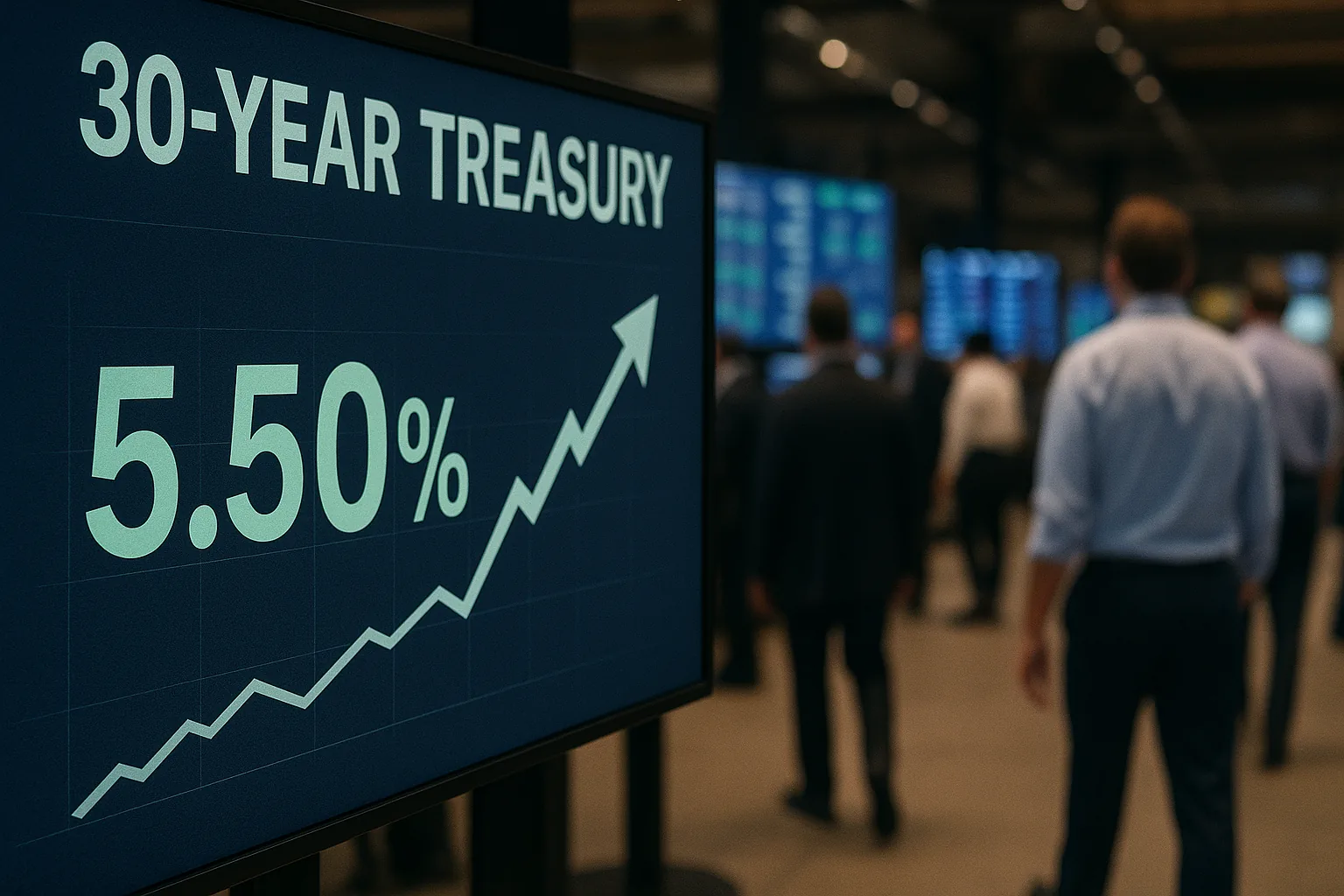
A potent combination of stronger-than-expected U.S. business activity data and hawkish commentary from a Federal Reserve official on Wednesday, September 23, 2026, triggered a significant repricing in contracts tracking the peak 30-year Treasury yield. In the session on Thursday, September 24, 2026, the implied probability of the long bond's yield reaching "5.5% or above" by the end of the month surged to 57% from just 7% a day prior. The sharp move on the CFTC-regulated Kalshi exchange suggests traders are increasingly positioning for the 30-year yield to break decisively above its current 19-year highs.
The shift occurred as the underlying 30-year Treasury yield traded around 5.42%, a level not seen since 2004. The broad-based rally across related contracts indicates a strong consensus that the recent upward pressure on long-term rates has further to run. The repricing effectively moves the market's median expectation for the peak September yield toward the 5.50% strike price, a level that was considered an outlier just days ago.
Distribution Analysis
| Outcome | Current Prob | Change | Volume |
|---|---|---|---|
| 5.48% or above | 84% | +75.0pp | 1,001 |
| 5.49% or above | 76% | +68.0pp | 776 |
| 5.5% or above | 57% | +50.0pp | 2,372 |
Net: All three tracked contracts rose on a combined volume of over 4,100 trades, shifting the implied peak yield for September firmly above 5.50%.
What's Driving the Shift
The abrupt change in market sentiment appears to be a direct reaction to fundamental economic and policy signals that emerged late Wednesday.
Resilient Economic Activity: The primary catalyst was the S&P Global purchasing managers' index released on Wednesday, which showed services PMI rising to its highest level in almost five years. Its manufacturing counterpart also rose to a level not seen in over four years. This picture of resilient growth counters narratives of an impending slowdown and suggests the U.S. economy can withstand higher borrowing costs, giving the Federal Reserve more latitude to continue its tightening cycle.
Hawkish Federal Reserve Commentary: The strong data was amplified by public remarks from Fed Governor Michael Barr, who said on Wednesday that "further policy adjustments" are likely needed to bring inflation down to the central bank's target. This explicit guidance toward future rate hikes reinforces the message from the Fed's September meeting, where it delivered the first increase in its policy rate since July 2023.
Market Context
The move toward higher yields is a continuation of a trend that has accelerated throughout September. The Federal Reserve's decision to raise its policy rate to a 3.75%-4.00% range on September 20 set a hawkish tone for the month, pushing yields across the curve to multi-decade highs.
The repricing in the prediction markets aligns with a broader shift in sentiment among institutional investors. A Bloomberg Markets Pulse survey published Thursday found that 53% of respondents now expect the 30-year yield to climb above 6% by the end of the year, a level not seen since the dot-com bubble in 2000. This suggests the market is not just pricing in a short-term spike but a potential regime shift toward structurally higher long-term rates.
The current 30-year yield of approximately 5.42% is already at the upper end of what many analysts had forecast for the entire year. The conviction behind the move in prediction markets, underscored by the high volume on the "5.5% or above" contract, indicates that traders see the path of least resistance as higher, at least through the end of the month.
What to Watch
This market is set to close on September 30, 2026. The resolution will depend on the daily 30-year par yield curve rate published by the U.S. Department of the Treasury. Any business day where the closing yield is at or above the specified threshold will cause the respective contract to resolve to "Yes." Traders will be closely watching upcoming data, including weekly jobless claims, for any signs of economic weakness that could challenge the current hawkish narrative. However, with strong momentum and a clear set of fundamental drivers, the focus remains on how much higher yields can climb before month's end.
