
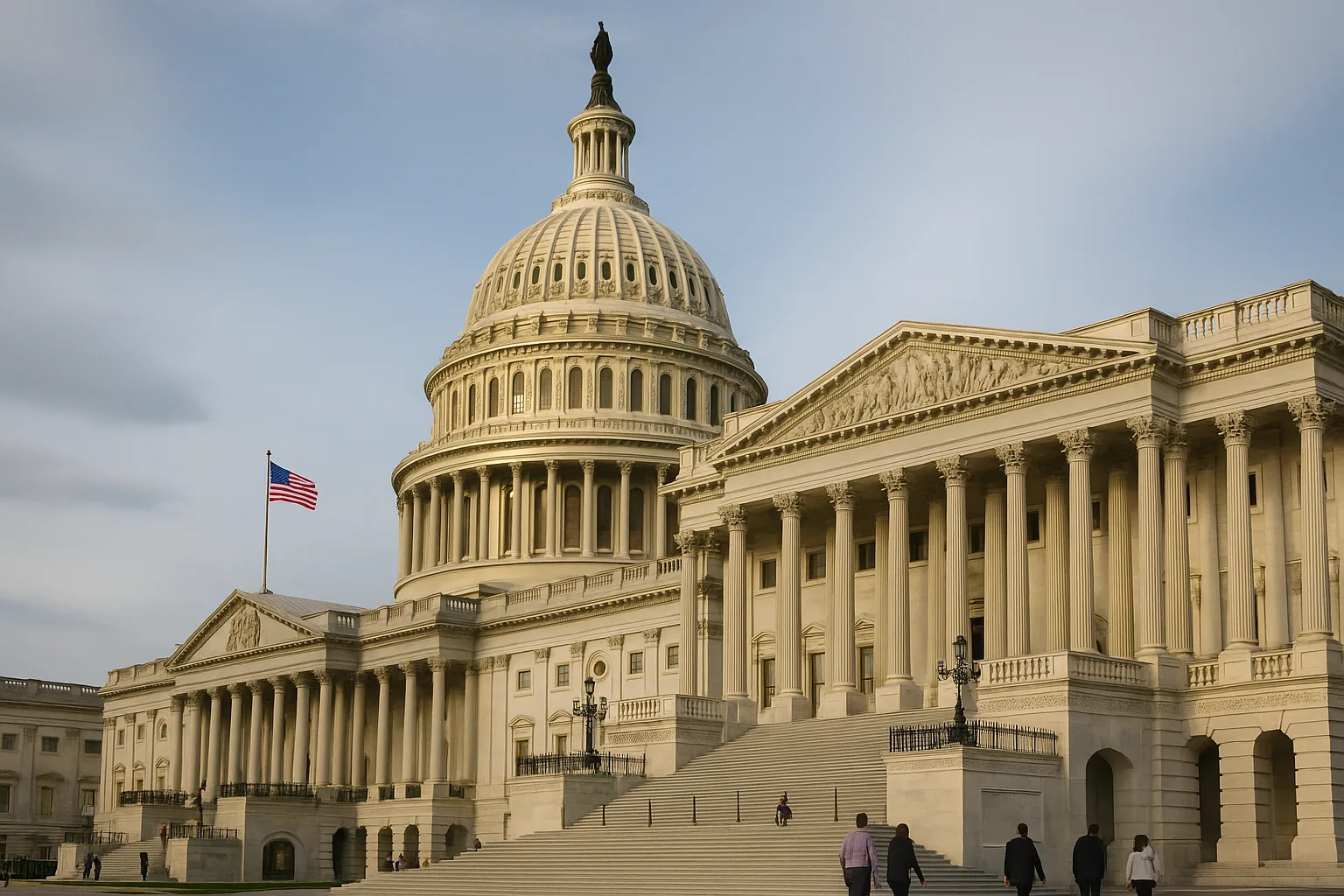
Expectations that AI biosecurity safeguards will be attached to the must-pass National Defense Authorization Act (NDAA) drove a sharp repricing in a key prediction market during Monday's session. On October 19, 2026, the contract pricing the odds of a comprehensive U.S. AI biosecurity law being enacted "Before Jul 1, 2027" surged 45 percentage points, climbing from 39% to 84%. The significant shift suggests a rapid consolidation of trader sentiment around the NDAA as the most viable path for passage before the conclusion of the 119th Congress in early 2027.
The market, traded on the CFTC-regulated exchange Kalshi, resolves based on the enactment of a U.S. federal law establishing biosecurity safeguards for nucleic acid synthesis, including customer screening and verification related to AI-driven biological risks. The move to 84% implies high confidence that such a measure will clear Congress and be signed into law within the next eight months, a notable increase in certainty for a policy area that has seen multiple proposals but no definitive legislative action to date.
Distribution Analysis
The repricing was concentrated in the single tracked outcome, which saw a substantial increase in implied probability on significant volume.
| Outcome | Current Prob | Change | Volume |
|---|---|---|---|
| Before Jul 1, 2027 | 84% | +45.0pp | 161 |
Net: The primary contract rose sharply, indicating a strong consensus among traders for a legislative breakthrough in the near term.
What's Driving the Shift
The dramatic repricing appears to be driven by a confluence of legislative strategy and a sense of urgency as the congressional calendar winds down.
NDAA as a Legislative Vehicle: The primary catalyst appears to be growing market conviction that AI biosecurity provisions will be included in the FY2027 National Defense Authorization Act. The NDAA is a massive, must-pass annual defense policy bill that is often used as a vehicle to enact other legislative priorities. With the 119th Congress set to adjourn in January 2027, attaching a biosecurity measure to the NDAA represents one of the fastest and most reliable paths to becoming law, bypassing the challenges of moving a standalone bill through both chambers in a limited timeframe.
Existing Congressional Momentum: The market's optimism is built on a foundation of prior legislative work. The Nucleic Acid Standards for Biosecurity Act (H.R. 3029) already passed the House of Representatives in July 2026, demonstrating bipartisan support for addressing the issue. Similarly, the Senate's Biosecurity Modernization and Innovation Act of 2026 (S. 3741) was introduced in January 2026, signaling parallel interest. Traders may be interpreting the NDAA as the mechanism to reconcile and enact these existing efforts.
Addressing a Regulatory Gap: This legislative push aims to fill a recognized policy void. According to a September 2026 Congressional Research Service report, the U.S. currently has no single, overarching federal law governing biosecurity risks associated with AI-enabled biotechnology, with existing oversight being a fragmented mix of federal guidance and limited regulations. The report notes concerns that AI could be misused to design novel biological compounds, making the establishment of a comprehensive legal framework a priority for policymakers.
Market Context
The 45-point spike represents a fundamental shift in the market's outlook. A probability of 39% suggests the outcome was viewed as little more than a coin-flip. The move to 84% signals that traders have moved past general uncertainty and are now pricing in a specific, high-probability event path—likely the successful inclusion of biosecurity language in the final NDAA conference report.
The current legal landscape is defined by a patchwork of policies rather than a single statute. The White House has taken executive action, but as the CRS notes, "no federal legislation establishing broad regulatory authorities has been enacted." This makes the passage of a bill like H.R. 3029 or S. 3741—either on their own or as part of a larger package—a significant and clearly defined event for the market to track.
What to Watch
The key development for this market will be the final negotiations and text of the FY2027 National Defense Authorization Act, which is typically finalized in the late fall or early winter. Traders will be closely monitoring the bill's conference report for the inclusion of provisions related to nucleic acid screening and AI biosecurity. The market is scheduled to close on January 1, 2028, with settlement based on official information from the White House and Congress.gov.
