
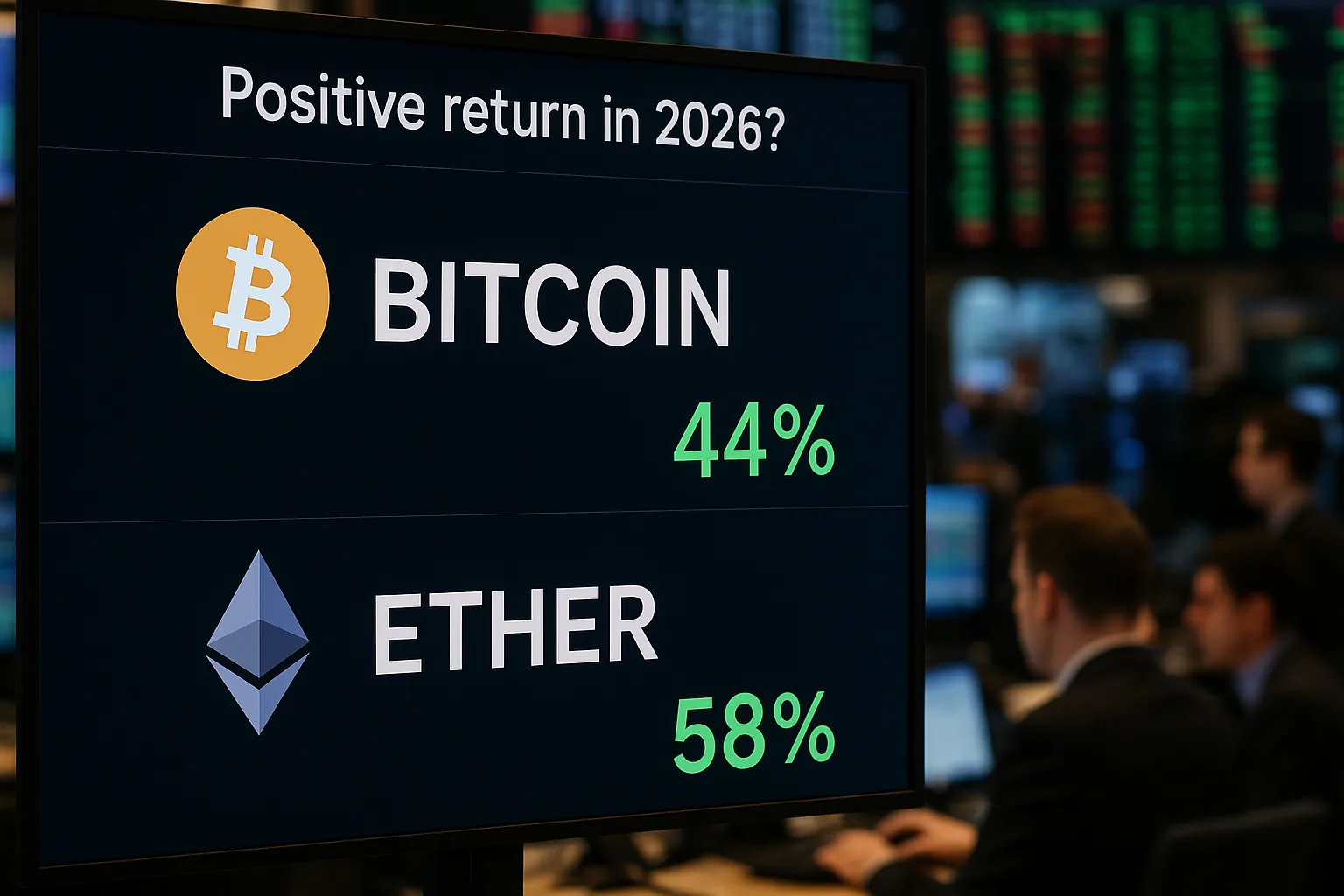
Renewed institutional inflows into U.S. spot ether exchange-traded funds (ETFs) this week appear to be driving a significant reallocation in prediction markets, boosting the odds for the largest cryptocurrencies to finish 2026 with a positive annual return. On the CFTC-regulated Kalshi exchange, contracts for Bitcoin (BTC) to end the year in the green saw their implied probability jump 14 percentage points in the session ending July 16, 2026, as traders sold positions in other major altcoins like Chainlink (LINK) and Stellar (XLM).
The shift reflects a market rotating capital toward assets with clear, regulated on-ramps for institutional capital, even as the broader crypto market struggles to recover from a difficult second quarter. While the odds for Bitcoin remain low at 16%, the sharp repricing suggests traders view ETF demand as a powerful potential catalyst for a second-half rally. The move came as U.S. spot ether ETFs took in $96 million over the first three days of the week.
Distribution Analysis
The market shows a distinct rotation, with probability shifting out of several large-cap altcoins and concentrating in Bitcoin, Ripple, and Ethereum. The total volume on contracts that gained probability was nearly identical to the volume on contracts that declined, underscoring the reallocative nature of the move rather than a broad market-wide sentiment shift.
| Outcome | Current Prob | Change | Volume |
|---|---|---|---|
| Chainlink (LINK) | 31% | -11.0pp | 893 |
| Ripple (XRP) | 30% | +7.0pp | 861 |
| Dogecoin (DOGE) | 17% | ~0pp | 52 |
| Bitcoin (BTC) | 16% | +14.0pp | 315 |
| Litecoin (LTC) | 14% | ~0pp | 2 |
| Stellar Lumens (XLM) | 14% | -12.0pp | 278 |
| Solana (SOL) | 14% | -3.0pp | 171 |
| Ethereum (ETH) | 13% | +1.0pp | 145 |
| Shiba Inu (SHIB) | 9% | ~0pp | 309 |
| Polkadot (DOT) | 8% | ~0pp | 126 |
Net: 3 of 10 contracts declined on 1,342 total volume, while 3 rose on 1,321 total volume, signaling a significant reallocation of probability toward market-leading assets with direct institutional product exposure.
What's Driving the Shift
The repricing appears tied to tangible fund-flow data and a corresponding shift in narrative focus among traders.
Spot Ether ETF Demand: The primary catalyst is a strong week for U.S. spot ether ETFs, which have seen accelerating inflows. The vast majority of this capital flowed into BlackRock's products, suggesting concentrated institutional buying. This provides a direct demand driver for Ethereum and a positive tailwind for Bitcoin, the other major crypto asset with a suite of spot ETFs.
A Flight to Quality: The distribution shift indicates a rotation out of altcoins and into the two largest crypto assets. Contracts for Chainlink and Stellar saw the sharpest declines, losing 11 and 12 percentage points, respectively. This suggests traders are consolidating bets into the assets most likely to benefit from the ongoing institutional adoption cycle, treating ETF flows as a more durable catalyst than project-specific developments.
Fading Altcoin Narratives: In late May and June, Stellar's (XLM) odds led this market, trading near 50% following an announcement of a partnership with the Depository Trust and Clearing Corporation (DTCC). The subsequent fall in its probability to 14% suggests that catalyst's impact has waned, with capital now chasing the more immediate ETF flow narrative.
Market Context
This reallocation is occurring against the backdrop of a challenging year for digital assets. The total crypto market cap dropped 12.6% in the second quarter, with Bitcoin and Ethereum posting significant losses. For these assets to achieve a positive annual return, a substantial recovery is required in the second half of 2026. For example, Bitcoin opened the year near $87,500 and traded around $64,600 on July 16, requiring a rally of over 35% just to break even.
Despite the difficult first half, many institutional analysts maintain a bullish long-term outlook. Projections from firms like JPMorgan and Bitwise call for Bitcoin to potentially reach between $80,000 and $180,000 by year-end, driven by the very institutional adoption now manifesting as ETF inflows. The current low probabilities priced by Kalshi traders suggest skepticism that these bullish scenarios will materialize in time to salvage a positive return for the 2026 calendar year.
What to Watch
The primary indicator for this market will be continued data on institutional product flows. Daily and weekly net flow figures for U.S. spot Bitcoin and Ether ETFs will likely remain the most significant driver of sentiment and pricing. The market, one of a series on the Kalshi platform, will resolve to "Yes" for any cryptocurrency that closes higher on December 31, 2026, than it opened on January 1, 2026. The settlement price will be determined by data from CF Benchmarks. The market is scheduled to close on January 1, 2027.
