
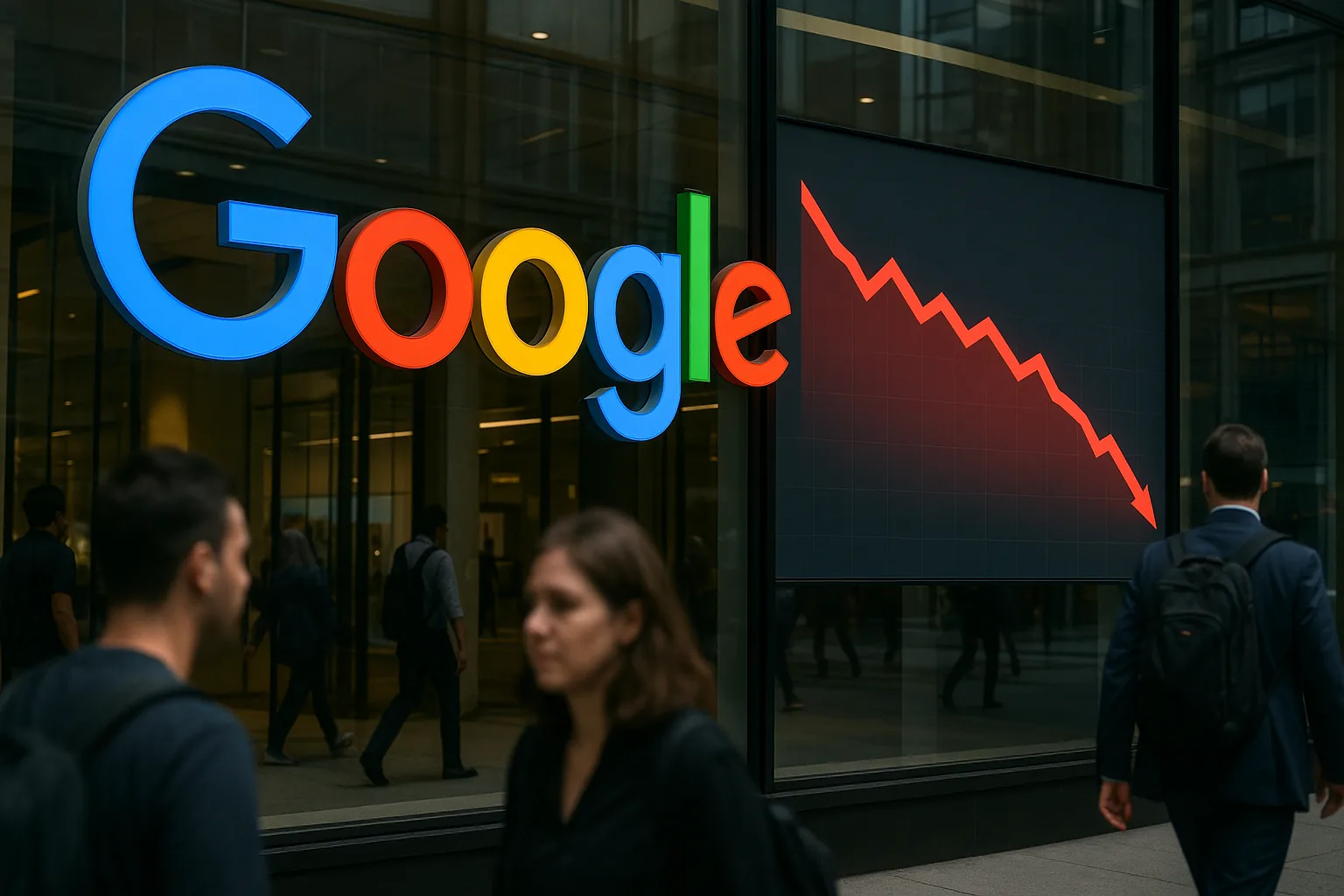
A significant development in the Department of Justice's antitrust lawsuit against Google sent shockwaves through prediction markets on Friday, September 11, 2026, triggering a sharp downward repricing of the company's future AI-driven market share. The probability that Google's AI market share would remain above 18.8% collapsed by 82 percentage points, falling from 86% to just 6%, as traders priced in the impact of a potential ban on the company's exclusive search-default agreements. The move reflects a broad-based sentiment shift, with the market's consensus now pointing toward a more rapid erosion of Google's dominance in the face of competition from other AI platforms.
Distribution Analysis
The repricing was not isolated to a single outcome. Across the market, which settles based on Google's AI market share as reported by OpenRouter, seven of the nine listed contracts declined. Probability shifted dramatically out of higher-share outcomes and reconsolidated at the lowest available tier, "Above 17.6%," which saw a modest gain. The most significant declines occurred in the 18.4% to 19.1% range, indicating a wholesale reassessment of expectations.
| Outcome | Current Prob | Change | Volume |
|---|---|---|---|
| Above 17.6% | 93% | +3.0pp | 1,636 |
| Above 18.4% | 39% | -40.0pp | 1,572 |
| Above 18.8% | 6% | -82.0pp | 1,253 |
| Above 19.1% | 4% | -76.0pp | 2,103 |
| Above 19.35% | 2% | -53.0pp | 2,495 |
| Above 19.6% | 1% | -40.0pp | 6,749 |
| Above 19.9% | 1% | -23.0pp | 4,082 |
| Above 20.4% | 1% | -6.0pp | 1,700 |
| Above 21.1% | 1% | ~0pp | 281 |
Net: 7 of 9 contracts declined on nearly 20,000 total volume, shifting the implied consensus for Google's AI market share significantly lower.
What's Driving the Shift
The sharp repricing appears directly linked to news from the long-running DOJ antitrust case, which targets the agreements that make Google the default search engine on billions of devices.
- Antitrust Ruling Impact: The market move coincides with reports of a ruling or remedy phase focused on prohibiting Google's lucrative exclusive-default agreements, particularly with mobile device manufacturers like Apple. Such a change would force platforms to offer users a choice of search engine, creating the most significant opening for competitors in over a decade. The power of these defaults is immense; while Google holds an 86.12% share on desktop, its mobile-only share worldwide is a staggering 95.82%, a figure largely attributed to its default status on Android and Safari.
- Accelerating AI Transition: Traders appear to believe that an end to default exclusivity would accelerate an existing trend of users shifting queries to AI-native platforms like Perplexity, ChatGPT, and others. While Google is a major player in AI, a level playing field on device defaults could disproportionately benefit rivals as consumers experiment with new information discovery tools. The market action suggests a belief that the structural shift away from traditional search is gaining momentum.
Market Context
This prediction market tracks a forward-looking, and more volatile, metric than Google's traditional search dominance. As of August 2026, Google's worldwide search share stood at 91.1%, a figure that has remained remarkably stable for years. However, this contract is settled against OpenRouter's AI market share data, which measures the evolving landscape of AI-powered queries.
The market's sharp reaction underscores the stakes of the DOJ lawsuit. Even a small percentage point loss in market share for a company that handles over 5 trillion searches a year represents a seismic shift. The pre-ruling odds, with high probabilities assigned to outcomes near 19%, suggested traders expected a slow, managed decline. The post-ruling prices reflect a new reality where competitors may finally have a structural opportunity to gain ground.
What to Watch
This market on the Kalshi exchange closes on September 14, 2026, with the final outcome determined by Google's market share as reported by OpenRouter. Traders will be closely watching for official statements from the Department of Justice, Google's legal response, and, most critically, any public signals from device makers like Apple about their future plans for default search engine selection. Any indication that a major platform will open up its default slot to competitors could drive further volatility.
