
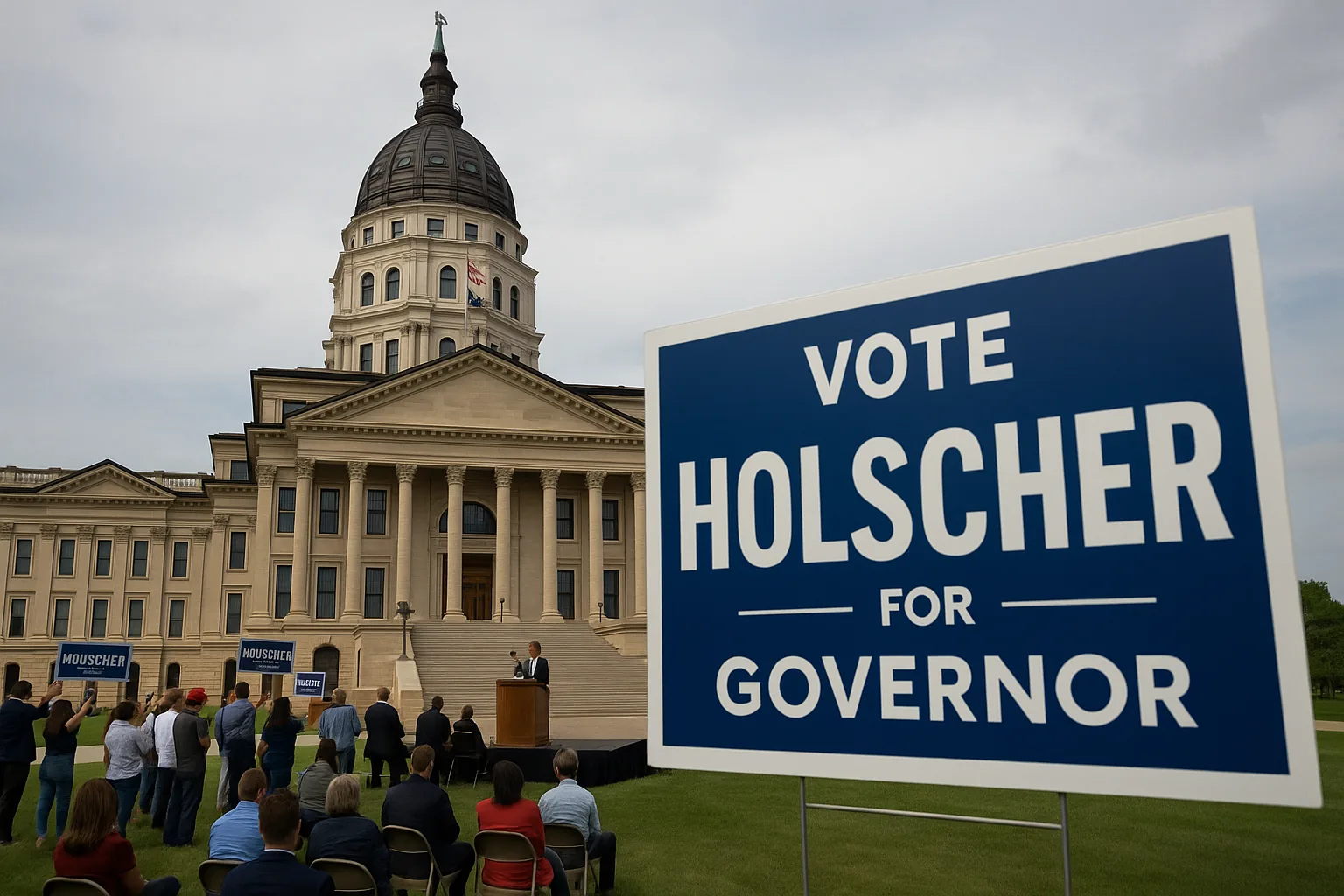
A post-primary endorsement from popular incumbent Governor Laura Kelly appears to have driven a significant repricing in the 2026 Kansas governor election market. In the session on Tuesday, August 11, 2026, contracts for Democratic nominee Cindy Holscher to win saw their implied probability jump 24 percentage points to 40%. The move, which came at the expense of Republican nominee Ty Masterson, followed Kelly's public backing of Holscher, a signal of party unity after a contentious primary.
The sharp shift suggests traders are reassessing the general election landscape, viewing a unified Democratic party as a more formidable challenger in the Republican-leaning state. Probability in the two-candidate market was reallocated directly from Masterson, whose odds fell 21 percentage points to 61%, indicating the market now views the race as more competitive than it did immediately following the August 4 primary.
Distribution Analysis
| Outcome | Current Prob | Change | Volume |
|---|---|---|---|
| Ty Masterson | 61% | -21.0pp | 311 |
| Cindy Holscher | 40% | +24.0pp | 384 |
Net: Probability shifted decisively toward the Democratic candidate, tightening the implied odds for the November general election.
What's Driving the Shift
The repricing appears to be a direct reaction to political developments following the state's primary election one week prior.
Key Endorsement Signals Unity: The primary driver of the shift appears to be the endorsement of Cindy Holscher by term-limited Democratic Governor Laura Kelly. Kelly had initially backed Holscher's primary opponent, Ethan Corson. Her subsequent endorsement of Holscher on August 6 was a critical step toward party consolidation. In her statement, Kelly framed the election as a choice to "move our state forward," warning that a Masterson governorship would take the state "back to the dark days" of former GOP Governor Sam Brownback. This unified front likely boosted trader confidence in Holscher's general election viability.
General Election Matchup Solidifies: The August 4 primary set the final matchup, pitting Holscher against Masterson. Holscher, a state senator, won her primary with 48.6% of the vote, overcoming the party establishment's preferred candidate. Masterson, the state Senate President, secured the GOP nomination with 43.1% in a crowded field, aided by an endorsement from former President Donald Trump. With the primary uncertainty resolved, the market is now focused solely on the dynamics of the head-to-head contest.
Contrasting Political Brands: The market repricing reflects the newly defined electoral choice. Both campaigns have quickly moved to label their opponent an "extremist." Holscher has presented herself as an anti-establishment candidate focused on public education and fighting corporate interests, while the Republican Governors Association has called Masterson a "results-oriented conservative." The significant shift in odds suggests traders may see Holscher's profile, now backed by the popular incumbent, as having a stronger-than-initially-expected appeal to the state's moderate voters.
Market Context
Despite the recent surge for the Democratic candidate, the market still implies Republican Ty Masterson is the favorite, assigning him a 61% probability of winning. This reflects the underlying political fundamentals of Kansas, where registered Republicans outnumber Democrats by a nearly 2-to-1 margin.
However, Governor Laura Kelly's own electoral success provides a template for a Democratic victory. In the 2022 general election, Kelly defeated Republican Derek Schmidt by a margin of 49.5% to 47.3%, demonstrating that a Democrat can win statewide by appealing to moderate Republicans and independent voters. The current market pricing of 40% for Holscher suggests traders see her path to victory as difficult but plausible, particularly with the full support of Kelly's political operation.
What to Watch
The key date for this market is the Kansas gubernatorial general election on November 3, 2026. Traders will closely watch polling data, campaign finance reports, and candidate debates over the coming months to further refine their odds. The market is scheduled to close on January 14, 2028, and will settle based on the certified winner of the election from official state government sources.
