
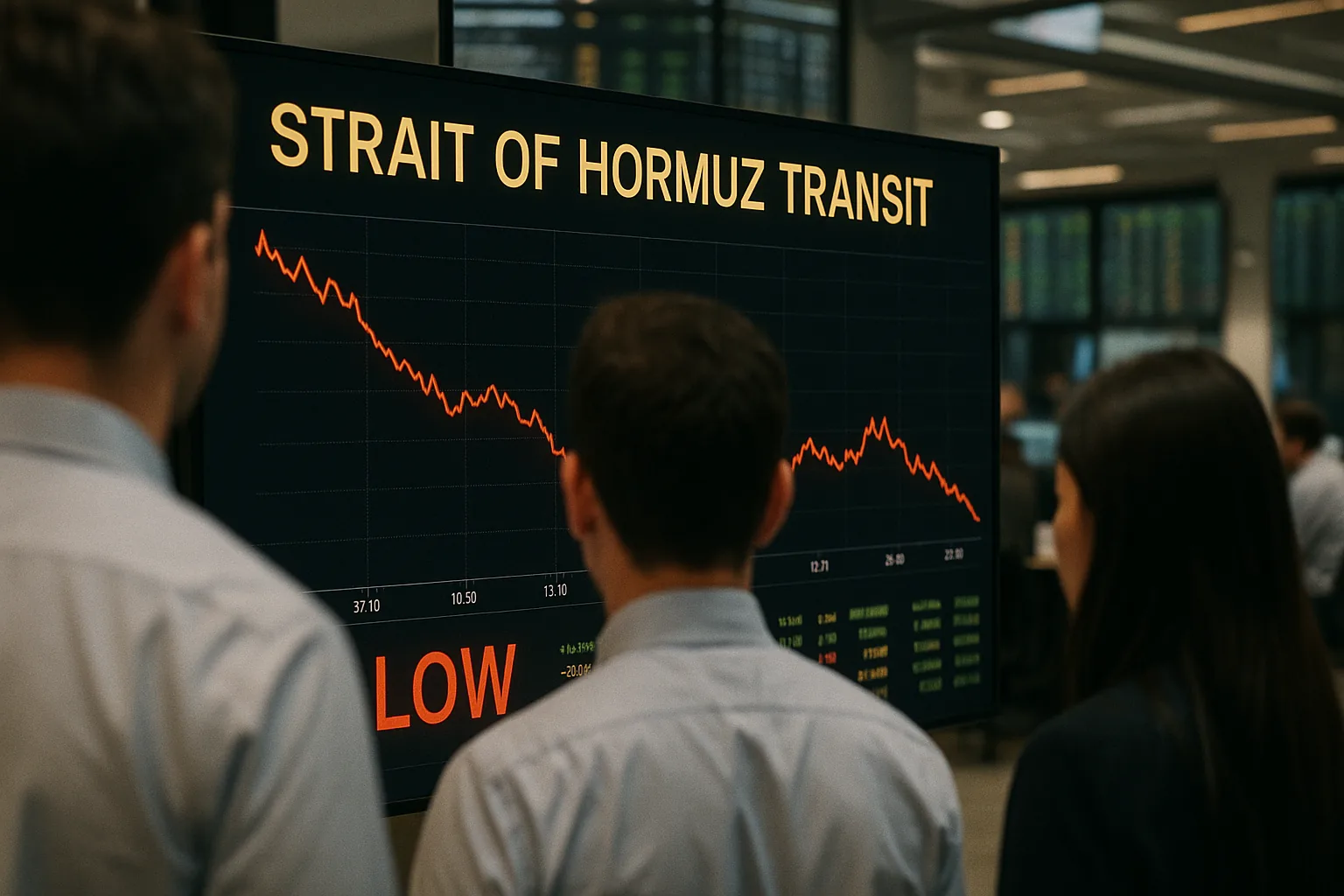
Persistently low vessel traffic through the Strait of Hormuz early this week, including a daily tally not seen since May, prompted a sharp downward repricing in prediction markets for total weekly transits. Contracts on the Kalshi exchange tracking the number of commercial ships passing through the chokepoint from August 24-30 saw probabilities shift away from higher-volume outcomes, reflecting new data showing daily crossings are hovering far below recent averages. The probability of more than 45 vessels transiting during the week plummeted from 86% to 14% in the session ending August 25, 2026, as traders adjusted forecasts to align with the sluggish start to the measurement period.
The repricing reflects a significant consolidation of expectations toward a more constrained traffic environment. While the market had previously assigned high odds to a modest recovery in vessel flow, the release of data showing as few as two to five commodity ships per day on Monday and Tuesday appears to have convinced traders that such an outcome is now unlikely. Probability mass shifted away from higher thresholds and concentrated in contracts implying a weekly total in the 30-to-40-vessel range.
Distribution Analysis
The market consists of a series of "Above X" contracts, where probabilities are cumulative and not mutually exclusive. The primary movement was a collapse in confidence for outcomes above 45 vessels, with that probability being reallocated to the 30-40 vessel range.
| Outcome | Current Prob | Change | Volume |
|---|---|---|---|
| Above 10 | 99% | ~0pp | 24 |
| Above 15 | 99% | +1.0pp | 325 |
| Above 20 | 94% | ~0pp | 1,287 |
| Above 25 | 81% | -26.0pp | 2,872 |
| Above 30 | 43% | +14.0pp | 5,548 |
| Above 35 | 27% | +18.0pp | 4,162 |
| Above 45 | 14% | -79.0pp | 1,902 |
| Above 40 | 12% | +5.0pp | 1,388 |
| Above 75 | 10% | -8.0pp | 411 |
| Above 50 | 9% | -3.0pp | 989 |
| Above 100 | 7% | ~0pp | 138 |
Net: Four of eleven contracts declined on 6,174 in total volume, while four rose on 11,424 in volume, shifting the implied consensus for weekly traffic significantly lower.
What's Driving the Shift
Weak Start to the Week: The most direct driver is real-world traffic data for the first two days of the contract's resolution period. Reports on August 25 and 26 confirmed that vessel transits remained severely depressed. Just two commodity vessels crossed on Monday, the lowest daily count since early May, followed by only five on Tuesday. These figures are substantially below the recent 10-day average of approximately 15 ships per day, making a weekly total above 45 mathematically challenging.
Heightened Enforcement Risk: The market adjustment coincided with Iran escalating its rhetoric and enforcement posture. On August 24, Iran's newly formed Persian Gulf Strait Authority announced it had blacklisted 45 commercial tankers for allegedly violating its passage rules, threatening them with fines or confiscation. This action likely reinforced trader views that the operational environment remains high-risk, discouraging a return to normal traffic levels.
Divergence Between Official & Actual Flow: There is growing evidence that a significant portion of regional oil exports is bypassing direct, trackable transit through Hormuz. Shippers are increasingly using workarounds like ship-to-ship transfers in the Gulf of Oman and "dark transits" with vessel transponders turned off. Because the prediction market resolves based on official IMF PortWatch data, these alternative shipping methods would not contribute to the final count, justifying lower odds on officially tracked traffic.
Market Context
Six months into the regional conflict, commercial traffic through the Strait of Hormuz remains a fraction of its former volume. Overall transits are approximately 90% below pre-conflict baselines, when 95 to 130 ships would pass daily. After a brief rebound during a temporary de-escalation in June, daily traffic has settled into a range of 10-15 vessels, according to an analysis of Kpler data.
The recent data showing daily traffic falling into the single digits represents a new low point, providing a clear catalyst for the market's re-evaluation. A competing prediction market on Polymarket shows a similar sentiment, with the "25-49" vessel bracket for the same week holding a dominant 72% probability.
What to Watch
The market will resolve based on the total number of transit calls for the Strait of Hormuz reported by the IMF's PortWatch platform for the period of August 24 through August 30, 2026. The market is scheduled to close on September 1, 2026. Traders will continue to monitor daily shipping data from maritime intelligence firms for the remainder of the week to assess whether the slow start persists or if a late-week surge could push the total into higher brackets.
