
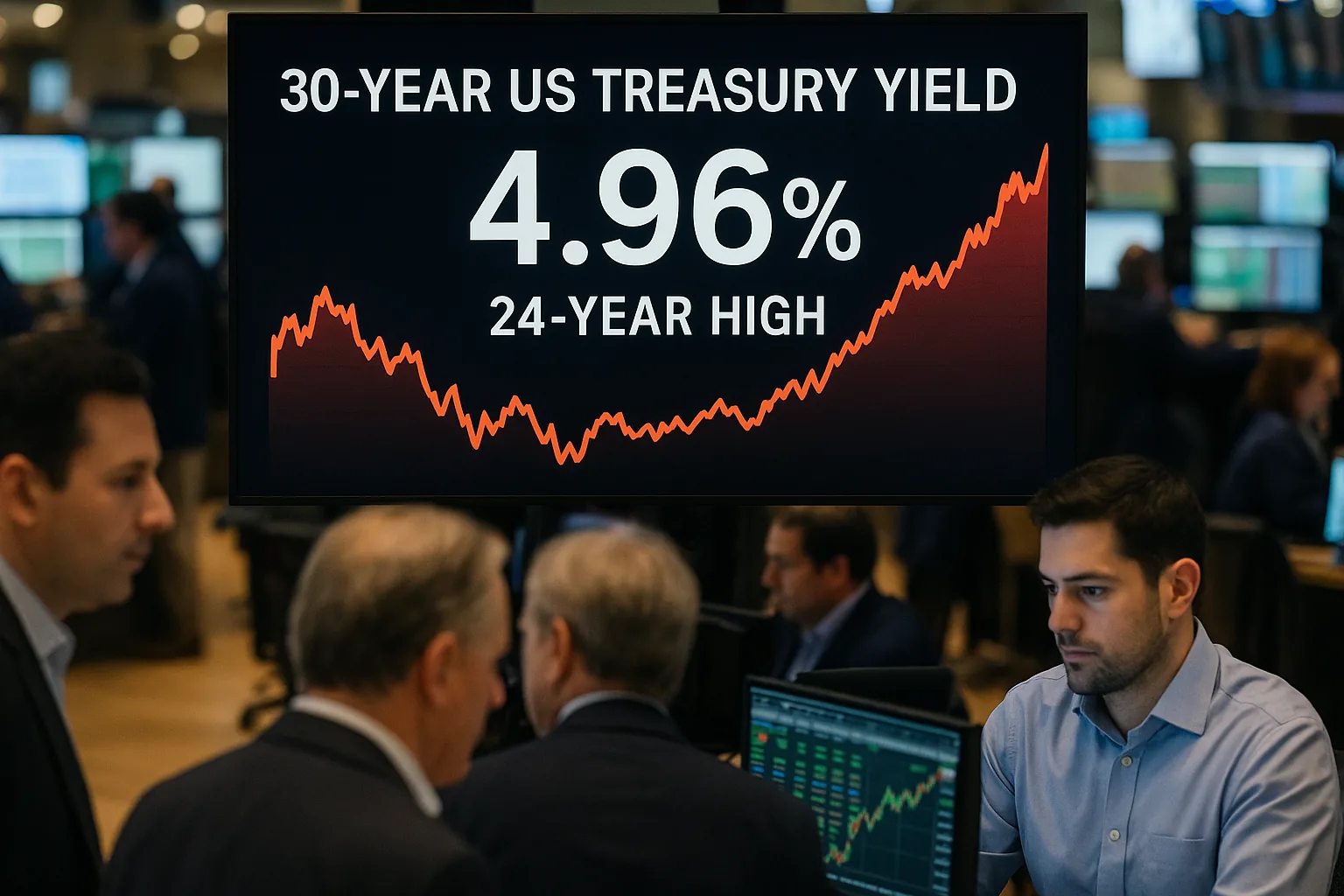
The 30-year U.S. Treasury yield closing at a 24-year high on Monday has triggered a significant repricing in prediction markets, with traders now assigning a greater than 90% probability that the long bond’s yield will breach 5.75% by the start of 2027. In Monday's session (October 05, 2026), the contract for the 30-year yield to reach "5.75% or above" surged 68 percentage points to 93%, up from just 25% previously. The sharp, high-volume move reflects a growing conviction that persistent inflation, heavy government debt supply, and potential structural economic shifts will continue to push long-term borrowing costs higher.
The repricing was not isolated to a single contract. All tracked markets for higher yields saw their probabilities rise, signaling a broad-based shift in expectations. The move came as the underlying 30-year Treasury yield closed at 5.66%, a level not seen since 2002, putting several key thresholds within striking distance. This action in the cash bond market served as the direct catalyst for traders on Kalshi, a CFTC-regulated exchange, to rapidly price in a higher-for-longer rate environment.
Distribution Analysis
The table below shows the implied probabilities for the 30-year Treasury yield reaching or exceeding various levels by January 1, 2027. These are structured as independent "Yes/No" markets rather than mutually exclusive buckets.
| Outcome (by Jan 1, 2027) | Current Prob. | Change (24h) | 24h Volume |
|---|---|---|---|
| 5.70% or above | 94% | +16.0pp | 7 |
| 5.75% or above | 93% | +68.0pp | 101 |
| 5.80% or above | 29% | +14.0pp | 100 |
Net: All 3 of 3 tracked contracts rose on a total volume of 208 trades, indicating a decisive, unified shift in market sentiment toward higher future yields.
What's Driving the Shift
The dramatic repricing appears to be driven by a convergence of real-time market data, macroeconomic fundamentals, and a re-evaluation of long-term economic potential.
Multi-Decade Highs in Spot Market: The most direct catalyst is the performance of the underlying asset. The U.S. Treasury's own data showed the 30-year yield closing at 5.66% on October 5. With the spot rate so close to the 5.75% threshold, prediction market contracts that once seemed speculative are now priced as highly probable. The market is aligning with the reality that these levels are no longer distant possibilities but immediate hurdles.
Persistent Supply and Inflation Pressures: The move is underpinned by persistent economic forces. Analysts have highlighted a combination of tighter Federal Reserve policy, elevated term premiums demanded by investors for holding long-term debt, and heavy Treasury supply needed to fund ongoing fiscal deficits. These factors create a fundamental backdrop of upward pressure on long-term yields.
Structural Economic Reassessment: Beyond near-term pressures, some analysts are pointing to more profound economic shifts. A recent report from Barclays warned that the 30-year yield could reach 6% if the current boom in artificial intelligence (AI) investment leads to sustained productivity gains. Such a structural shift would imply a higher neutral interest rate, giving the Federal Reserve less reason to cut rates and forcing investors to demand higher compensation for holding long-duration bonds.
Market Context
The conviction displayed in the prediction market is notably more aggressive than some quantitative models, though it aligns with the high-end scenarios being discussed by strategists. For instance, statistical models from Convex project a year-end 2026 central estimate of 5.71% for the 30-year yield. The Financial Forecast Center’s model projects a monthly average of 5.70% for January 2027. While these are close to the current spot rate, the 93% odds for a 5.75% print suggest traders see risks as heavily skewed to the upside.
This view contrasts with others who see yields as peaking. Analysts at Standard Chartered recently initiated a long position in 10-year bonds, forecasting that yields will ease over a 12-month period as inflation and oil prices moderate. The prediction market's sharp move higher suggests traders are currently discounting this more dovish scenario in favor of the pressures outlined by firms like Barclays.
What to Watch
The resolution of this market depends on the daily yield data published by the U.S. Department of the Treasury. A "Yes" outcome is triggered if the 30-year yield is at or above the specified level on any business day before the contract expires on January 1, 2027.
Traders will be closely watching several upcoming economic data releases for their potential impact on the Federal Reserve's policy path. Key events include the U.S. Consumer Price Index (CPI) release for September on October 14, followed by the Producer Price Index (PPI) on October 15. The next Federal Open Market Committee (FOMC) rate decision is scheduled for October 28, which will provide crucial forward guidance on monetary policy.
