
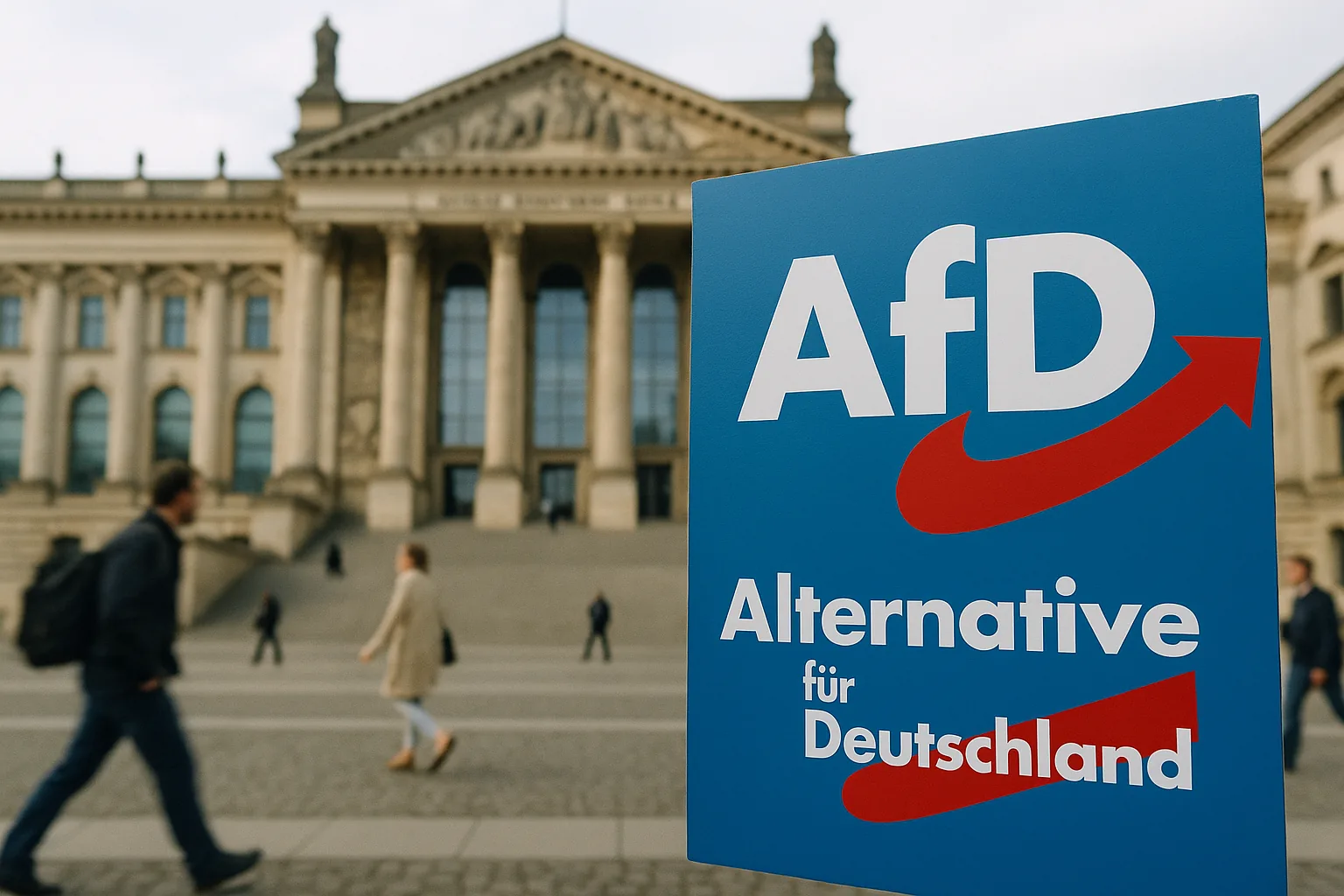
The final results of the September 6 Saxony-Anhalt state election, which saw the far-right Alternative for Germany (AfD) party win a historic plurality but fall short of an absolute majority, prompted traders to drastically lower the odds of the party entering a state government by 2027. In the session on Monday, September 7, 2026, the implied probability on a contract for the AfD to join any German state government plunged 46.0 percentage points, falling from 78.0% to 32.0%. The significant repricing reflects the stark parliamentary arithmetic facing the AfD, which, despite its victory, lacks a clear path to power due to a "firewall" from mainstream parties.
The market shift indicates that initial enthusiasm over the AfD's record-breaking 43.8% vote share has given way to a more sober assessment of the political deadlock. With the AfD securing 39 of 83 seats, three short of the 42 needed to govern alone, forming a government now depends on complex coalition negotiations, potential support from other parties, or defections, none of which are guaranteed.
Distribution Analysis
| Outcome | Probability After | Change | 24h Volume |
|---|---|---|---|
| Yes | 32.0% | -46.0pp | 660 |
Net: The binary market saw a sharp reversal, with traders pricing out a high-probability scenario after the election's final seat count became clear.
What's Driving the Shift
The dramatic drop in the AfD's governance odds is rooted in the post-election political reality in Saxony-Anhalt, where victory at the polls does not guarantee the power to govern.
No Absolute Majority: The primary driver is the final seat allocation. The AfD won 39 seats, making it the largest party but leaving it three seats shy of the majority required to unilaterally elect a minister-president and form a government. AfD's lead candidate, Ulrich Siegmund, acknowledged the need to find support, stating his goal is to "organize exactly such a stable majority in the coming days and weeks" by seeking support from a parliamentary group or individual members of parliament.
The 'Firewall' Holds: Germany's mainstream political parties have a long-standing policy of refusing to cooperate or form coalitions with the AfD, which is classified as a proven right-wing extremist group by the domestic intelligence agency in Saxony-Anhalt. In the wake of the election, leaders from Chancellor Friedrich Merz's Christian Democratic Union (CDU) and other parties reiterated their refusal to work with the AfD, maintaining the so-called "firewall".
BSW's Pivotal but Uncertain Role: The newly elected BSW party, with five seats, holds the mathematical balance of power. However, the party has sent mixed signals. While BSW leaders have criticized the firewall against the AfD and expressed a willingness to help an AfD governor take office via abstention in a third-round vote, they have also ruled out a formal coalition and proposed an independent minister-president. This leaves the AfD's most plausible path to power highly uncertain and dependent on a party that has not committed its support.
Market Context
The price action on the Kalshi exchange, a CFTC-regulated prediction market, suggests a two-phase reaction to the election. An initial spike to 78.0% likely reflected the headline news of the AfD's landslide victory, which dominated early reports.
The subsequent 46.0-point collapse to 32.0% demonstrates a more detailed analysis by traders, who priced in the complex realities of German parliamentary politics once the full seat count and statements from other party leaders were absorbed. Forming a government without the AfD would require an unwieldy and unprecedented five-party coalition of the CDU, SPD, Greens, Left Party, and BSW, an outcome considered highly unlikely. The market is now pricing a significant probability of a political stalemate that could potentially lead to new elections rather than an imminent AfD-led government.
What to Watch
The key event traders will monitor is the election of the minister-president by the state parliament. The new parliament must convene by October 6, though no firm deadline exists for the leadership vote. The process allows for three rounds of voting; a candidate needs an absolute majority in the first two rounds, but a simple plurality suffices in the third. All eyes will be on the voting behavior of the BSW and whether any individual lawmakers from the CDU or other parties break ranks to support the AfD's candidate.
