
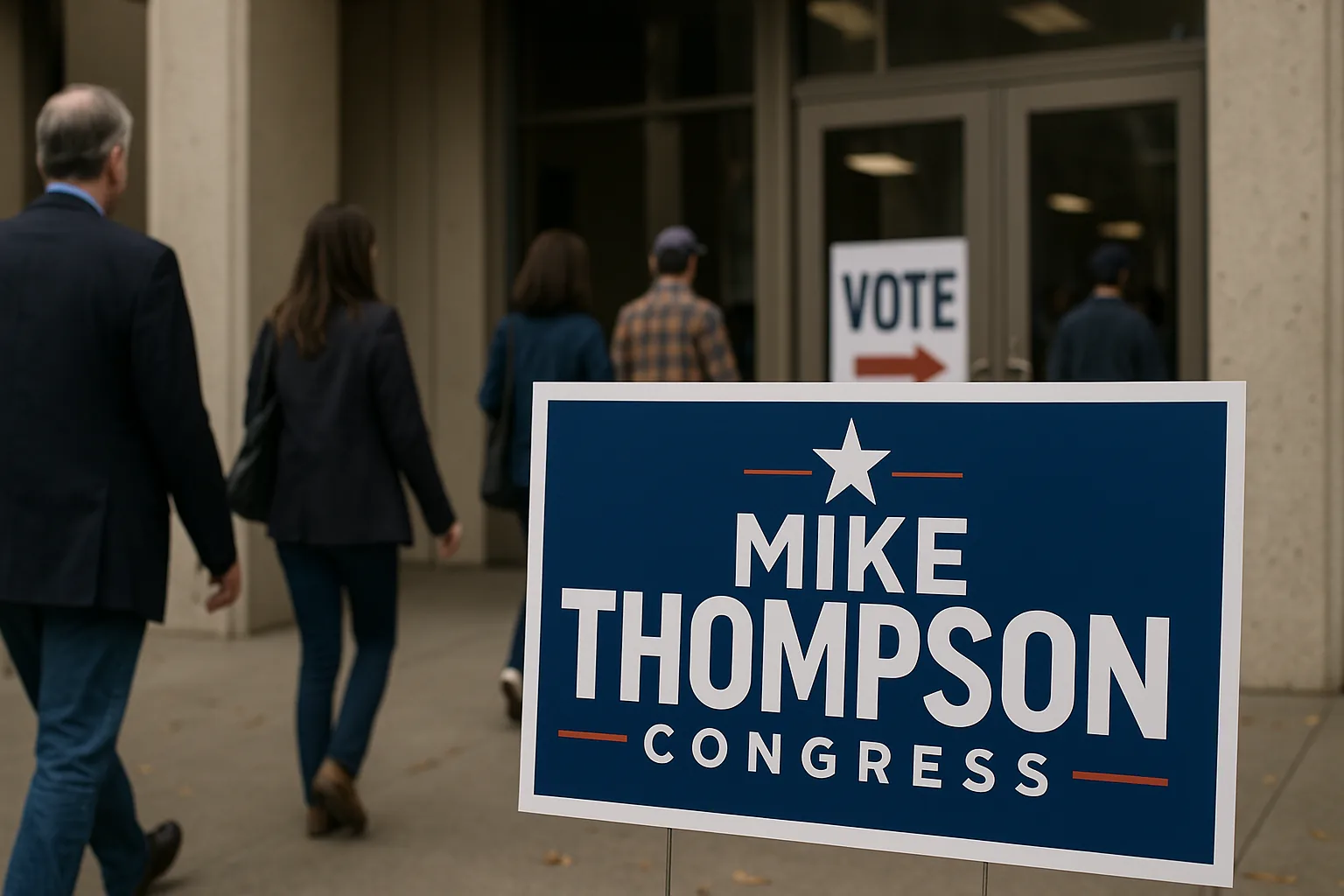
New campaign finance disclosures showing incumbent Rep. Mike Thompson's formidable fundraising operation appear to have triggered a significant repricing in the prediction market for California's 4th Congressional District. In the session on September 14, 2026, contracts for challenger Eric Jones to win the seat fell 57 percentage points to 32%, a sharp reversal that shifts the market's implied odds heavily in favor of the incumbent. The move aligns market odds with political forecaster ratings that consider the district "Safe Democratic."
The repricing follows the release of Federal Election Commission (FEC) filings for the cycle, which show Thompson has raised over $4.2 million. While both candidates are well-funded, the data highlights Thompson's deep institutional support and superior cash on hand, reinforcing the structural advantages of his incumbency. The general election will see two Democrats, Thompson and Jones, face off after they were the top-two finishers in the June 2, 2026, primary.
Distribution Analysis
The shift in probability was a direct transfer from the challenger to the incumbent. The odds for Eric Jones winning fell from a high of 89% to 32%, with the corresponding probability shifting to Mike Thompson. This move corrects what may have been an illiquid market position to one that more closely reflects the underlying political landscape.
| Outcome | Current Prob. | Change | Volume |
|---|---|---|---|
| Mike Thompson (D) | 68% | +57.0pp | Inferred |
| Eric Jones (D) | 32% | -57.0pp | 12 |
Net: Probability in the two-candidate market shifted entirely from the challenger to the incumbent, reversing the favorite status on low trading volume.
What's Driving the Shift
The significant repricing, while occurring on thin volume, appears to be a delayed reaction to fundamental electoral factors, primarily campaign finance and primary election results.
- Incumbent Financial Strength: FEC data reveals the scale of Rep. Thompson's financial advantage. He has raised $4.2 million, with a significant portion ($1.8 million) coming from PACs, and maintains over $1 million in cash on hand. While challenger Eric Jones has a higher top-line fundraising number of $8.3 million, he reports no PAC contributions and has less cash on hand ($656k). The composition of Thompson's funding suggests deep establishment support critical for a general election.
- Correction to Primary Results: The previous 89% odds for Jones were misaligned with the results of the June 2 top-two primary, where Thompson secured a commanding 41.0% of the vote against Jones's 22.2%. The recent market move brings implied probabilities closer to the demonstrated electoral strength of the candidates.
- Low Volume Signal: It is crucial to note that the 57-point price swing for the Jones contract was registered on a trading volume of just 12 contracts. This indicates the move may reflect the actions of a small number of traders rather than a broad market consensus shift, though the new pricing is more consistent with external political analysis.
Market Context
The market for the CA-04 winner, hosted on the CFTC-regulated exchange Kalshi, is now pricing incumbent Mike Thompson as the strong favorite, with implied odds of 68%. This stands in stark contrast to the previous market state, which had challenger Eric Jones as the overwhelming favorite at 89%.
The shift represents a market correction, aligning odds with the consensus of political analysts who rate the district as non-competitive. Given that both general election candidates are Democrats, the race is expected to be decided on factors like name recognition, incumbency, and institutional party support, all of which favor Thompson. His long career in Congress, first elected in 1998, has allowed him to build a powerful political and financial base.
What to Watch
The market will settle based on the official winner of the November 3, 2026, general election as declared by the California Secretary of State. The next major data points for traders will be the pre-election FEC campaign finance reports, which will provide a final look at the candidates' financial health heading into the election. The market is scheduled to close on November 3, 2027, allowing ample time for official results to be certified.
