
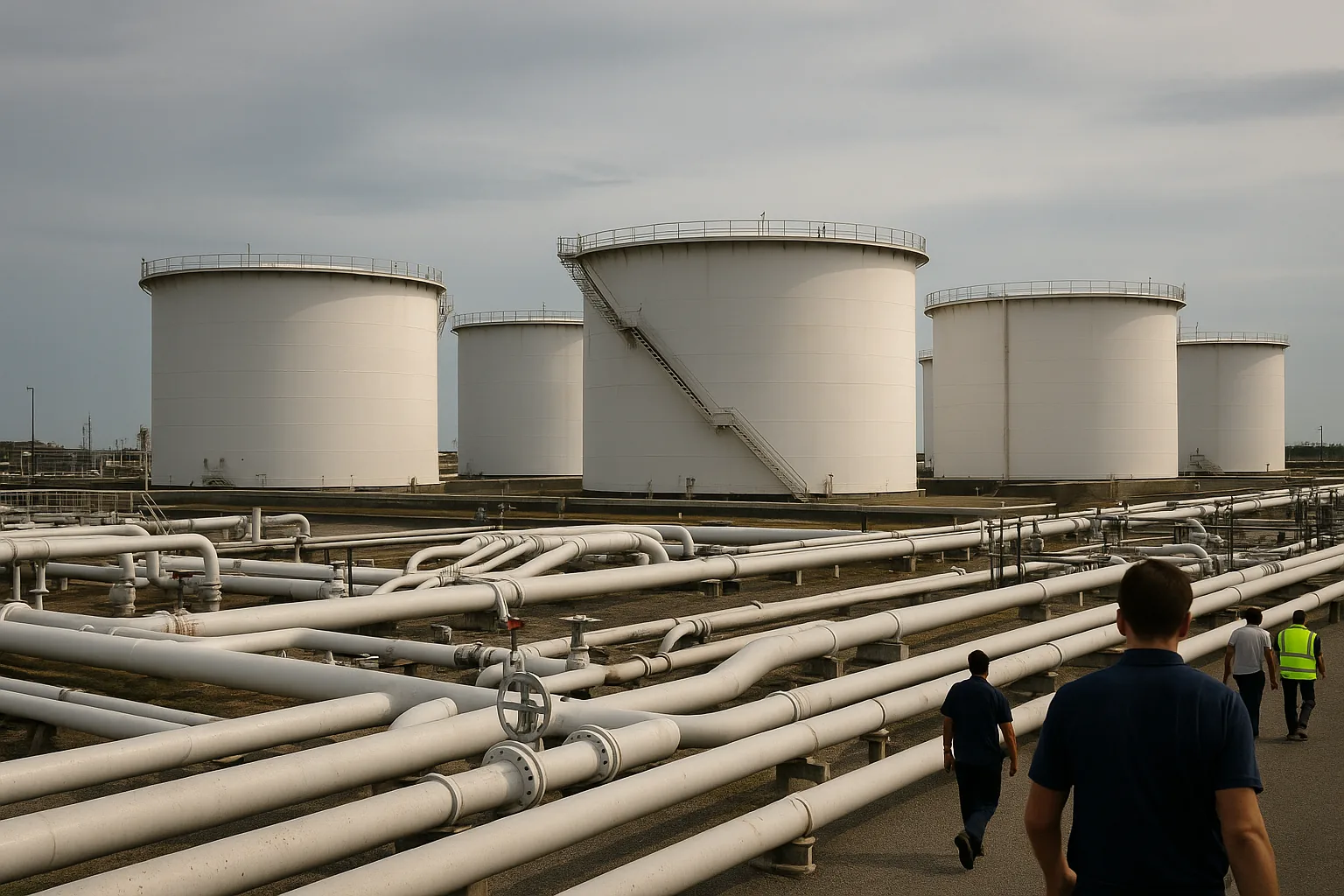
Intensifying supply disruptions, led by an attack on a key Saudi Arabian oil pipeline, fueled a significant bullish repricing in prediction markets on Tuesday, September 15, 2026. Traders on the Kalshi exchange aggressively increased their odds for West Texas Intermediate (WTI) crude oil reaching historically high prices by the end of the month. The move reflects growing concern that geopolitical instability and strained logistics could keep global oil supplies tight, with contracts now implying a strong possibility of prices peaking well above $105 per barrel.
The repricing was broad and decisive. For instance, the contract for WTI reaching "$110.51 or above" by September 30 saw its implied probability surge 50 percentage points to 37% on heavy trading volume. This was part of a wider trend where expectations for the month's peak price shifted markedly higher, breaking away from official forecasts issued just a week prior and aligning with a spot price that has climbed above $105 per barrel.
Distribution Analysis
The following table displays the implied probabilities for the maximum WTI front-month settlement price reached by September 30, 2026. The data shows a clear shift into higher price brackets, with the majority of actively traded contracts seeing an increase in implied odds.
| Outcome | Current Prob | Change | Volume |
|---|---|---|---|
| 106.01 or above | 95% | +20.0pp | 223 |
| 107.01 or above | 95% | -1.0pp | 220 |
| 106.51 or above | 87% | +39.0pp | 7 |
| 109.51 or above | 73% | +36.0pp | 678 |
| 107.51 or above | 63% | +85.0pp | 425 |
| 111.01 or above | 57% | -3.0pp | 352 |
| 112.01 or above | 57% | +11.0pp | 10 |
| 108.51 or above | 54% | -9.0pp | 1,128 |
| 108.01 or above | 53% | -30.0pp | 912 |
| 115.51 or above | 50% | +1.0pp | 381 |
| 116.01 or above | 50% | ~0pp | 10 |
| 115.01 or above | 48% | +11.0pp | 309 |
| 116.51 or above | 48% | +27.0pp | 116 |
| 109.01 or above | 45% | +23.0pp | 145 |
| 117.01 or above | 44% | ~0pp | 275 |
| 112.51 or above | 43% | +5.0pp | 68 |
| 118.01 or above | 42% | +17.0pp | 36 |
| 110.01 or above | 40% | -5.0pp | 148 |
| 117.51 or above | 40% | -14.0pp | 5 |
| 110.51 or above | 37% | +50.0pp | 1,263 |
| 119.01 or above | 33% | ~0pp | 625 |
| 121.51 or above | 23% | ~0pp | 201 |
| 122.01 or above | 23% | ~0pp | 200 |
| 122.51 or above | 23% | ~0pp | 176 |
| 123.01 or above | 23% | ~0pp | 166 |
| 119.51 or above | 20% | +3.0pp | 465 |
| 121.01 or above | 20% | ~0pp | 250 |
| 120.01 or above | 18% | +2.0pp | 373 |
| 125.01 or above | 17% | ~0pp | 400 |
| 120.51 or above | 16% | +1.0pp | 3,243 |
| 125.51 or above | 15% | ~0pp | 500 |
Net: 15 of 31 contracts rose on total volume of 7,743, shifting the implied consensus range for the September peak price significantly higher.
What's Driving the Shift
The sharp repricing appears directly linked to a confluence of severe geopolitical and logistical pressures on the global oil supply.
Saudi Supply Shock: The primary catalyst is the disruption to a major Saudi Arabian pipeline following recent attacks. Reports indicate Saudi Arabia halted loadings at its Yanbu port after its East-West pipeline, which has a capacity of 4 to 5 million barrels per day, was taken offline. This pipeline is a critical alternative to the disrupted Strait of Hormuz, and its closure has an immediate and significant impact on the availability of crude for export.
Persistent Geopolitical Risk: The pipeline attack compounds pre-existing supply fears. The Strait of Hormuz, a chokepoint for one-fifth of global oil supplies, remains severely constrained, limiting exports from other key producers. This sustained tension has created a market highly sensitive to any additional supply-side shocks.
Declining Global Inventories: These acute disruptions are occurring against a backdrop of already tight market fundamentals. In its September 9 outlook, the U.S. Energy Information Administration (EIA) noted that global oil inventories were falling and forecast they would continue to decline through the end of 2026. This lack of a supply buffer means shocks like the Saudi pipeline outage translate more directly into price pressure.
Market Context
The prediction market's rapid adjustment highlights how quickly real-world events are outpacing official forecasts. As of September 9, the EIA raised its forecast for the average WTI price in 2026 to $84.65 per barrel. With the spot price now trading around $104.20, and prediction markets pricing in a strong chance of a peak above $110, traders are signaling that the EIA's assumptions have been overtaken by the severity of the supply disruptions.
Even before the latest escalation, markets were pricing in a bullish environment. Throughout early September, contracts for WTI to remain above $91.50 held an implied probability of 96%, according to data aggregated by Frenzy Capital. The latest moves represent not a change in direction, but a dramatic acceleration of that existing trend.
What to Watch
The market's direction for the remainder of the month will likely hinge on news out of the Middle East. Traders will be closely watching for any updates on the status of the Saudi East-West pipeline and shipping traffic through the Strait of Hormuz. The next EIA Weekly Petroleum Status Report will also be critical for assessing the impact of these disruptions on U.S. inventories. This market is set to resolve based on the highest WTI front-month futures settlement price recorded by the Intercontinental Exchange (ICE) on or before September 30, 2026.
