
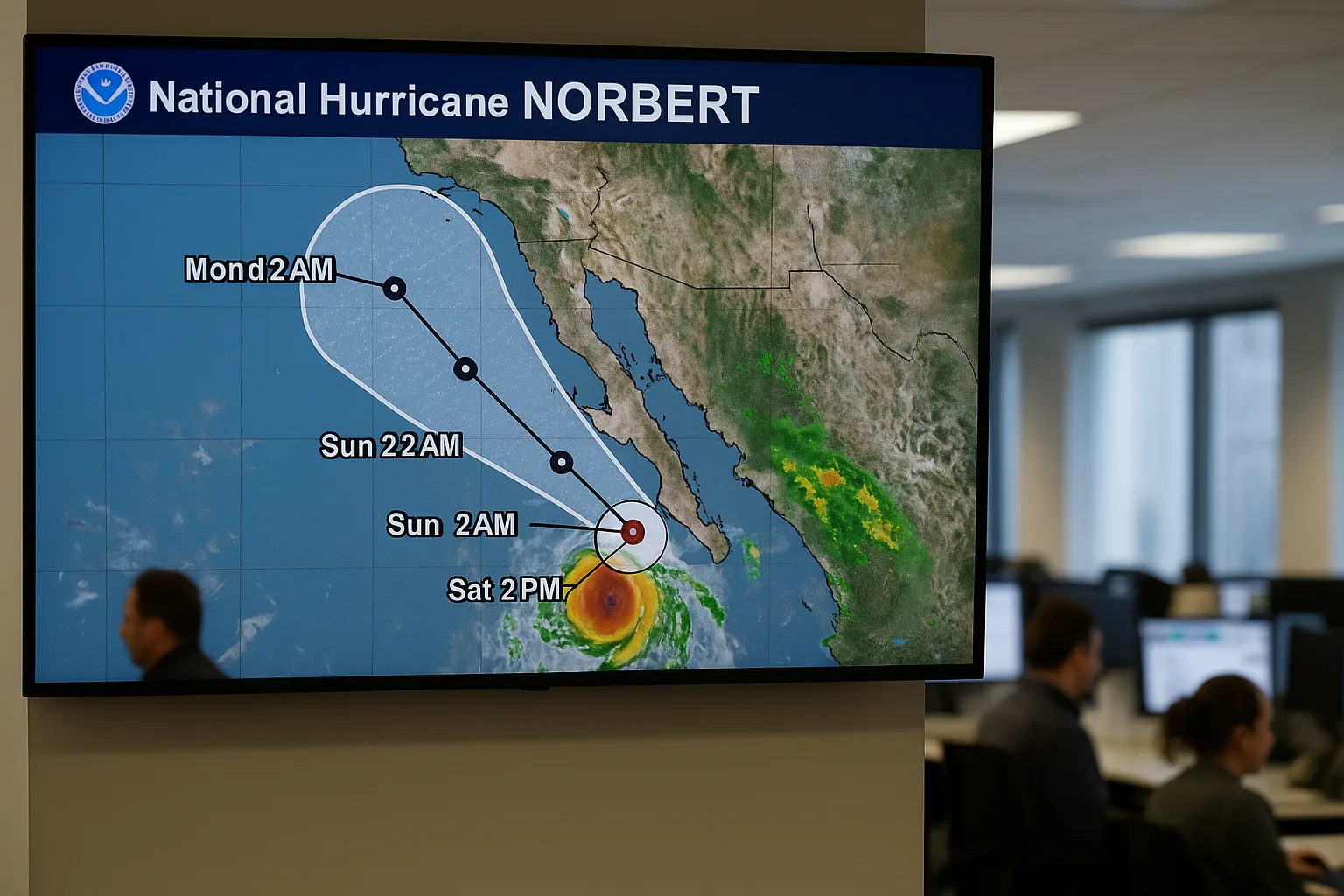
Forecasts from the National Hurricane Center on Saturday, September 12, 2026, projecting that Tropical Storm Norbert will weaken and dissipate without reaching hurricane intensity, prompted a significant repricing in a related prediction market. On the Kalshi exchange, the contract for Norbert to become a "Category 1 or above" hurricane collapsed by 77 percentage points, falling from 85% to a low of 7%. The market adjustment aligns with the latest meteorological data, which shows Norbert with maximum sustained winds near 50 mph—well below the 74 mph threshold for a Category 1 storm.
Distribution Analysis
The sharp decline in probability was consistent across all contracts related to Norbert achieving hurricane strength, indicating a strong market consensus that the storm's potential for intensification has passed.
| Outcome | Current Prob | Change | Volume |
|---|---|---|---|
| Category 1 or above | 7% | -77.0pp | 1,858 |
| Category 2 or above | 5% | -36.0pp | 1,592 |
Net: 2 of 2 contracts declined on 3,450 total volume, shifting the implied consensus decisively away from Norbert reaching hurricane status.
What's Driving the Shift
The market repricing was directly tied to official government forecasts that reversed earlier expectations of the storm strengthening.
Official NHC Forecast: The primary driver was a series of public advisories issued by the National Hurricane Center (NHC). In Advisory Number 14 on Saturday, the NHC stated that after a brief period of potential fluctuation, a "gradual weakening trend" would begin. The forecast explicitly projected Norbert would "degenerate into a remnant low by Tuesday and dissipate by Wednesday." This guidance effectively removed the path to intensification that traders had previously priced in.
Weakening Storm Vitals: The market's shift reflects the storm's current condition. The most recent NHC advisory from late Saturday night located Norbert far from land, about 1,530 miles east of Hilo, Hawaii, with maximum sustained winds of 50 mph. With the storm already in a weakening phase and moving over open ocean, the conditions required for it to gain the nearly 25 mph in wind speed needed for hurricane status are no longer expected to materialize.
Reversal of Earlier Projections: The steep drop from an 85% probability is contextualized by earlier, more bullish forecasts. On Thursday, September 10, some forecasts suggested Norbert could strengthen into a hurricane by Saturday. As late as Friday, September 11, analyses projected the storm would reach hurricane intensity over the weekend. The high initial odds were based on these now-outdated models. The weekend's NHC advisories represented a definitive official turn against that scenario, triggering the market correction.
Market Context
This market provides a clear example of how weather-related prediction contracts respond in real-time to new data from official sources like the NHC. The initial 85% probability for Norbert to reach hurricane strength was based on forecasts from mid-week, when conditions for intensification appeared more favorable.
The subsequent collapse to single-digit odds demonstrates traders rapidly assimilating new official guidance that invalidated the previous thesis. The high volume accompanying the price drop suggests strong conviction among market participants that the window for Norbert to become a hurricane has closed. The storm poses no threat to land, with no coastal watches or warnings in effect.
What to Watch
The prediction market is scheduled to close on December 2, 2026, but is expected to resolve much sooner. The settlement sources are the National Oceanic and Atmospheric Administration (NOAA) and The Weather Company. Based on the NHC's forecast for the storm to dissipate by Wednesday, September 16, the market is likely to resolve as "No" within the next few days, confirming the outcome currently priced by traders.
