
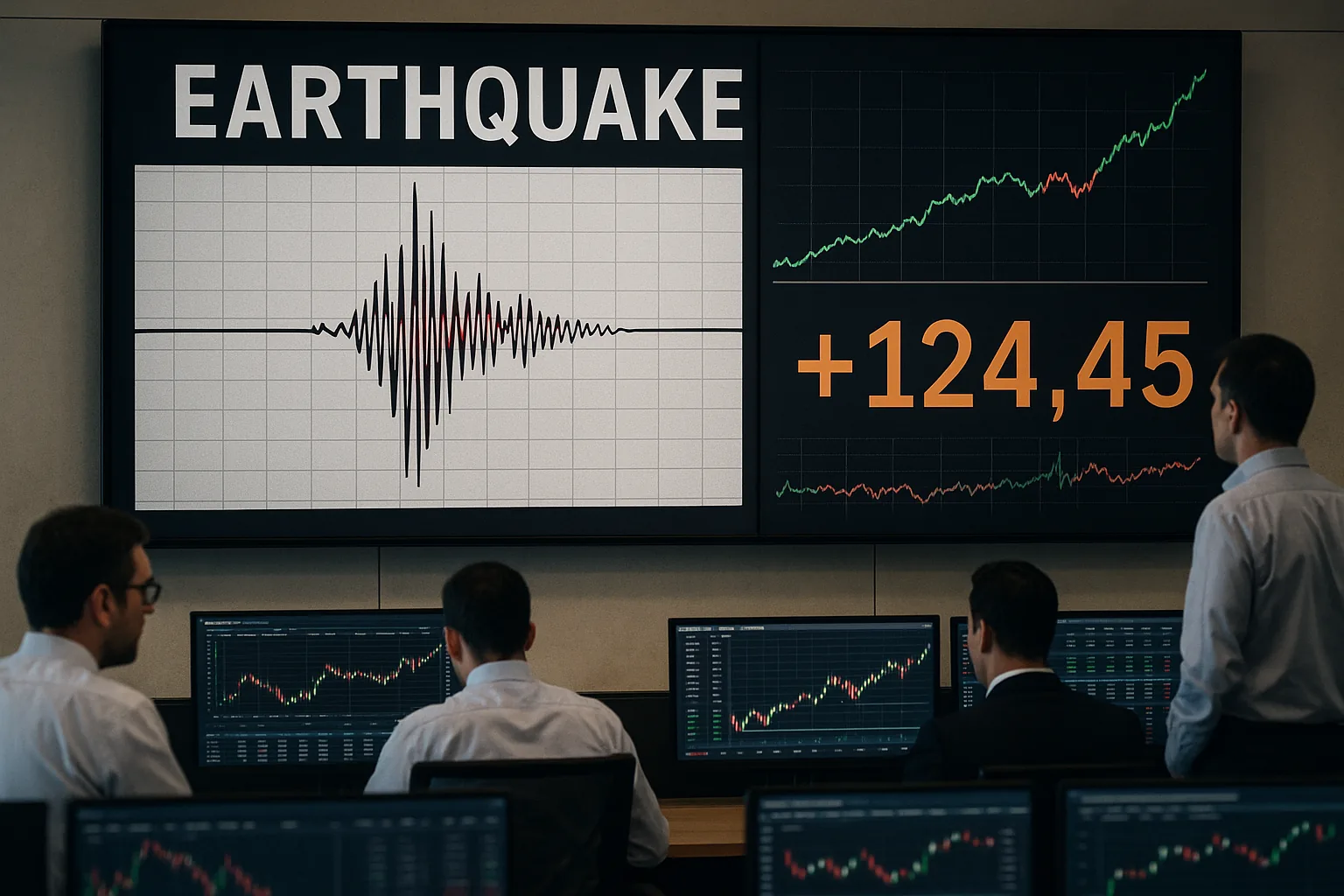
A cluster of moderate earthquakes recorded worldwide on September 27-28, 2026, coincided with a significant repricing in a prediction market for major seismic events, with traders dramatically increasing the implied probability of a magnitude 7.1 or greater earthquake occurring before October 1. In the session on Sunday, September 27, 2026, the contract for a M7.1+ quake jumped from 12% to 60%, a sharp 48-percentage-point spike. The move suggests that despite scientific consensus that short-term earthquake prediction is not possible, traders are reacting to recent seismic patterns as potential precursors to a more powerful event.
The shift was not uniform, indicating a specific reallocation of risk toward higher-magnitude events. While contracts for extremely powerful quakes saw their probabilities rise, contracts for moderately powerful events in the M6.9 to M7.0 range declined. This indicates traders may be selling off intermediate outcomes to fund bets on more extreme scenarios as the contract's deadline approaches.
Distribution Analysis
The following table shows the probability distribution for various earthquake magnitudes occurring before October 1, 2026, on the Kalshi exchange. The data reflects market prices as of the evening of September 27, 2026.
| Outcome | Current Prob | Change | Volume |
|---|---|---|---|
| 7.1+ | 60% | +48.0pp | 104 |
| 7.3+ | 46% | +20.0pp | 66 |
| 7.5+ | 26% | +21.0pp | 320 |
| 6.9+ | 25% | -29.0pp | 188 |
| 7.2+ | 24% | +7.0pp | 258 |
| 7.0+ | 20% | -10.0pp | 621 |
| 6.8+ | 13% | +13.0pp | 617 |
| 7.4+ | 4% | +33.0pp | 126 |
Net: 6 of 8 contracts rose on a combined volume of 1,490, shifting the implied probability toward a higher-magnitude earthquake.
What's Driving the Shift
Global Seismic Cluster: The repricing appears linked to a series of moderate earthquakes detected worldwide within a 24-hour window. These include a 5.5-magnitude earthquake near Port McNeill, Canada, a 4.9-magnitude quake near the Philippines, a 4.9-magnitude event in the South Sandwich Islands region, and a 4.8-magnitude quake near New Caledonia. While none of these events are classified as major, the temporal clustering may have been interpreted by traders as a signal of heightened global seismic stress.
Scientific Consensus vs. Market Behavior: The market's reaction contrasts sharply with established scientific understanding. The U.S. Geological Survey (USGS) states that neither it nor any other scientists have ever predicted a major earthquake, as a valid prediction must specify the time, location, and magnitude. The USGS clarifies that swarms of small earthquakes are frequent and are "rarely followed by a large earthquake." The market's price action reflects speculation on short-term risk, a fundamentally different activity from the long-term, probabilistic forecasts issued by seismologists.
Expiring Contract Dynamics: With a settlement date of October 1, 2026, the market has only a few days remaining. This short time horizon makes prices extremely sensitive to any new information or perceived patterns. The lack of a major earthquake to date means the contract value was low, creating an environment for high-volatility repricing on any potential catalyst.
Market Context
This market operates on a series of related contracts, where a higher magnitude event automatically resolves lower-magnitude contracts to "Yes." For example, a confirmed M7.2 earthquake would resolve the "6.8+", "6.9+", "7.0+", "7.1+", and "7.2+" contracts.
The recent movement shows a nuanced shift in expectations. Probability mass appears to have moved out of the M6.9 (-29.0pp) and M7.0 (-10.0pp) range and into the higher-magnitude outcomes. The significant increase across all contracts from M7.1+ to M7.5+ suggests a growing belief that if an event does occur in the final days, it is more likely to be exceptionally strong than previously priced. The high volume on both declining (809) and rising (1,490) contracts indicates active trading and a widespread re-evaluation of risk.
What to Watch
The market will close at 11:59 p.m. ET on September 30, 2026. The definitive settlement source is the U.S. Geological Survey's earthquake map. Any confirmed earthquake of sufficient magnitude reported by the USGS before the deadline will cause the relevant contracts to resolve to "Yes." Traders will be monitoring the USGS global feed closely for any seismic activity in the final days of trading.
