
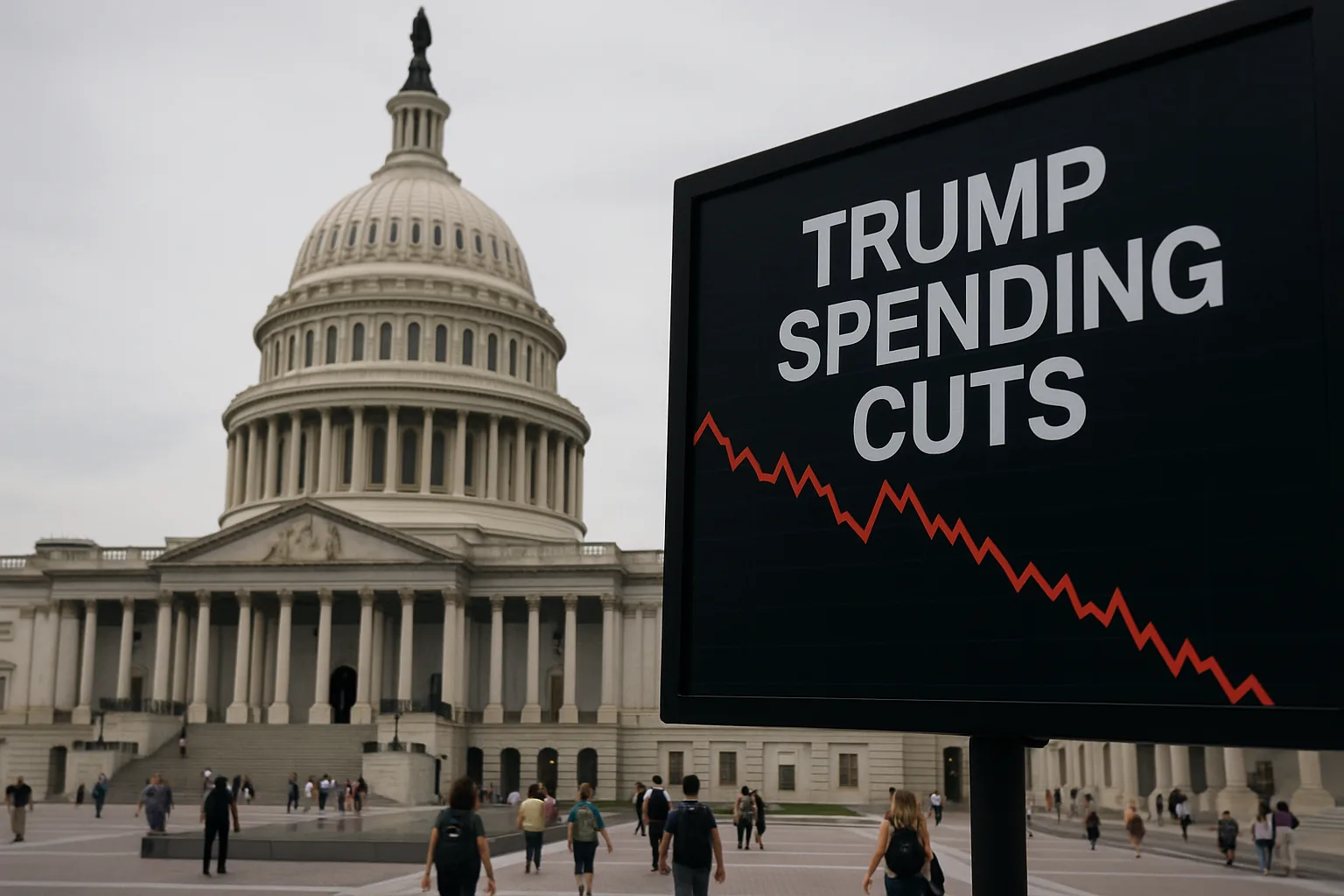
A series of damaging government watchdog reports throughout August and early September 2026, which found the Trump administration's flagship cost-cutting initiative overstated savings by billions, has triggered a sharp downward repricing in markets betting on the scale of future government spending cuts. The move, which accelerated in the session ending September 06, 2026, saw traders shift probability away from scenarios involving substantial reductions. The contract for "At least $100 billion" in cuts plunged from 96% to 12%, while the contract for minimal cuts of "At least $1 billion" soared from 11% to 80% on high volume, suggesting a major reassessment of the administration's ability to achieve significant fiscal restraint.
The repricing follows a September 3 report from the Government Accountability Office (GAO), detailed by FedScoop, which found that the Department of Homeland Security's claimed $10.5 billion in savings from contract terminations, done in partnership with the now-dissolved Department of Government Efficiency (DOGE), amounted to less than 1% of that figure in reality. This report compounded earlier findings from the GAO in August that DOGE's widely publicized "$110 billion" in savings were "unreliable and lacked supporting evidence." The market action indicates traders are interpreting these official audits as confirmation that the administration's primary tool for reducing spending has failed to deliver, making large-scale cuts before the end of the term highly improbable.
Distribution Analysis
| Outcome | Current Prob | Change | Volume |
|---|---|---|---|
| At least $1 billion | 80% | +69.0pp | 1,209 |
| At least 100 billion | 12% | -84.0pp | 112 |
| At least 200 billion | 11% | -17.0pp | 11 |
| At least 50 billion | 10% | +1.0pp | 19 |
Net: 2 of 4 contracts declined on a total of 123 in 24-hour volume, while volume on rising contracts reached 1,228, shifting the implied consensus sharply toward minimal spending cuts.
What's Driving the Shift
The market's dramatic re-evaluation appears to be a direct response to a convergence of official data and reports that undermine the narrative of successful, large-scale spending reduction efforts by the Trump administration.
DOGE Savings Claims Discredited: The primary catalyst appears to be a series of GAO reports dismantling the achievements of the administration's key cost-cutting agency. An August 6 GAO report stated DOGE was not transparent in its methodology and took credit for cuts that were already in process. This was followed by a more specific September 3 analysis of DHS contract cancellations, which found actual savings were a fraction of the $10.5 billion claimed. This pattern of official debunking has eroded market confidence in future cuts.
Rising Federal Deficit: The GAO findings coincide with broader fiscal data showing a worsening deficit. According to a Newsweek report from August 14, the U.S. budget deficit swelled to $1.8 trillion for the first ten months of the fiscal year, higher than the previous year, driven by increased outlays and interest payments. This underlying trend runs contrary to the premise of a government successfully reining in its spending.
Pattern of Congressional Resistance: The administration's difficulty in implementing cuts via executive action has been compounded by legislative roadblocks. As reported by WMAL-FM in February 2026, Congress has rejected most of the administration’s proposed discretionary spending cuts for fiscal year 2026, opting instead to hold funding flat or provide increases for many programs targeted for elimination. This has established a clear pattern of resistance that limits the scope for future legislative savings.
Market Context
The probability shift represents a flight from ambitious but increasingly unlikely outcomes to a more conservative consensus. The near-total collapse of the "At least 100 billion" contract, which had been priced at 96%, shows that what was once considered a near-certainty is now viewed as a long shot. The massive inflow into the "At least $1 billion" contract, which now implies an 80% chance of resolving "Yes," reflects a market consensus that while some token cuts are achievable, the prospects for substantial fiscal consolidation have evaporated.
The volume pattern provides a strong signal of conviction. While the contracts for deeper cuts ("$200 billion") saw price drops on low volume, the +69 percentage point jump in the lowest-tier contract was backed by over 1,200 contracts traded, more than ten times the volume of the declining contracts combined. This suggests a broad-based move toward pricing in a low-cut reality.
What to Watch
The market, which trades on the CFTC-regulated Kalshi exchange, will continue to react to major fiscal policy announcements and data releases. The administration's Fiscal Year 2027 budget, analyzed by the Congressional Budget Office in July 2026, will remain a key document for traders. The official settlement source for this market is the Federal Reserve Economic Data (FRED) series on Federal Government Current Expenditures. The market is scheduled to close on March 31, 2029, and will resolve based on the net change in spending over the course of President Trump's term.
