
Episode summary
The Chip That Could Unlock AGI.
 The a16z Show
· · Hosts: Matt Bornstein · Guests: Naveen Rao
Summary
Naveen Rao argues that AI hardware should move beyond digital computing and toward analog systems that better match the physics of intelligence. He says Unconventional AI is not just a chip company, but an effort to study first principles of learning in physical systems, with the goal of building a substrate that can express dynamics, causality, and stochastic behavior more naturally than today’s precision-first machines.
He frames the bet as both technical and practical. Digital computing won because early systems needed reliable scaling, but he says AI has become a new kind of workload that is constrained by energy and infrastructure. He points to the brain’s efficiency, data center power use, and the prospect of a 400-gigawatt shortfall as reasons to rethink the architecture underneath AI rather than keep scaling the same model.
Rao expects the first useful targets to include transformers, diffusion models, flow models, and energy-based models, especially where dynamics matter. He says the company will work with players like TSMC and could even collaborate with Nvidia or Google in some contexts. More broadly, he sees Unconventional as a practical research lab: open-ended early on, but aimed at a manufacturable product that could make AI cheaper, more ubiquitous, and closer to AGI by better capturing causality.
Key takeaways
- Naveen Rao says Unconventional AI is exploring whether analog circuits can better implement intelligence than the digital substrate used for 80 years.
- He argues AI is becoming constrained by energy, citing roughly 4% of the U.S. grid going to data centers and a projected need for 400 gigawatts more capacity over 10 years.
- Rao expects the earliest strong fit to be models with dynamics, including transformers, diffusion models, flow models, and energy-based models.
- He sees TSMC as a partner and leaves open collaboration with Nvidia or Google, rather than framing the startup as purely adversarial.
- Rao says the company’s culture will prioritize high-agency people who can move across theory, systems, and hardware.
Notable quotes
“I think AI is the next evolution of humanity. I think it takes us to a new level. Allows us to collaborate and understand the world in much deeper ways”
“We've been building largely the same kind of computer for 80 years. We went digital back in the 1940s”
“we believe we can find this the right isomorphism in electrical circuits that can subserve intelligence”
“by some estimates we need 400 gawatts additional capacity over the next 10 years to power the demand for AI”
How the episode opens
I think AI is the next evolution of humanity. I think it takes us to a new level. Allows us to collaborate and understand the world in much deeper ways.
Naveen Ralph is here expert in AI. Naveen Ralph probably one of the smartest guys in this domain. He sees things well before anybody else sees them.
You had a lot of success doing Nirvana Mosaic and data bricks. Why start a new chip company now? First off, it's not a chip company per se.
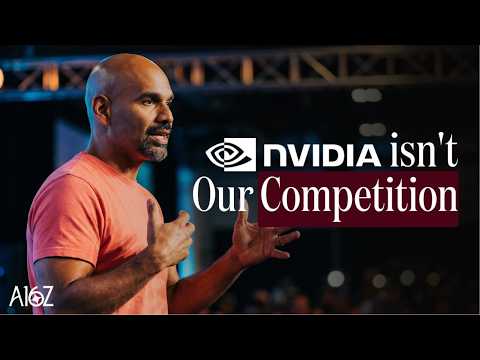
Most of what we're doing is really kind of looking at first principles of how learning works in a physical system. Nvidia, TSMC, Google. Are these potential allies for unconventional?
Are these competitors? So, I think TSMC is absolutely going to be a partner. Google kind of has everything internally.
And Nvidia, of course, they built the platform that everyone programs on today. So, are we going to be at odds with Nvidia going forward? I don't know.
We'll see what the world looks like, but there could be a world where we collaborate. Has anyone called you crazy yet for doing this? Oh, yeah.
Plenty of people. Our guest today is Naveen Ralph, co-founder and CEO of Unconventional AI, which is an AI chip startup. Prior to that, Naveen was at data bricks as head of AI and co-founder of two successful companies, Mosaic in the uh cloud computing world and Nirvana uh doing AI chip accelerators uh before it was cool.
Um uh we're here reporting from Nurups. Um and uh yeah, great to great to have you on the on the podcast, Vivian. Welcome.
Thanks. Thanks for having me. So, you were kind of at the vanguard thinking about what the proper hardware is for running AI workloads.
Absolutely. I mean, you know, it's like uh when you have a hammer, everything's a nail, I suppose.
From the episode’s captions: roughly the first two minutes, lightly cleaned. Keep watching on YouTube →
Topics
- ai hardware
- analog computing
- data center energy use
- agi
- chip architecture tradeoffs
Companies and tickers mentioned
- INTC
- Unconventional AI
- Databricks
- Mosaic
- Nervana
- Intel
Watch the episode
Watch “The Chip That Could Unlock AGI.” on YouTube
Summary, takeaways and quote selection by Octagon. Quotes are short excerpts; the full conversation is in the episode.
More from The a16z Show
-
 How AI Could Bring Halo and Other Classic Games Back to Life
-
 Mike Volpi on Why AI Infrastructure Will Outlast the Hype Cycle
-
 Why HubSpot’s Co-Founder Is Betting Against the SaaSpocalypse
-
 Inside Salesforce’s Acquisition Strategy for the AI Era
-
 How AI Is Turning Figma’s Finance Team Into Builders
-
 The New AI Agents That Shop, Plan, and Gossip
The a16z Show, this episode and its artwork belong to Andreessen Horowitz. Octagon is not affiliated with the show; this page is an independent summary.
