
Episode summary
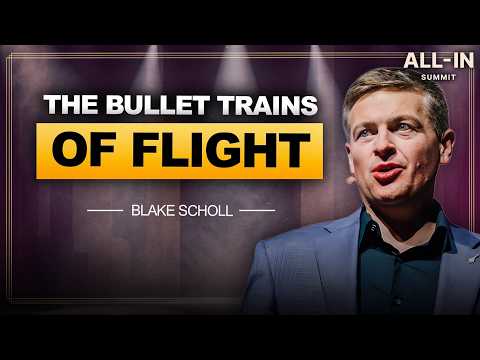
Blake Scholl: Why Plane Speed Stalled, Supersonic Commercial Flight, & Revolutionizing the Engine
 All-In Podcast
· · 18 min · Hosts: David Sacks, Jason Calacanis, Chamath Palihapitiya, David Friedberg · Guests: Blake Scholl
Summary
Blake Scholl argues that commercial aviation has stalled for decades and that Boom Supersonic exists to restart real innovation: legal, boomless supersonic flight, first on transatlantic routes and eventually for more passengers than just the wealthy. He says Boom proved a privately developed jet could break the sound barrier, and that its “boomless cruise” approach can redirect sonic boom energy upward, helping end the long U.S. ban on supersonic overflight.
The conversation shifts to the company’s decision to build its own engine after a failed outsourcing attempt with Rolls-Royce. Blake Scholl says that setback pushed Boom toward vertical integration, digital design, and manufacturing parts in-house, including turbine blades, with a first engine core moving to test soon. He frames this not only as a path to a better airplane, but as a manufacturing strategy for American industrial renewal.
He also says the engine technology has an immediate business use on the ground: powering data centers. Blake Scholl claims demand is already strong, that the company can deploy 42 megawatts in trailer-sized units, and that the first engine will be auctioned to customers. On timelines and economics, he says a round trip across the Atlantic at Mach 1.7 could take 3 hours, with a break-even fare of about $3,500, while the company’s goal is to make that available around 2030, give or take.
Key takeaways
- Blake Scholl says Boom’s boomless-cruise approach can make supersonic flight legally and politically viable by avoiding a ground-level sonic boom.
- He says the company’s first commercial engine application is 42 megawatts of behind-the-meter power for data centers, not passenger aircraft.
- Blake Scholl says the transatlantic round trip target is 3 hours at Mach 1.7, with a break-even fare of about $3,500.
- He says Boom’s failed outsourcing plan led the company to vertically integrate engine design and manufacturing, which he sees as a strategic advantage.
- The host says Boom has already won unusual regulatory momentum, with a supersonic legalization effort passing the House unanimously and moving through the Senate.
- Blake Scholl says the broader goal is supersonic access for every class of passenger, from Air Force One to private jets to commercial flights.
Notable quotes
“our first application of our engine isn't in the sky. It's actually on the ground for data centers”
“Round trip across the Atlantic at Mach 1.7, 3 hours, and the break even fair is about $3,500”
“I think everybody wants to know the New York to Los Angeles, San Francisco time”
How the episode opens
Set to fly at Mach 1.7 with 130 orders from major airlines. — The founder and CEO of Boom Supersonic, Lake Shaw, — Boeing hasn't built a new airplane in 20 years. I mean, it's David and Goliath, but Goliath is like asleep. We're here to bring back supersonic passenger travel and ultimately to make the planet dramatically more accessible. This whole airplane was built by essentially 50 people.
By 50 people. The moment you become an expert, what you're steeped in is the past and then you're completely useless. Courage is not being fearless.
Courage is acting despite the fear. If there's no boom at all, there's nothing to argue about. The world needs supersonic flight.
Passengers deserve it. Please welcome Blake Schol. Good morning, Houston.
We have a problem. In 1969, we landed on the moon and we flew an airliner through the sound barrier. Yet more than half a century later, we can't go to the moon and we can't fly faster than the speed of sound.
The legacy, the political legacy of Concord was a ban on supersonic flight over the US. Boeing brought us into the jet age in 1957 with the 707. But fast forward to today and their latest airliner is a literal carbon fiber copy of their first.
By the way, we have interns born after the last time Boeing launched a new airplane in 2004. This is insane. But imagine imagine an alternate timeline in which innovation and flight had continued.
What if we could cross the Atlantic in three and a half hours? What if Sydney were as accessible as Honolulu is today? What would that do for business, for culture, even for love?
Who could do something about this? 12 years ago, I was a software engineer and an ads guy from Amazon and Groupon.
From the episode’s captions: roughly the first two minutes, lightly cleaned. Keep watching on YouTube →
Topics
- supersonic flight
- sonic boom
- data center demand
- private jets
- engine technology
Watch the episode
Summary, takeaways and quote selection by Octagon. Quotes are short excerpts; the full conversation is in the episode.
More from All-In Podcast
-
 Freedom vs. Safety: Axon CEO Rick Smith on the Future of Policing
-
 Midterm Blood Bath, $4T AI Sell Off, Data Center Freeze, What’s Next for Trump
-
 All-In Podcast REACTS to Democrat Sweep!
-
 Anthropic S-1 Shocker, Greatest Business Ever? Google’s $500B Wipeout, Midterm Predictions
-
 WHOOP CEO, Will Ahmed: 50B Hours of Health Data, a 4 Million Member Data Moat, & the FDA Fight
-
 AI Cyber Panic, Ken Griffin’s Bubble Warning, The Fall of France?
All-In Podcast, this episode and its artwork belong to All-In Podcast, LLC. Octagon is not affiliated with the show; this page is an independent summary.
