
Episode summary
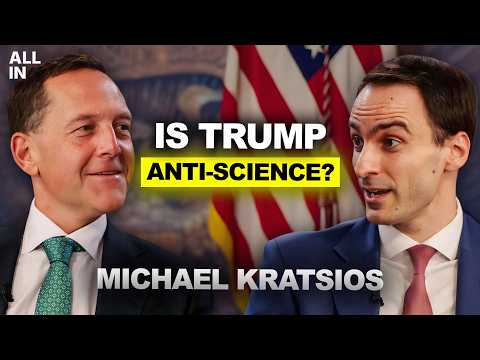
Inside Trump's Science Agenda: Anti-Science Claims, Fauci's Damage, DEI & China w/ Michael Kratsios
 All-In Podcast
· · 56 min · Hosts: David Sacks, Jason Calacanis, Chamath Palihapitiya, David Friedberg · Guests: Michael Kratsios
Summary
Michael Kratsios argues that the administration is not anti-science but is trying to redirect U.S. science policy toward what he calls “gold standard” research. He says science has become politicized over the last 15 to 20 years, especially during COVID, and that the government should stop treating bigger budgets as proof of support. Instead, he wants agencies to ask whether the roughly $200 billion in annual S&T spending is producing the best breakthroughs.
He defends cuts and reallocations by pointing to what he describes as wasted funding at NSF and in climate research, including DEI-related grants and reliance on extreme climate scenarios like RCP 8.5. Kratsios says the administration wants to back basic research, but with more experimentation in how grants are awarded, including “golden tickets,” shorter or longer grant durations, and more support for scientists outside universities.
The conversation also centers on stagnation in American science and the race with China. Kratsios cites NIH’s rising budget alongside declining output per dollar, says the median intramural NIH researcher is 71, and argues the U.S. must do more to recruit STEM talent. He ties that to big national projects like the Genesis Mission, quantum by 2028, fusion by 2035, and American boots back on the moon in 2028.
Key takeaways
- Kratsios says the administration is not anti-science, but wants to shift federal funding toward basic research and away from politicized or low-return programs.
- He argues roughly one quarter of NSF grants under the Biden administration went to DEI-related initiatives, which he says amounted to about $8 billion over four years.
- He says the administration wants to test new grant models like “golden tickets” and variable grant lengths to reward risk-taking and faster experimentation.
- Kratsios says the U.S. should focus government funding on areas the private sector will not fund, while using AI to “double the scientific output of the United States.”
- He warns that China’s scale, talent pipeline, and industrial policy are intensifying the scientific competition, and says the U.S. must do more to develop and retain STEM talent.
Notable quotes
“We want to essentially double the scientific output of the United States”
“The thing that is not true and what the data does not support is that it is a climate emergency”
“We have to win this fusion race. We set a target for 2035 for example for that”
“I think generally our argument it has”
“the median age of an intramural researcher at NIH is 71 years old”
How the episode opens
Is this administration anti-science? — We want to essentially double the scientific output of the United States. — Did we lose it or did it lead to moments where you have like Fouchy? — That's a great question. — Are we in this moment, this populist moment right now in the West where science and technology is viewed as a tool of the elite and therefore it must be broken and destroyed?
That's what's most tragic. — That is a crazy crazy fact. Has science stagnated in America? What the heck is going on? I'm going — Michael Katios, welcome to the All-In Interview. — Thank you for having me. Excited to be here.
So, you are the director of the Office of Science and Technology Policy here at the White House. Can you just tell me a little bit about what that role is? What do you do here?
Yeah. So the office of science and technology policy was uh created in in the 60s to coordinate science and tech policy across the administration. So very unique to the US is that we don't have an agency that does science and technology.
We have lots of agencies that do pieces of the science and technology enterprise. We have a national science foundation that does basic research. We have a department of energy that runs our national labs.
The Department of War has uh extensive R&D um programs like DARPA for example. So the one office in the White House or in the in the administration broadly that's able to coordinate all those efforts is the office that that I run called OSTP. Um and we try to do is work with the president to set the national S&T agenda uh and then ultimately implement that across all of our agencies.
From the episode’s captions: roughly the first two minutes, lightly cleaned. Keep watching on YouTube →
Topics
- anti-science claims
- de i grants
- climate science cuts
- nih funding and researcher age
- u s competition with china for stem talent
Watch the episode
Summary, takeaways and quote selection by Octagon. Quotes are short excerpts; the full conversation is in the episode.
More from All-In Podcast
-
 Jensen OUT as Nvidia CEO: "Spy" Scandal, Export Restrictions, Market Impact
-
 Freedom vs. Safety: Axon CEO Rick Smith on the Future of Policing
-
 Midterm Blood Bath, $4T AI Sell Off, Data Center Freeze, What’s Next for Trump
-
 All-In Podcast REACTS to Democrat Sweep!
-
 Anthropic S-1 Shocker, Greatest Business Ever? Google’s $500B Wipeout, Midterm Predictions
-
 WHOOP CEO, Will Ahmed: 50B Hours of Health Data, a 4 Million Member Data Moat, & the FDA Fight
All-In Podcast, this episode and its artwork belong to All-In Podcast, LLC. Octagon is not affiliated with the show; this page is an independent summary.
