
Episode summary
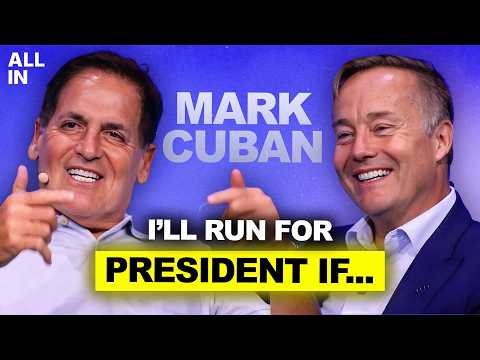
Mark Cuban on the AI Bubble: Who Actually Gets Wiped Out?
 All-In Podcast
· · 42 min · Hosts: David Sacks, Jason Calacanis, Chamath Palihapitiya, Ben Horowitz, David Friedberg, Brad Gerstner · Guests: Mark Cuban
Summary
Mark Cuban argues that today’s AI market looks bubbly, but not in the same way as the dot-com era. He says the biggest damage will likely hit VCs, private funds, and leveraged buyers who paid up for AI assets, while most consumers won’t feel a broad market collapse. He also warns that companies are “pricing to perfection,” making massive data-center and AI infrastructure bets before the economics are proven.
A central theme is that AI is powerful but far harder to implement than the hype suggests. Cuban says simple agents and productivity wins are real, especially for programmers, but enterprise deployment remains brittle, requires systems thinking, and still needs people. He points to the need for forward-deployed engineers, the limits of current tools, and the fact that AI still cannot reliably handle basic workflows without human correction.
He is most optimistic about entrepreneurship, where AI dramatically lowers the cost and time to start and test businesses. Cuban also highlights health care, arguing that self-directed health monitoring with AI, wearables, and bloodwork can improve decision-making without replacing doctors. On politics, he says large language models may become a truth-seeking counterweight to algorithm-driven social media, while also arguing that mobility, markets, and the ability to build will keep shaping where talent and capital flow.
Key takeaways
- Cuban thinks the AI bubble is less likely to hurt ordinary people than to wipe out VCs, funds, and PE investors who bought at peak prices.
- He says AI is “a lot harder to implement than anybody expected,” especially inside enterprises where systems integration still breaks down.
- Cuban argues that AI’s biggest near-term upside is entrepreneurship, because it can compress prototyping and business formation from months to minutes.
- He says self-directed health care using AI, wearables, and blood panels can make patients and doctors smarter, but will not replace physicians.
- He believes large language models may become a truth-seeking force that partially offsets social media’s attention-driven political algorithms.
Notable quotes
“it could just destroy a lot of VCs and a lot of funds and a lot of PE, right? Because they're going all in”
“AI is a lot harder to implement than anybody expected”
“self-directed health care with AI, man, you're going to get some early wins and then when you do go talk to your doctor”
How the episode opens
You and I live through a couple of bubbles. We've seen this movie before. — Um and and this wave seems very different than do waves. So, let's talk about that. Are you concerned about a bubble? We're seeing bubbly like behavior. People
It's not It's not the traditional dot bubble, right? Because back then there was companies going public getting crazy valuations and people are buying them and the stock would go up, you know, 50% 100% with companies that had no revenue, no traffic, no nothing. and you'd go get a cab back then and people would be talking about them.
Yeah. And you don't you don't see that at all today. So, it's not a bubble that's going to impact most people in the room, right?
Or most people um across the US, but it could just destroy a lot of VCs and a lot of funds and a lot of PE, right? Because they're going all in.
I'm going all in. App 111 started with an $8 domain and no VC funding and became one of the largest ad platforms in the world. Now that same engine powers AppL ads for e-commerce.
Your ads run inside mobile games reaching over a billion people with full screen distraction-free attention. The platform finds buyers and optimizes for profit. You set the target, it does the rest.
One cookware brand went from 4 million to $16 million, turned profitable, and is on pace for 80 million this year. Visit apploven.com/allin to launch your first campaign today.
It used to be that product managers for brokerages had to outperform the numbers, right, for, you know, the S&P or whatever. But now you got to outperform to keep the money coming in. You got to outperform the the fund next door.
From the episode’s captions: roughly the first two minutes, lightly cleaned. Keep watching on YouTube →
Topics
- ai bubble
- enterprise ai
- ai-first workspace
- healthcare and biometrics
- wealth tax and politics
Watch the episode
Watch “Mark Cuban on the AI Bubble: Who Actually Gets Wiped Out?” on YouTube
Summary, takeaways and quote selection by Octagon. Quotes are short excerpts; the full conversation is in the episode.
More from All-In Podcast
-
 Jensen OUT as Nvidia CEO: "Spy" Scandal, Export Restrictions, Market Impact
-
 Freedom vs. Safety: Axon CEO Rick Smith on the Future of Policing
-
 Midterm Blood Bath, $4T AI Sell Off, Data Center Freeze, What’s Next for Trump
-
 All-In Podcast REACTS to Democrat Sweep!
-
 Anthropic S-1 Shocker, Greatest Business Ever? Google’s $500B Wipeout, Midterm Predictions
-
 WHOOP CEO, Will Ahmed: 50B Hours of Health Data, a 4 Million Member Data Moat, & the FDA Fight
All-In Podcast, this episode and its artwork belong to All-In Podcast, LLC. Octagon is not affiliated with the show; this page is an independent summary.
