
Episode summary
Mohamed El-Erian: 'AI Is In a Rational Bubble' | At Barron's
 At Barron's
· · Hosts: Andy Serwer · Guests: Mohamed El-Erian

Summary
Mohamed El-Erian argued that the dollar’s weakness reflects foreign investors’ growing caution about US policy rather than a full rejection of the United States. He said overseas buyers still want US corporate exposure, but they are hedging the dollar because of tariffs, high deficits, and a more interventionist industrial policy. He expects the dollar to stay roughly in the 97-99 range, with the next move more likely lower than higher.
On AI, El-Erian was highly bullish about the technology’s long-run productivity potential, but warned that the market around it is a “rational bubble.” He said many firms and investors are overinvesting because the payoff could be huge, while a separate set of companies are simply slapping on an AI label to attract capital. He also said AI may widen the gap between strong GDP growth and weakening labor demand, creating pressure on the Federal Reserve.
El-Erian said the economy remains surprisingly resilient, with 3.8% second-quarter growth and likely about 3% in the third quarter, but he thinks the Fed is behind the curve because it is too data-dependent and not strategic enough. He argued the Fed should consider a higher equilibrium inflation rate, and he said tariff policy has so far helped the US by raising revenue and limiting retaliation.
Key takeaways
- El-Erian said foreign investors still want US corporates, but they are hedging dollar exposure because of tariffs, deficits, and policy uncertainty.
- He expects the dollar to remain around 97-99 on the index, with depreciation more likely than appreciation.
- El-Erian called AI a "rational bubble": overinvestment makes sense given the payoff, but many weaker AI stories will fail.
- He said the economy is resilient enough to absorb shocks, with second-quarter growth at 3.8% and third-quarter growth likely near 3%.
- El-Erian thinks the Fed is too focused on backward-looking data and should think more strategically about productivity, labor supply, and a higher inflation equilibrium.
Notable quotes
“I cannot tell you how optimistic I am about AI. I think that this is a general purpose technology”
“AI um is an irrational bubble. And what do I mean by rational bubble? That if you analyze it in terms of incentives”
“I suspect we will we will stay at 97 99. And if we are to move in either direction, it's more likely to be towards depreciation than appreciation”
“I think the economy is surprisingly resilient. Andrew, we've thrown everything at it. Absolutely everything at it, including a shutdown”
“The Fed itself says that for at least another two years, we're going to exceed the car target. That's seven years”
How the episode opens
Hello everyone and welcome to At Barons. I'm Andy Sherwer and welcome to our guest Muhammad El Arian, economist. Muhammad, great to see you.
Thanks for having me. Let's start off by talking about the dollar and the issue about whether it really still is the world's reserve currency or will continue to be. You've seen the dollar weaken, gold, all the craziness going on there.
Crypto seems to be back. What's your take? So, one of the big surprises this year is that the dollar is having the weakest year for a very long time, even though every single other US asset is attracting a lot of attention.
And part of that explanation lies in what you see foreign ETFs that invest in the US do. They're very happy to take US corporate exposure, but they're hedging the dollar. And what you're seeing outside the US is an understanding that they have started overweight the dollar, that the dollar is not the reserve currency that they thought it was.
There is no other reserve currency to replace it. So, it's not as if they're going from the dollar to the euro or to the Chinese currency. at the margin they're going into gold but they're hedging any additional dollar exposure.
Now, is this some sort of indictment of US government policy on the one hand and also approval of the private sector in the United States and you're talking about that bifurcation then? Yeah. My my daughter when we talked about it said, "Oh, so they go long long US corporates and they short the mess and yes they are shorting things that is taking them time to understand.
That includes the complete change in US trade policy, the weaponization of tariffs in a way we haven't seen for a very long time.
From the episode’s captions: roughly the first two minutes, lightly cleaned. Keep watching on YouTube →
Topics
- ai investing
- rational bubble
- economy strength
- federal reserve
- market outlook
Watch the episode
Watch “Mohamed El-Erian: 'AI Is In a Rational Bubble' | At Barron's” on YouTube
Summary, takeaways and quote selection by Octagon. Quotes are short excerpts; the full conversation is in the episode.
More from At Barron's
-
 Kai-Fu Lee on How AI Can Help Grow a Company's Earnings
-
 Rocket CEO: "Homeowners Are Still Waiting to Buy Homes"
-
 Moderna CEO on the Biotech’s Cancer Vaccine and Pipeline
-
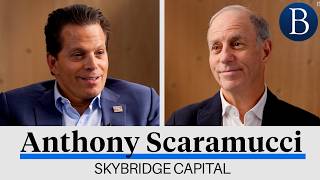 Anthony Scaramucci on Katie Zacharia, Trump, and the Midterms | At Barron's
-
 IMAX CEO on 'The Odyssey,' Chris Nolan, and Company's Sudden Ascent | At Barron's
-
 PG&E's CEO on Data Centers, Energy Rates, and the Stock | At Barron's
At Barron's, this episode and its artwork belong to At Barron's. Octagon is not affiliated with the show; this page is an independent summary.
