
Episode summary
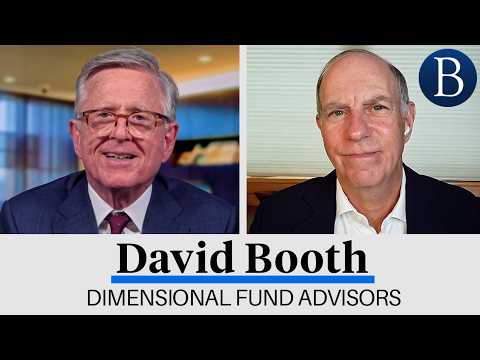
'Stay Calm' Author Discusses the Science of Investing | At Barron's
 At Barron's
· · 28 min · Hosts: Andy Serwer · Guests: David Booth
Summary
David Booth argues that investing became a genuine science once researchers had better data and computing power in the 1960s and 1970s, and that the evidence has made it hard to justify most active management. He says Dimensional Fund Advisors is built on applying that science, not on pretending markets can be consistently outguessed, and he contrasts that with plain indexing by emphasizing judgment in trading and portfolio implementation.
A major theme is that investors should stay calm and focus on long-term expected returns rather than short-term market moves. Booth says public stock and bond markets offer attractive returns over time, with stocks having compounded around 10% a year over the last century and bonds around 4% to 5%, and he argues that index funds make those returns accessible to ordinary investors at low cost. He also says active managers can serve a useful role in price discovery, even if most fail to beat the market after fees.
Booth extends the same framework to bonds, philanthropy, and education. He says the yield curve can be analyzed scientifically without forecasting rates, and he ties his gifts to the University of Chicago, the University of Kansas, and MoMA to the idea of combining science with judgment and purpose. On the American dream, he says it is still alive but endangered by weak K-12 education and the risk that the country is not preparing enough people for the future.
Key takeaways
- Booth says the data since the 1960s have made it difficult to find a strong, repeatable case that most active managers can beat the market.
- He argues that Dimensional does not literally index, because trading judgment can reduce hidden costs such as the price pressure around index changes.
- Booth says long-term investing should be centered on a sensible mix of stocks and short-term fixed income rather than short-term market timing.
- He says active managers still help markets by contributing to price discovery and a kind of wisdom-of-crowds effect.
- Booth thinks the American dream remains strong for talented entrepreneurs, but is threatened by poor U.S. K-12 education.
- He says philanthropy should target places where a gift can have durable impact, such as business education, athletics, or art conservation.
Notable quotes
“we're based on um we're found on the idea we can apply the science of investing”
“don't try to time short-term moves in the market”
“the tale is the extremes. We got so many incredibly talented young kids coming out of school”
How the episode opens
Hello everyone and welcome to At Baronss. I'm Andy Serur and welcome to our guest David Booth, co-founder and chairman of DFA Dimensional Fund Advisors and author of the new book Stay Comp. David, great to see you. Thanks so much for joining us.
Oh, glad to do it. At my age, I'm glad to be anywhere. — I hear you. So tell us a little bit about uh DFA. What does Dimensional Fund Advisors do and how is it different from other money managers?
Well, we're based on um we're found on the idea we can apply the science of investing and by that I mean in the 1960s and 70s uh um investing emerged as a science. Before 1960, it was very difficult um to do any kind of serious academic research because the data uh just wasn't there and um computers weren't big enough. And that changed in the 60s and u once they have the data and computers, you know, it unleashed a tremendous amount of research uh over over this last 60 years or so.
Um and they could test for the first time a lot of claims that were made in investing. Um you one of the um first claims was uh managers always gave was yeah sure we can beat the market you know with our genius we can we can out guess the market the market makes mistakes we can find those and uh and make you a lot of money capitalizing on them um turns out that uh was a wild claim but doesn't show up in the data uh you know for the last 60 years I've been doing research on the people trying to out guess the market and it's very difficult to um find a compelling argument.
From the episode’s captions: roughly the first two minutes, lightly cleaned. Keep watching on YouTube →
Topics
- uncertainty in investing
- investing science
- behavioral investing
- risk management
- long-term investing
Companies and tickers mentioned
- Dimensional Fund Advisors
Watch the episode
Watch “'Stay Calm' Author Discusses the Science of Investing | At Barron's” on YouTube
Summary, takeaways and quote selection by Octagon. Quotes are short excerpts; the full conversation is in the episode.
More from At Barron's
-
 Kai-Fu Lee on How AI Can Help Grow a Company's Earnings
-
 Rocket CEO: "Homeowners Are Still Waiting to Buy Homes"
-
 Moderna CEO on the Biotech’s Cancer Vaccine and Pipeline
-
 Anthony Scaramucci on Katie Zacharia, Trump, and the Midterms | At Barron's
-
 IMAX CEO on 'The Odyssey,' Chris Nolan, and Company's Sudden Ascent | At Barron's
-
 PG&E's CEO on Data Centers, Energy Rates, and the Stock | At Barron's
At Barron's, this episode and its artwork belong to At Barron's. Octagon is not affiliated with the show; this page is an independent summary.
