
Episode summary
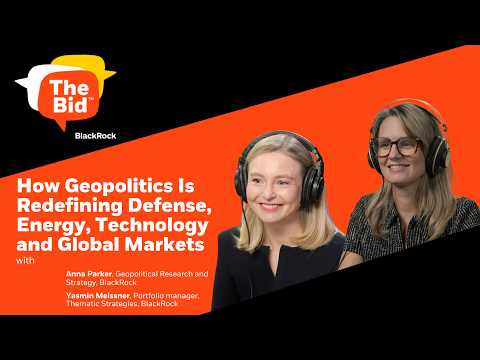
How Geopolitics is Redefining Defense, Energy and Technology Investing | The Bid investing podcast
 BlackRock The Bid
· · 27 min · Hosts: Oscar Pulido · Guests: Anna Parker, Yasmin Meissner
Summary
Geopolitical competition is pushing the global economy toward what the guests call a “resilience economy,” with energy security, defense spending and AI infrastructure becoming linked investment themes. The host and the guests argue that investors should look past headline volatility and focus on how countries are rewiring supply chains, budgets and technology stacks to reduce strategic dependence.
On energy, the guests say the Iran war showed how vulnerable chokepoints can be, but also how much resilience already exists in the system. They point to bypass routes around the Strait of Hormuz, coordinated strategic stockpile releases and China’s reduced imports as reasons oil markets did not spiral as many feared. At the same time, they argue the next phase is more investment in routes, storage and energy-source diversification.
On defense and technology, the guests say the story is shifting from hardware to software, drones and space-based capabilities. They also argue that AI is a geopolitical as well as commercial race: the US and China are competing for advantage, but the supply chain remains globally interdependent. For investors, the key question is where the choke points are, how governments respond, and whether portfolios should seek exposure across equities, credit and private markets.
Key takeaways
- The guests frame defense, energy and AI as linked pillars of a “resilience economy,” not separate themes.
- Anna Parker says the recent Iran conflict revealed both energy-system vulnerability and surprising resilience, especially around the Strait of Hormuz.
- Yasmin Meissner says NATO allies are moving toward around 5% of GDP for defense spend by 2035, signaling durable demand.
- Anna Parker says AI infrastructure is a global supply-chain story, with no country fully able to build the stack on its own.
- Yasmin Meissner says rare earths, semiconductors and energy infrastructure are the most important strategic choke points to watch.
Notable quotes
“What I think actually is the most important theme here is around the way that the global economy is re-wiring to focus more on resilience”
“this is the largest capex cycle that we've seen in history”
“the three are linked to each other. So AI needs power”
“technology competition really runs the gamut of the full stack, including the race to kind of secure the inputs needed”
“what we've learned so far. And I think it's been remarkable to see how resilient the global energy market has actually been amidst record disruption”
How the episode opens
Geopolitical tensions are increasingly reshaping the global economy. Defense spending is rising, energy security has moved back up the policy agenda, and competition over artificial intelligence and critical technologies is becoming an important part of national security. At the same time, conflicts and supply chain disruptions
Are exposing just how interconnected, and in some cases vulnerable, the global system has become. So, what does this changing geopolitical landscape mean for markets and investors? Welcome to The Bid, where we break down what's happening in the markets and explore the forces changing the economy and finance.
I'm Oscar Pulido. Today, I'm joined by Anna Parker, part of the geopolitical research and strategy team at BlackRock, and Yasmin Meissner, portfolio manager for thematic strategies at BlackRock. Together, we'll look beyond the geopolitical headlines and explore how a greater focus on national security and resilience is reshaping defense, energy, and technology.
We'll discuss what these shifts could mean for markets, how the defense landscape is evolving, and the strategic vulnerabilities and choke points investors should be watching. Anna and Yasmin, thank you so much for joining us on The Bid.
Thank you so much for having us, Oscar. It's amazing to be here. — Thanks for having us. Looking forward to a good discussion.
Well, it's great to have you both on. We're going to talk about geopolitics, and it's worth remembering that the BlackRock Investment Institute a couple of years ago talked about a number of different megaforces. One of those was geopolitical fragmentation, and a megaforce really is meant to describe a structural theme that we think is going to be present in markets for many years to come.
So, it's fair to say that there's a lot of noise going on right now with respect to geopolitics, and Anna, if I could start with you, when you step back from the headlines, what's the bigger story that investors should focus on?
From the episode’s captions: roughly the first two minutes, lightly cleaned. Keep watching on YouTube →
Topics
- geopolitics
- defense spending
- energy security
- ai competition
- supply chain resilience
Companies and tickers mentioned
- BLK
- BlackRock
- Anduril
- Epirus
- PwC
Watch the episode
Summary, takeaways and quote selection by Octagon. Quotes are short excerpts; the full conversation is in the episode.
More from BlackRock The Bid

BlackRock The Bid, this episode and its artwork belong to BlackRock. Octagon is not affiliated with the show; this page is an independent summary.
