
Episode summary
Democrats’ Immigration Unity Tested in Homeland Funding Fight
 Bloomberg Surveillance
· · 7 min · Guests: Wendy Schiller
Summary
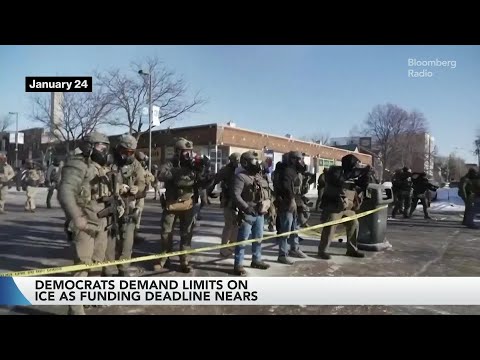
Wendy Schiller argued that the Homeland Security fight is less about abstract budgeting than about whether Americans accept aggressive domestic immigration enforcement as normal. She said the Trump administration’s tactics, including ICE operations and visible street enforcement, are rattling independents and some Republicans because they feel closer to a police-state model than to traditional American law and order. Schiller framed the issue as a policy fight heading into the midterms, not just a referendum on Trump’s personality.
She said the White House is struggling between hard-line figures and more moderate voices, with President Trump now recognizing the policy could cost Republicans the House and Senate. Schiller also pointed to Senator Susan Collins as a crucial internal GOP player, arguing that as appropriations chair she can pressure the president by tying ICE policy to Republican Senate control and her own reelection in Maine.
On the substance of the funding fight, Schiller said Democrats have not yet secured clear limits on warrants, stops, or detention policy, but they did win restored and increased funding for research, science, and health, while reducing the administration’s ability to cut that spending.
Key takeaways
- Schiller said ICE-style street enforcement is politically toxic for many Americans because it feels closer to a surveillance state than to ordinary policing.
- She argued President Trump now sees that his immigration posture could cost Republicans both chambers of Congress.
- Schiller said Senator Susan Collins can use her role as Appropriations chair to pressure the White House on ICE policy and Senate control.
- Democrats still have unresolved concerns about warrants, detentions, and new detention centers, even after securing more funding for research, science, and health.
- Schiller estimated Trump’s durable base at 34% of the country, which she said is not enough to win national elections.
Notable quotes
“I don't think across the country we become China. But I think if you're living in cities where you used to walk down the street”
“That is not the kind of country America wants to live in. 63% of America says we don't want this”
“I think the president has 34% of this country. Period. They have been loyal since he first ran in 2016”
“they did get they got all the funding for research for science and health restored and increased”
How the episode opens
Well, I mean, Tom, you're right to sort of point out things also like the Coast Guard when it I mean, basically the whole idea is sort of internal security against external forces. That's really what I was I saw. I see.
And I'm doing it what Homeland Security was supposed to do. And and the justification for homeland security was communication, that there were people who thought that the 2001 tragedy was a failure of communication across independent agencies that didn't talk to each other. And so if you were in the same Cabinet department led by a single secretary, you're going to talk to each other and you'll be better coordinated.
And that would make the country safer. That was the rationale. And so this is what it was always supposed to be, internal security, but against external forces.
So the question is, do you think people have been living here for ten years or 15 years are the external enemy? And that's what the demonstration is arguing. My oldest cash flow.
I'm in Shanghai having a beverage of my choice at a peace hotel with cash flow. And and Wendy, he's explaining to me the police state of China like the three or four levels of police officers on the streets of Shanghai or wherever, have we become China with our domestic enforcement? I don't think across the country we become China.
But I think if you're living in cities where you used to walk down the street and they were police officers that you knew your local town or your county and maybe a state, as we call them in Rhode Island, on the highway, you accepted that. That's part of what you expected. You don't expect mass people with machine guns on the street that can stop you and ask you who you are.
From the episode’s captions: roughly the first two minutes, lightly cleaned. Keep watching on YouTube →
Topics
- homeland security funding
- immigration enforcement
- ice operations
- congressional democrats unity
- ice body cameras and warrants
Watch the episode
Watch “Democrats’ Immigration Unity Tested in Homeland Funding Fight” on YouTube
Summary, takeaways and quote selection by Octagon. Quotes are short excerpts; the full conversation is in the episode.
More from Bloomberg Surveillance
-
 Stocks Rise as Inflation Data Ease Fed-Hike Worry | Bloomberg Surveillance
-
 Bloomberg Surveillance TV: November 13th, 2026 | Bloomberg Surveillance
-
 Bloomberg Surveillance TV: November 12th, 2026 | Bloomberg Surveillance
-
 Jensen Huang Ousted by Nvidia Board as CEO | Bloomberg Surveillance
-
 Bloomberg Surveillance TV: November 11th, 2026 | Bloomberg Surveillance
-
 AI Stocks Rebound as Fed Hike Bets Return | Bloomberg Surveillance
Bloomberg Surveillance, this episode and its artwork belong to Bloomberg. Octagon is not affiliated with the show; this page is an independent summary.
