
Episode summary
Trump Threat to Sue BBC Over Speech Edit Faces High Hurdles
 Bloomberg Surveillance
· · 13 min · Guests: Howard Stringer, Gregory Germain, Lyrissa Lidsky
Summary
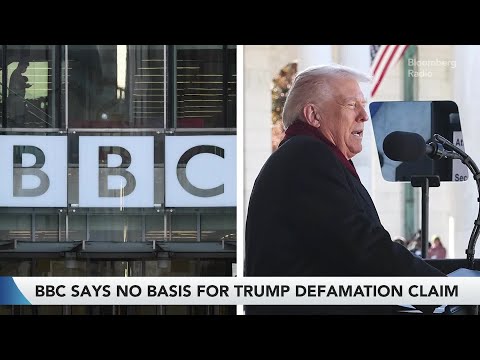
The guest argues that the BBC’s central problem is not one edit or one controversy, but the erosion of trust in a major public institution. He says leadership changes, board decisions, and a clearer commitment to fairness are the first steps to rebuilding confidence, and he rejects the idea that the BBC is institutionally broken. He also frames the dispute with President Trump as a warning shot: the president may want the BBC to be fairer, but the legal and financial fight may be more about sending a message than collecting damages.
The guest says the lawsuit faces serious hurdles, including the difficulty of proving actual malice and the broader challenge of attacking a news organization that has long been seen as globally trusted. He argues that the BBC remains important to British democracy and to the United States, even if recent mistakes created the impression that its news operation had a deeper problem.
The conversation widens into a broader media critique. The guest says television audiences have fragmented, the old network era is gone, and social media has made truth harder to discern. Even so, he says strong institutions can still survive by concentrating on trust, honesty, and good content.
Key takeaways
- The guest says the BBC can recover, but only if leadership acts quickly and restores trust in the news operation.
- He argues President Trump’s threatened lawsuit is mainly a signal to the BBC to be fair, not necessarily a serious path to a large payout.
- The guest says the BBC will struggle to sue or be sued on easy terms because the actual malice standard is a very tough barrier for public figures.
- He says media audiences are now fragmented, making it harder for any one anchor or network to dominate as CBS once did.
- He believes trust and honesty remain the key competitive advantages for legacy media companies in a streaming-heavy world.
Notable quotes
“with all great institutions, leadership is critical. And presumably there will be discussions about who runs the BBC now very quickly”
“I think the BBC knows what its responsibilities are. However, do you believe that the damage is being sought by President Trump are reasonable”
“I think retaining some of the values and the values that are most important are trust and honesty”
“the networks aren't as strong as they used to be”
How the episode opens
I would say the brilliance of the BBC. It was designed as an institution that would be fairer and offer truth and fairness. To a British audience and subsequently to a worldwide audience with the worldwide news network.
And in many ways, American television was built on that standard. And so giving that trust up, giving that opportunity up, I think, would be a mistake. How do they restructure emotionally?
How do they recapture the minds of the United Kingdom to say, you can trust us? It's been shattered with this debate with the president, the president, President Trump, folks suggesting he'll sue the BBC for many billions of dollars. Howard Stringer, what is the first step to rekindle a new trust with the British?
Well, I think with all great institutions, leadership is critical. And presumably there will be discussions about who runs the BBC now very quickly and how the board is constructed and the lessons will be learned. I think that's been true across the board.
When I was at CBS News, we were under attack by the government. I had conversations. In a lawsuit with General Westmoreland.
And before that, I had conversations with Presidents Nixon and Reagan. But News Division's news division is only a part of the BBC. But news divisions are always the threat to politicians, and politicians tend to dislike you if you suggest they're wrong.
And so the BBC has always been. Had a reputation for fairness. Now it's under attack now.
And I think I think lessons will be learned regardless of what we feel about it. But the BBC is very important to global democracy. And I think President Trump knows that.
Howard Stringer with his Sir Howard Stringer folks this morning here with all of his work with Sony and CBS News over the years.
From the episode’s captions: roughly the first two minutes, lightly cleaned. Keep watching on YouTube →
Topics
- trump defamation lawsuit
- bbc streaming geo-blocking
- actual malice standard
- free speech court jurisdiction
- media resignations
Companies and tickers mentioned
- SONY
- NYT
- BBC
- Sony
- The New York Times
Watch the episode
Watch “Trump Threat to Sue BBC Over Speech Edit Faces High Hurdles” on YouTube
Summary, takeaways and quote selection by Octagon. Quotes are short excerpts; the full conversation is in the episode.
More from Bloomberg Surveillance
-
 Stocks Rise as Inflation Data Ease Fed-Hike Worry | Bloomberg Surveillance
-
 Bloomberg Surveillance TV: November 13th, 2026 | Bloomberg Surveillance
-
 Bloomberg Surveillance TV: November 12th, 2026 | Bloomberg Surveillance
-
 Jensen Huang Ousted by Nvidia Board as CEO | Bloomberg Surveillance
-
 Bloomberg Surveillance TV: November 11th, 2026 | Bloomberg Surveillance
-
 AI Stocks Rebound as Fed Hike Bets Return | Bloomberg Surveillance
Bloomberg Surveillance, this episode and its artwork belong to Bloomberg. Octagon is not affiliated with the show; this page is an independent summary.
