
Episode summary
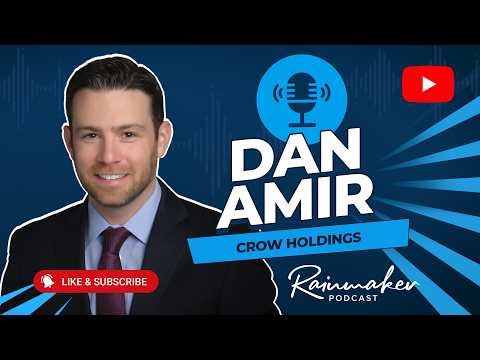
Dan Amir: Inside Crow Holdings' Wealth Distribution Playbook
 Dakota Rainmaker Podcast
· · Hosts: Gui Costin · Guests: Dan Amir
Summary
Dan Amir describes how Crow Holdings built a dedicated wealth-distribution effort on top of a business that was originally institutional-first. Crow Holdings Capital began with foundations, endowments, pensions, and sovereign wealth, but Dan argues that over the last six years the growth in private real estate partnerships has shifted toward the individual wealth community, making that channel increasingly important to the firm.
He explains that his team is organized geographically rather than by channel, because RIAs, wirehouses, and private banks often overlap in practice. The team includes people with different backgrounds, including RIA-focused distribution experience, wirehouse experience, and a less linear path, with the goal of bringing multiple perspectives to the same market. Dan says the group runs on a disciplined cadence: annual business plans, weekly team meetings, quarterly reviews against goals, and CRM-driven reporting to leadership.
The conversation also turns to leadership and execution. Dan emphasizes trust, accountability, and hiring people with different strengths, while still giving them clear tools and expectations. He argues that fundraising in private real estate is difficult right now, so the right approach is to build durable relationships rather than pressure people into transactions. He also sees AI and CRM workflow as force multipliers, but only if the underlying data is clean and the human user stays in the loop.
Key takeaways
- Dan Amir says Crow Holdings’ private real estate growth is now increasingly tied to the individual wealth channel, even though the firm started in institutions.
- He leads a four-person team going to five, structured geographically so one coverage person can handle RIAs, wirehouses, and private banks in the same market.
- Dan says weekly meetings, quarterly reviews, and CRM reporting are central to measuring progress against the annual business plan.
- He argues that leadership means trusting professionals to do the job, holding them accountable consistently, and hiring for different backgrounds and perspectives.
- Dan says difficult fundraising markets are best handled by building durable relationships, not by pressuring salespeople into transactional behavior.
Notable quotes
“for us at the stage that we are at um it really hasn't made sense to quote unquote channelize”
“You want to make sure your progress is known, but you also you don't want to communicate overcommunicate with so much detail that you know the punchline gets buried”
“It is incredibly important. our CRM. Uh, of course it helps us track our activity. It helps us, you know, measure our progress against goals”
How the episode opens
Welcome to the Rain Maker podcast with your host Geek Cen. The goal of this podcast is to give listeners a unique look into sales strategies from top industry executives. We introduce you to the heads of sales and heads of distribution who will help you understand the inner workings of the successful sales organizations from philosophy to execution.
This podcast is essential for sales professionals seeking wisdom from the best in the field. If you're not familiar with Dakota and their Dakota rain maker content, please check out dakota.com to learn more about their services.
This episode is brought to you by Dakota Marketplace. Are you tired of constantly jumping between multiple databases and channels to find the right investment opportunities? Introducing Dakota Marketplace, the comprehensive institutional and intermediary database built by fundraisers for fundraisers.
With Dakota Marketplace, you'll have access to all channels and asset classes in one place, saving you time and streamlining your fundraising process. Say goodbye to the frustration of searching through multiple databases, websites, form ADVs, and say hello to a seamless and efficient fundraising experience. Sign up now and see the difference Dakota Marketplace can make for you.
Visit dakota.comdotenarketplace today. What is up everybody? It's Geek Cen, founder of Dakota.
Welcome to the latest episode of the Rain Maker podcast. I'm so excited to be joined by Dan Amir who's managing director investor coverage Crow Holdings. Dan, welcome.
Thank you. Good to be here. — Dan Amir is a managing director in the investor coverage group of Crow Holdings Capital. Since joining the firm in 2017, Dan has helped drive a broad range of business development initiatives and currently leads the firm's effort to build relationships with high- netw worth investment platforms and individual advisory platforms. Prior to joining Crow, Dan was a vice president at Morgan Stanley Investment Management, where he focused on fundraising efforts for private real estate infrastructure funds.
From the episode’s captions: roughly the first two minutes, lightly cleaned. Keep watching on YouTube →
Topics
- wealth distribution teams
- private real estate fundraising
- institutional rigor in wealth channel
- crm and ai for sales activity
- sales leadership and culture
Companies and tickers mentioned
- Crow Holdings
- BNY Mellon
- Morgan Stanley
- Salesforce
- Claude
Watch the episode
Watch “Dan Amir: Inside Crow Holdings' Wealth Distribution Playbook” on YouTube
Summary, takeaways and quote selection by Octagon. Quotes are short excerpts; the full conversation is in the episode.
More from Dakota Rainmaker Podcast
-
 Fix the Data First: Why AI Strategy Starts With Your Data Foundation, with Taylor Lowe of Metal
-
 The Lowest Standard You Accept Defines Your Culture: Jonathan Kingery, DoubleLine
-
 Check Your Title at the Door: Lori McEvoy on Building a Winning Distribution Team
-
 The Art of Subtraction: Sales Leadership Lessons from Wellington’s Chip Saltz
-
 Culture Is the Strategy: Christina Adamson of Ares Wealth Management Solutions
-
 If It's Not in Salesforce, It Didn't Happen Michael O'Shea on Sales Discipline at Origin Investments
Dakota Rainmaker Podcast, this episode and its artwork belong to Dakota Team. Octagon is not affiliated with the show; this page is an independent summary.
