
Episode summary
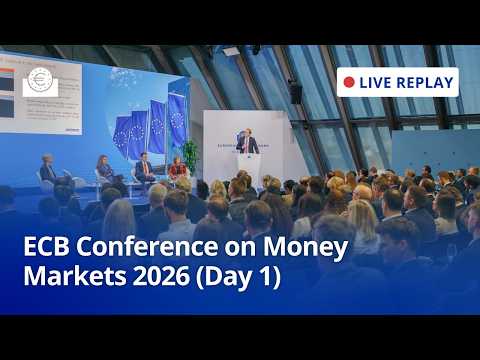
Live - ECB Conference on Money Markets 2026 (Day 1)
Summary
The opening of the ECB money markets conference framed money markets as no longer “deep plumbing” but a central policy issue again, as operational frameworks are being revised and non-banks, stablecoins, and tokenization reshape liquidity. Isabel Schnabel used her final ECB Executive Board speech to set out four lessons from the past seven years: policy needs flexibility, shocks should be judged by their inflation effects rather than their labels, monetary dominance depends on sound fiscal and regulatory frameworks, and implementation should use the smallest balance sheet necessary.
The first paper argued that preferred-habitat effects can show up even in ultra-short repo maturities, not just in long bonds. By exploiting the move from T+3 to T+2 bond settlement in 2014, the speaker said some dealers shifted from spot-next to tomorrow-next repo to source collateral in time for delivery, pushing the affected special repo rate up by about 5 to 7 basis points. The claim was that collateral scarcity and market fragmentation limit arbitrage, and that these repo distortions can feed through to deposit, mortgage, and corporate lending rates.
Stefania D’Amico praised the identification but urged extra checks around specialness volatility and country-specific effects, noting that the paper’s mechanism may mix maturity preference with collateral preference and settlement frictions. A question from the audience turned to the coming T+1 move, and the speaker said the direction of any rate impact would depend on whether leveragers or short sellers dominate on the day.
Key takeaways
- Isabel Schnabel argued the ECB must preserve policy flexibility because the post-pandemic world is more volatile and model uncertainty is higher.
- Schnabel said the ECB should respond to shocks based on their effect on the inflation path, not on whether they are demand or supply shocks.
- The keynote warned that rising public debt and the growth of non-bank finance can threaten monetary dominance and complicate transmission.
- The first paper claimed the 2014 switch from T+3 to T+2 settlement moved special repo demand from spot-next to tomorrow-next and lifted the affected rate by 5 to 7 basis points.
- The speaker said collateral scarcity, not duration risk, is what prevents arbitrage from fully eliminating the repo kink.
- Stefania D’Amico said the paper is strong but suggested more robustness on specialness volatility and country-risk changes around the reform.
Notable quotes
“Today the question at the root of our first workshop, how operational frameworks behave is back at the top of the policy agenda”
“The lesson is therefore that we should expect the unexpected and avoid becoming too attached to a particular view of the world or to a particular class of models”
“The first takeaway is that central banks should prioritize instruments that allow them to adjust monetary policy quickly as conditions change”
“I will argue that this dynamic distorts both the term structure of interest rates and the pass through of monetary policy”
“the treated repo maturity increased by five to seven basis points relative to the repo yield curve”
How the episode opens
Good morning everyone. I'm Eman Raman Rouso, director general of market operations at the ECB and I'm your host for this conference. It's a real pleasure to welcome you to the 2026 ECB conference on money markets here in Frankfurt and online.
It's wonderful as well to see so many familiar faces. Many of you have been loyal to the conference over the years and I'd like to thank you. This conference has come a long way.
Let me take a moment to look at where we started and where we are today. The journey began 19 years ago in 2007 as a small workshop with mostly Euro system colleagues on a rather niche topic. Why Aonia at the time the ECB overnight benchmark rate traded a few basis points above the MRO our um rate for main refinancing operations.
A few basis points. Back then, uh, money markets were seen as the deep plumbing of the financial system, essential but mostly invisible and left to the specialists. And during the following decade, liquidity became so abandoned with central banks expanding their balance sheets uh with QE that money markets seemed to matter even less.
That has changed and has changed fast. Today the question at the root of our first workshop, how operational frameworks behave is back at the top of the policy agenda. Operational frameworks are being revamped and money markets are again at the heart of monetary policy implementation.
Non-banks have become key players reshaping market structure and stable coins as well as tokenization are starting to change how liquidity moves and how fast it moves. This conference has grown with its subject. Today it's fully booked and streamed live.
Its keynote speakers come from the very top of central banking markets and academia. And this year we received a record 150 academic paper submissions.
From the episode’s captions: roughly the first two minutes, lightly cleaned. Keep watching on YouTube →
Topics
- money market functioning
- monetary policy transmission
- european repo market
- central bank balance sheets
- hedge funds and treasury repo markets
Watch the episode
Watch “Live - ECB Conference on Money Markets 2026 (Day 1)” on YouTube
Summary, takeaways and quote selection by Octagon. Quotes are short excerpts; the full conversation is in the episode.
More from ECB


ECB, this episode and its artwork belong to their owners. Octagon is not affiliated with the show; this page is an independent summary.
