
Episode summary
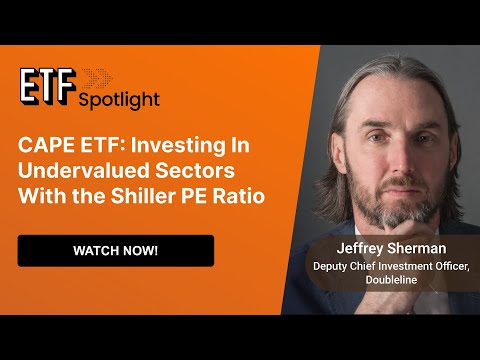
CAPE ETF: Investing In Undervalued Sectors With the Shiller PE Ratio
 ETF Spotlight
· · Hosts: Jeffrey Sherman
Summary
Jeffrey Sherman says the CAPE ETF is a sector-rotation strategy built to find value in the S&P 500 at the sector level rather than the stock level. The fund uses Robert Shiller and John Campbell’s CAPE ratio, comparing each sector’s current valuation to its own history and then focusing on the cheapest sectors.
Sherman argues that the key refinement is to avoid value traps. After ranking the 11 S&P 500 sectors by relative CAPE, the ETF keeps the cheapest five, drops the one with the weakest one-year total return, and equally weights the remaining four sectors. He says the portfolio is still large-cap and tied to the S&P 500, but it is designed to be a different way to express value exposure.
He also addresses the fund’s use of ACTIVESHARES and VIIV, saying the holdings are not fully public but the structure has still supported tight trading. In portfolio use, Sherman says investors often use CAPE to supplement large-cap value exposure and diversify away from the concentration risk in the S&P 500, especially as technology has become a much larger share of the index.
Key takeaways
- Sherman says CAPE is a sector-level value strategy, not a stock-picking value fund.
- The ETF ranks all 11 S&P 500 sectors by relative CAPE, keeps the cheapest five, then drops the weakest momentum name.
- The final portfolio holds four equally weighted sectors, while still maintaining large-cap market exposure.
- Sherman says investors use CAPE to complement large-cap value allocations and reduce concentration risk in the S&P 500.
- He says the CAPE approach has done better than the S&P 500 year to date and has tracked well over time.
Notable quotes
“the CAPE ETF focuses on identifying value within various sectors of the market”
“you take the 11 sectors of the S&P, you calculate this relative CAPE ratio, you rank them the cheapest five”
“whichever one has the worst one-year total return, you get rid of that and you're left with four sectors”
“we think that CAPE is part of that overall suite for overall allocation”
“what you find is you're looking at different ways to diversify”
How the episode opens
Past performance is no guarantee of future results. Content is offered for information purposes only. Unless stated otherwise, any and all individuals participating in the video are third parties that include both professional investors and individual investors who may not be licensed or certified by any institute or regulatory body.
Unless stated otherwise, the views or opinions expressed may not reflect those of Seeking Alpha as a whole. The accuracy and completeness of content shared cannot be guaranteed. Seeking Alpha does not take account of your objectives or financial situation, and does not offer any personalized investment advice.
Seeking Alpha is not a licensed securities dealer, broker, US investment adviser, or investment bank. Hey, everyone, Daniel Snyder from Seeking Alpha. Welcome back to another episode of ETF Spotlight.
Today, we have a true pleasure to speak with Jeffrey Sherman. He is the Deputy Chief Investment Officer at DoubleLine. We're talking about the CAPE ETF, C-A-P-E, today.
So, let's go ahead and dive on in with Jeffrey. Jeffrey, thank you for joining us on the show. Yeah.
Good morning, Daniel. Thanks for having me. So, let's start at the beginning.
The CAPE ETF. How did this thing come to fruition? And what should investors just know about it from a high-level perspective?
Yeah, I think the most simplest way to think about it is that it's a sector rotation product that focuses on assessing value within the sectors of the S&P 500. So, where a lot of traditional value products or value managers, or even value strategies, focus on building up value from the security selection basis, the CAPE ETF focuses on identifying value within various sectors of the market. And it does so by using the CAPE ratio that Professor Shiller invented along with his grad student, John Campbell, back in the seminal piece they wrote back in 1988.
From the episode’s captions: roughly the first two minutes, lightly cleaned. Keep watching on YouTube →
Topics
- cape etf
- shiller pe ratio
- value investing
- s&p 500 sectors
- long-term valuation
Companies and tickers mentioned
- Doubleline
Watch the episode
Watch “CAPE ETF: Investing In Undervalued Sectors With the Shiller PE Ratio” on YouTube
Summary, takeaways and quote selection by Octagon. Quotes are short excerpts; the full conversation is in the episode.
More from ETF Spotlight
-
 CGDV Fund: Misleading Name, Exceptional Performance
-
 Extreme Tech Sentiment: Put Buying Spike Points to XLK Rally
-
 BIZD vs PBDC ETF: High-Yield Income from Top BDCs
-
 The Alpha Analyst: STCE ETF: AI-Driven Strategy For Crypto And Fintech Exposure
-
 Harrison Schwartz: Why PPLT Is My Top Platinum ETF Pick Through 2030
-
 Covered Call ETFs vs. Dividend Growth: Gary Gambino Explains DGRO and DIVO
ETF Spotlight, this episode and its artwork belong to Zacks Investment Research. Octagon is not affiliated with the show; this page is an independent summary.
