
Episode summary
WTF Just Happened To Global Markets
 Eurodollar University
· · Hosts: George Gam, Jeff Snider
Summary
The episode argues that the day’s selloff is bigger than an AI-stock correction: equities are dropping, but Treasury bonds are rallying at the same time, which the host treats as the more important signal. The Nasdaq fell more than 5%, the S&P 500 dropped 4%, and heavily owned AI names like Nvidia, Oracle, AMD, and Micron were hit hard, but the host says the move is now broadening into industrials, banks, and consumer names as investors reassess the economy itself.
The immediate catalyst was political: after election results raised the odds of tougher regulation and even talk of a national data-center moratorium, markets began pricing more resistance to AI infrastructure buildout. But the host argues that the real problem had been building for months. Data centers require huge amounts of electricity, water, land, transmission, and financing, while the biggest players and the weaker neocloud lenders alike are already straining under massive capex, circular financing, and rising credit protection costs.
Bonds, in the host’s view, are pricing something wider than an AI bust: energy-driven demand destruction, weaker real growth, and less room for the Fed to keep hiking. Lower Treasury yields, a falling probability of another December rate hike, and stress in Chinese AI stocks all reinforce the same message. The market is no longer just asking whether AI valuations are too high; it is asking what the broader economy looks like if the expected AI boom fails to materialize.
Key takeaways
- The host says the bigger signal is in bonds: Treasury yields are falling even as stocks sell off, implying a weaker growth and inflation outlook.
- The host argues political resistance to data centers is only the latest pressure on an AI buildout that already depended on cheap financing, rapid power expansion, and perfect demand.
- The host says even profitable giants like Amazon, Alphabet, and Microsoft are being forced into unusually aggressive AI capex and financing structures.
- The host links the selloff to a broader energy shock, saying higher utility and fuel costs can destroy demand rather than create a lasting inflation spiral.
- The host points to China’s AI unwind as a warning that once valuations depend on endless growth, the reversal can be severe.
- The host says the Fed’s room to hike again is shrinking as markets price more economic damage and less tolerance for higher rates.
Notable quotes
“Everybody thinks this is about AI stocks, but now we've got the bond market that's actually in rally mode on top of everything else”
“We're seeing a bond market rally develop. The 2-year yield has fallen to a recent low near 4.48%”
“Too much had to go perfectly to support current stock prices and valuations”
“The industry was already consuming extraordinary amounts of cash. Financing structures were becoming increasingly circular”
“The bubble hasn't burst yet. Not fully. Not in the United States at least”
How the episode opens
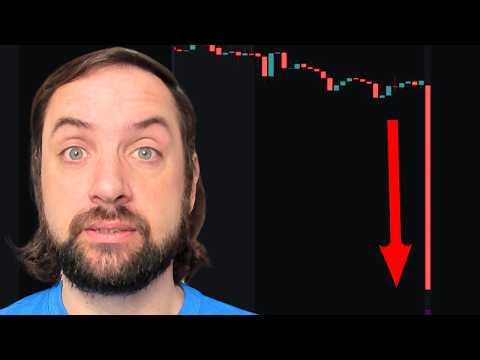
Everybody thinks this is about AI stocks, but now we've got the bond market that's actually in rally mode on top of everything else. But the stock market, that's got today's attention. The Nasdaq just plunged more than 5%, falling into correction territory.
The S&P 500 dropped 4% heading for its worst day since April 2025. The Dow lost more than 1650 points as of this recording, erasing almost its entire post-election rally in a single session. Again, the epicenter seems to be artificial intelligence.
Broadcom and Nvidia fell approximately 9%. Oracle dropped 8%. AMD and Micron lost around 15% each.
These are just one day totals. Semiconductor ETF fell roughly 11% putting on track for the worst day since the CO outbreak in March of 2020. But this is no longer just a technology sell-off, at least today.
Caterpillar fell 5%, JP Morgan dropped 4%, Boeing lost 4%, Nike declined 3%. But at the same time, maybe more importantly, Treasury bonds are rallying. Not just a fluctuation.
We're seeing a bond market rally develop. The 2-year yield has fallen to a recent low near 4.48% down almost half a percentage point in 5 weeks. The 10 years around 483, heading toward 480, roughly 50 basis points below its recent high.
September's technical effects are gone, just as I told you they would be, and the market is increasingly free to price the fundamentals. and the fundamentals are becoming more concerning. So, the immediate explanation for today's stock crash is that the midterm election results may make data centers harder to build.
Investors are worried about more regulation, environmental restrictions, and even proposals for a national moratorum. But that is only the approximate cause. It is one more concern, perhaps one too many concerns, piled on top of anxieties that have been building for months.
From the episode’s captions: roughly the first two minutes, lightly cleaned. Keep watching on YouTube →
Topics
- global markets
- bond selloff
- stock market correction
- ai-driven selloff
- gold yield
Companies and tickers mentioned
- Monetary Metals
- Bravais Social
Watch the episode
Watch “WTF Just Happened To Global Markets” on YouTube
Summary, takeaways and quote selection by Octagon. Quotes are short excerpts; the full conversation is in the episode.
More from Eurodollar University
-
 Commodity Markets Are Preparing for Something
-
 Baby Food Prices Just Revealed a Dark Truth About the U.S. Economy
-
 You Won’t Believe What the Bond Market Just Did
-
 IKEA Just Sent a TERRIFYING Warning About Consumer Spending
-
 WTF Is Happening to Gold, Silver and Gas?
-
 The US Consumer Is Just Broke (Here's the Proof)
Eurodollar University, this episode and its artwork belong to Jeff Snider. Octagon is not affiliated with the show; this page is an independent summary.
