
Episode summary
We Asked a Macro Trader Why War and Oil Haven’t Broken This Market
 Excess Returns
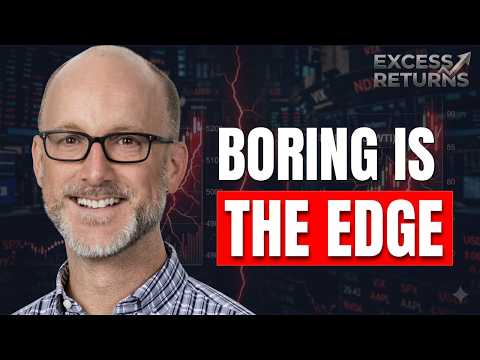
· · Guests: Brent Donnelly
Summary
Brent Donnelly argues that the market is being driven less by classic fundamentals than by policy shocks, positioning, and the way those shocks change the reaction function. His base case is that stocks need a steady stream of bad news to fall, while they can rise with little more than stability. That makes mean reversion, sentiment, and reassessment triggers more useful than blanket contrarianism in this regime.
He is constructive on equities as long as the S&P 500 holds the 200-day moving average and the news flow stops worsening. He sees the current tape as resembling prior V-shaped bottoms after policy shocks, with Mag 7 earnings still the key variable because those companies are so large a share of the index. Oil shocks, in his view, are a real risk to watch, but not automatically fatal for stocks unless they start to damage growth or earnings.
On rates, Brent says central banks can react differently to oil, but he is wary of trades built on the idea that too much is already priced in. In FX, he thinks the dollar is mostly cyclical and heavily dependent on positioning going into a crisis. He is bullish gold as a debasement hedge now that retail excess in silver has cooled, while bonds still matter primarily as a recession hedge.
Key takeaways
- Brent Donnelly says stocks need “a steady stream of bad news” to fall, but can climb if conditions simply stop getting worse.
- He would turn more bullish or bearish on equities based on the S&P 500’s 200-day moving average and other reassessment triggers, not on headlines alone.
- He thinks the Mag 7 remain the market’s main earnings risk because they make up such a large share of index capitalization.
- Brent says the dollar’s crisis behavior is mostly determined by positioning, citing one episode where it fell 10% in a month and another where it rallied 4%.
- He is bullish gold as a structural debasement trade, but more neutral on silver because retail enthusiasm has already become crowded.
- He still sees bonds as a useful recession hedge even though correlations broke down in inflationary periods like 2018 and 2022.
Notable quotes
“stocks need a steady stream of bad news to go down and they just need nothing for for them to go up”
“A way to lose a lot of money generally is to just be contrarian all the time and to just trade positioning all the time”
“I think your base case has to always be that the US economy is unbelievably resilient”
“if you can think about whatever asset class you're trading and think about like, okay, what are the headlines that would really change market pricing or market perception here”
“the best predictor of success is rationality and the best predictor of failure is overconfidence”
How the episode opens
The fundamental thing I think that I just always have in my head is that stocks need a steady stream of bad news to go down and they just need nothing for for them to go up. A way to lose a lot of money generally is to just be contrarian all the time and to just trade positioning all the time cuz you miss every structural trend and every like meaningful trend in the market is generally accompanied by significant positioning for a really long time. But if you're getting just these rolling shocks, then positioning and sentiment and mean reversion become a lot more useful because by definition, a shock is not permanent.
The more worries there are, the you know, the more the S&P 500 is going to climb the wall of worry. And I mean, honestly, that has to be the base case all the time. And then you try to know when you see it when like this credit stuff bleeds through or like the top of the K stops spending.
You're watching Excess Returns, the channel that makes complex investing ideas simple enough to actually use or better questions lead to better decisions. is our guest today. When people say they want to look at markets through the beady little eyes of an expert, they're only talking about one man.
Spectra Markets, author of Alpha Trader, new edition out soon, so I hear. And publisher of the AMFX. It's my favorite BD, which is to say nothing about his eyes.
Brent Donnelly, welcome back to Access Returns.
You You're actually not the first person to to say that. Um, but I'm so I'm not insulted at this point. I guess it's just true. — It's just true. your beady little eyes. Is that — Yeah, they're not getting uh any less beady as I get older.
From the episode’s captions: roughly the first two minutes, lightly cleaned. Keep watching on YouTube →
Topics
- policy shocks
- market volatility
- positioning vs fundamentals
- regime shifts
- gold and bitcoin flows
Companies and tickers mentioned
- Spectra Markets
Watch the episode
Watch “We Asked a Macro Trader Why War and Oil Haven’t Broken This Market” on YouTube
Summary, takeaways and quote selection by Octagon. Quotes are short excerpts; the full conversation is in the episode.
More from Excess Returns
-
 An AI Bubble Could Hit Stocks. Inflation Could Hit Bonds. How Do You Diversify and Keep Both?
-
 Tech Is Priced for a Boom. 86% of the Economy Grew 0.7%. What If AI Slows?
-
 Tech Is the Cheapest Since 2022. Walmart Is 46 Times Earnings. Where Is the Bubble?
-
 This $1.5 Trillion Manager Expects More Fed Hikes. So Why Is He Still Bullish?
-
 AI Stocks Cracked. Margins Could Be Peaking. So Why Is a Liquidity Expert Watching the Debt Wall?
-
 The AI Trade Is Cracking | Peter Boockvar on What to Own Instead
Excess Returns, this episode and its artwork belong to Excess Returns. Octagon is not affiliated with the show; this page is an independent summary.
