
Episode summary
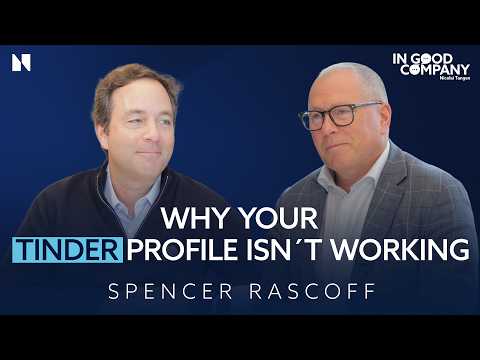
Match Group CEO: What Makes a Match on Tinder? | Podcast | In Good Company
 In Good Company
· · Hosts: Nicolai Tangen · Guests: Spencer Rascoff
Summary
Match Group’s core argument is that online dating is still early in its evolution, and that better personalization, richer profiles and more social product design can materially improve outcomes. Spencer Rascoff says the company’s recommendation system has been simplified into one unified ranking engine and will move to real-time feedback later in 2026, with the goal of improving matches, chats and “sparks.” He also says the best-performing profiles are the ones that show effort: multiple photos, detailed prompts, friends, hobbies and context, not just a gym selfie.
Rascoff frames Match Group as a response to a broader social problem: loneliness. He says online dating can widen the pool of potential partners, lower divorce risk by helping people learn more about themselves, and reduce social friction for Gen Z, who increasingly date in groups rather than one-on-one. He links that shift to COVID, social media and remote work, and says the company is building features like Double Date and in-app events to make meeting people feel safer and less like a job interview.
He also describes a turnaround at Match Group after taking over in February 2025: reset the roadmap, improve employee engagement, hire more Gen Z talent, and prioritize culture before monetization. Looking ahead, he expects Tinder to become more social and Hinge to remain the more intentional app, while AI becomes increasingly central to both operations and the dating experience.
Key takeaways
- Spencer Rascoff says Match Group has combined multiple ranking systems into one and expects real-time recommendations by the end of 2026.
- He argues the strongest profiles on Tinder and Hinge are rich, effortful and contextual, not photo-only or overly curated.
- Rascoff says loneliness is a “global health crisis,” and he believes online dating helps by broadening choice and strengthening social bonds.
- He says Gen Z has made dating more social and less formal, with friends-first meetups replacing many one-on-one dates.
- He says Match Group’s turnaround started with people and culture, including a reset roadmap and a 17-point rise in employee engagement.
- Rascoff expects Tinder to become a safer, more social first dating app, while Hinge remains the intentional dating app.
Notable quotes
“We have a recommendation algorithm the Rex Algo which tries to figure out who to show to whom”
“What we've recently done was we've done what we call Q unification where we've combined all of these decks into one”
“My most surprising finding was how much potential there still is 15 years later”
“There's no such thing as a loser. They're just somebody that hasn't met their their right person yet”
“I think it's tragic. It's it's a it's an existential risk to society, to our species”
How the episode opens
You don't want to date a loser, right? — Well, there's, you know, we believe there's someone for everyone, so I don't pass judgment. There's no such thing as a loser. — That's kind of your business model. — There's no such thing as a loser. They're just somebody that hasn't met their their right person yet.
That's that sounds that sounds really good.
Hi everyone, I'm Nicola Tangan, the CEO of the Norwegian Soan Wealth Fund. Today I'm joined by somebody really special, Spencer Roskov, the CEO of Match Group. That's the company behind Tinder, Hinge, and around a dozen of other dating apps.
Now, think about it for a second here. 40% of couples today meet online, not through friends, not at work. So, this is one of the biggest shifts in human behavior that we have ever seen.
And Spencer, he sits in the middle of it. a bit of an outsider. He built the property giant Zillow before taking over match a year and a half ago and we in the Norwegian southern wealth fund own 1% of match.
So we are cheering you on Spencer.
Thank you. I am glad that you are. I appreciate it and thank you for having me. — Now how are matches actually made?
We have a recommendation algorithm the Rex Algo which tries to figure out who to show to whom. The way I like to think about it is um there are decks of cards kind of on the table. Imagine 10 decks of cards on this table with 52 cards each.
The order of each deck has already been determined by us based on certain rules associated with each user type. Like there might be a deck that is optimized to show people in a particular order um to um uh keep to to keep them as a payer essentially to retain their you know their monetization.
From the episode’s captions: roughly the first two minutes, lightly cleaned. Keep watching on YouTube →
Topics
- dating app algorithms
- gen z dating trends
- loneliness
- ai in dating apps
- leadership and company building
Companies and tickers mentioned
- MTCH
- Match Group
- Tinder
- Hinge
Watch the episode
Watch “Match Group CEO: What Makes a Match on Tinder? | Podcast | In Good Company” on YouTube
Summary, takeaways and quote selection by Octagon. Quotes are short excerpts; the full conversation is in the episode.
More from In Good Company


In Good Company, this episode and its artwork belong to Norges Bank Investment Management. Octagon is not affiliated with the show; this page is an independent summary.
