
Episode summary
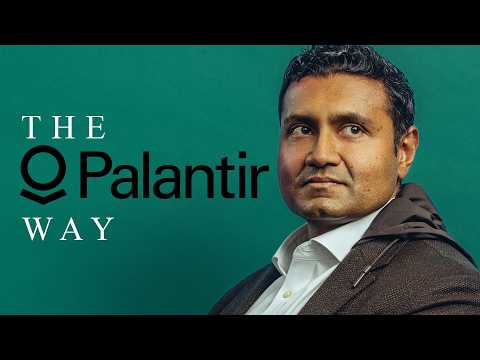
Why Great Builders are Heretics | Palantir CTO
 Invest Like the Best
· · 1 hr 29 min · Hosts: Patrick O'Shaughnessy · Guests: Shyam Sankar
Summary
Shyam Sankar argues that American progress comes from “heretics”: builders who defy bureaucracy, accept personal cost, and turn unlikely ideas into working systems. He uses figures like Hyman Rickover, Andrew Higgins, Billy Mitchell, and John Boyd to show a pattern in U.S. military history: the people who are punished at the time are often the ones who create the capabilities that later prove decisive.
He ties that worldview to Palantir’s culture, describing the company as an environment built to identify extreme talent, expose people to high-stakes responsibility, and let them discover both superpowers and kryptonite. In his telling, the best learning comes from “gamma ray” moments—work that is stressful, ambiguous, and consequential enough to force growth. Alex Karp is held up as the model for how to unlock talent without being threatened by other people’s success.
Sankar also explains Palantir’s forward deployed engineering model and its enterprise ontology approach: software should be built in the field, with end users, to solve real decisions rather than merely manage data. He extends that logic to national defense, arguing that the U.S. has become too financiallyized and too dependent on a narrow defense industrial base, and that re-industrialization will require reviving the same founder-like, high-agency talent that once powered American mass production.
Key takeaways
- Sankar says the U.S. only wins when “heretics” ignore the bureaucracy and build what the system says cannot be built.
- He argues Palantir’s talent model depends on giving people high-stakes “gamma ray” assignments that reveal both superpowers and kryptonite.
- Sankar says forward deployed engineering works because value is validated by outcomes in the field, not by selling software from afar.
- He believes Palantir’s ontology layer makes an enterprise “programmable” by modeling both data and actions.
- Sankar argues U.S. defense has become too concentrated in specialist primes and needs a broader industrial base again.
Notable quotes
“I think they're really founders, you know, they're founder figures uh and they get obsessed with delivering something that it makes no sense”
“the only [ __ ] that ever worked the things that helped us win all the wars were the things that the heretics actually did”
“we have more in common with like a Hollywood talent agency than we do with kind of a typical software company”
“the maximum rate of learning will be coincident with your maximum ability to tolerate pain”
“what makes this stuff really valuable is decisions, not data”
How the episode opens
My guest today is Sham Sankar, the CTO of Palunteer Technologies. I think you'll find by listening to Sham that the business itself, their mission and how they've built it and indeed him and his life are completely fascinating. We talk about his entire worldview, which I find personally the most interesting.
This need to re-industrialize the United States after decades of moving so much of our production and as he would argue therefore our learning of how to innovate and make things off of our own shores. We talk about the history of heretics, people who have against the odds designed solutions that have driven so much of our success around the world. Please enjoy my conversation with Sham Sangar.
So Sham, I think the most fun place for me to begin because it's an it's an area that you're interested in that I'm fascinated by is a history of people in American military lore who you call heretics. You refer to them as heretics. People like Heyman Rickover and Andrew Higgins who designed 90% of the boats that landed at Normandy.
John Boyd who invented the udaloop which one of the great biographies of a of a military figure that I've ever read. talk to us a little bit about how you would define a heretic um in your use of that term and why you're so interested in that group of people in US history.
Well, I think they're really founders, you know, they're founder figures uh and they get obsessed with delivering something that it makes no sense because they're fighting particularly in the military context. You're like fighting the bureaucracy. You're going to end your career. You pay extreme prices for it. So there's almost like a pathological obsession with winning which I really relate to both personally but also that's what I see in great founders.
From the episode’s captions: roughly the first two minutes, lightly cleaned. Keep watching on YouTube →
Topics
- defense tech
- re-industrialization
- ai value accrual
- enterprise ontology
- china as adversary
Companies and tickers mentioned
- PLTR
- Palantir Technologies
Watch the episode
Watch “Why Great Builders are Heretics | Palantir CTO” on YouTube
Summary, takeaways and quote selection by Octagon. Quotes are short excerpts; the full conversation is in the episode.
More from Invest Like the Best


Invest Like the Best, this episode and its artwork belong to Colossus | Investing & Business Podcasts. Octagon is not affiliated with the show; this page is an independent summary.
