
Episode summary
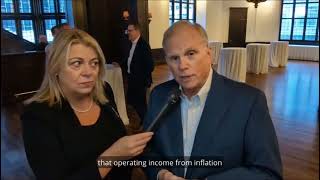
RE West 2026: Martha Delgado of Saint Francis Foundation Spoke to Courtney McQuade

Summary
Higher interest rates are making real estate a tougher asset class, Martha Delgado said, because borrowing costs reduce net operating income, higher cap rates pressure valuations, and refinancing becomes harder. She also said tenants may not be able to absorb unlimited rent increases, so owners have to balance pricing power against occupancy.
Delgado argued that real estate still has a role in a foundation portfolio, but it has to compete for every marginal dollar. For St. Francis Foundation, she said the goal is income to meet grant-making spending needs, plus inflation protection through appreciation. She distinguished between different real estate exposures, noting that apartments can generate current income while land development may take years to return capital.
Her next real estate dollar, she said, would be hard to place anywhere other than real estate debt. Delgado pointed to a maturity wall this year and next year as a refinancing opportunity, saying freshly issued debt could offer higher yields. She also said she is looking for opportunities in workforce housing and wants to understand how operators can make those economics work while still serving a housing-crisis need.
Key takeaways
- Delgado said higher interest rates are negative for real estate because they pressure income, valuations, and refinancing capacity.
- She said real estate debt looks attractive because a maturity wall this year and next year should create refinancing opportunities.
- For St. Francis Foundation, real estate must generate income for grant-making and help preserve purchasing power against inflation.
- Delgado said real estate, like other alts, has to earn its place against listed fixed income in a total portfolio framework.
- She said workforce housing is compelling, but the economics still have to work for both investors and residents.
Notable quotes
“the opportunity to refinance properties uh there's maturity wall um this year and next year refinancing that needs to happen”
“real estate, like other asset classes, is competing uh for allocations in a portfolio”
“its role should be to generate income so the foundation can meet its spending needs”
“when nurses and and even doctors, you know, cannot afford to live close to their place of work”
How the episode opens
The Fed raised interest rates for the first time in over 3 years. Where does that leave real estate? I'm here at our Real Estate West Forum in Half Moon Bay. With me is Martha Delgado of the San Francisco Foundation who just came off of moderating our state of the industry panel. Martha, your take?
Thank you for having me, Courtney. Always great to be here. Um higher interest rates.
Uh I think we may find ourselves in a situation where we have to contend with higher interest rates uh that are probably going to stay higher for longer. Uh and that's due really a lot of inflation pressure, which you know, we can get into it a separate conversation. But broadly speaking, higher interest rates uh tend to be negative for the asset class.
Uh higher interest rate for an equity owner of real estate means less uh net income, net operating income because of higher borrowing costs. Uh also, higher interest rate means higher cap rates usually. And so, higher cap rates drive down valuations, and that leads into refinancing.
So, refinancing um uh you may not as an equity owner be able to refinance as much. Um and there's also pressure on tenants to be able to um uh pay higher rents. Um one way to offset the decline in valuations from higher cap rates is through raising rents, but you have to be able to understand how much you can actually raise those rents um on the tenants to be able to um maintain high occupancy.
And so, it but but it is uh a bit of a mixed bag in that um I I think that there are opportunities within real estate that have secular uh secular tailwinds um such as hospitality. And then there's other aspects of real estate such as real estate debt that can benefit from the ability to refinance real estate debt that was uh really had very low borrowing costs.
From the episode’s captions: roughly the first two minutes, lightly cleaned. Keep watching on YouTube →
Topics
- real estate alternatives
- portfolio discipline
- real estate yield
- grant-making foundation investing
- maturity wall
Companies and tickers mentioned
- Saint Francis Foundation
Watch the episode
Summary, takeaways and quote selection by Octagon. Quotes are short excerpts; the full conversation is in the episode.
More from Markets Group
-
 The €3bn German Allocator Who Said No to Alternatives
-
 RE West 2026: Valerie Red Horse Mohl of the California Endowment Spoke to Courtney McQuade
-
 Stefan Beiner on Repo, Resilience, and Why Governance Beats Prediction in Pension Investing
-
 IF Great Plains 2026: Group Interview with Christine Giordano
-
 IF Great Plains 2026: Matt Clark of South Dakota Spoke to Christine Giordano
-
 IF Great Plains 2026: Ash Williams of J.P. Morgan Asset Management Spoke to Christine Giordano
Markets Group, this episode and its artwork belong to their owners. Octagon is not affiliated with the show; this page is an independent summary.
