
Episode summary
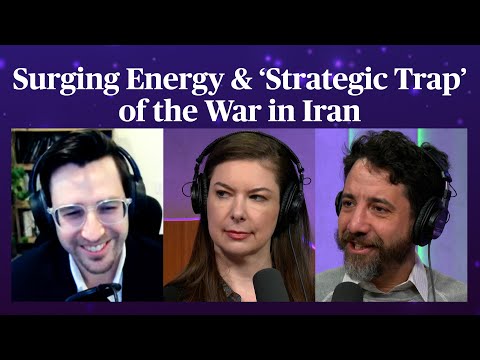
Greg Brew on Surging Energy and the 'Strategic Trap' of the War in Iran | Odd Lots
 Odd Lots
· · 55 min · Hosts: Tracy Alloway, Joe Weisenthal · Guests: Gregory Brew
Summary
Gregory Brew argues that the war has become a strategic trap for the United States because Iran has treated the attack as an existential threat and responded by trying to restore deterrence. In his view, Tehran’s strikes on Gulf energy assets, the closure of the Strait of Hormuz, and the damage to facilities in Qatar and elsewhere are designed to show that attacking Iran creates more pain than it receives.
Brew says Washington and many market participants initially assumed the war would be short and that Donald Trump would quickly declare victory, but that assumption has proven wrong. He argues Trump is now more worried about looking weak than about short-term oil prices, while the administration also lacks a clean military or diplomatic path to reopen Hormuz without conceding something important.
The discussion also covered why Kharg Island matters as Iran’s main oil export terminal, why seizing it would not fully solve the problem, and how sanctions have already created a durable gray-market export system. Brew expects energy prices to stay elevated, with even a quick end to the fighting still leaving lasting supply disruptions and geopolitical damage across the Gulf.
Key takeaways
- Gregory Brew says Iran’s strikes are meant to restore deterrence by proving that attacking it raises costs for the United States, Israel, and the GCC.
- Brew argues Trump initially expected a fast off-ramp, but now appears more concerned about avoiding the appearance of weakness than about high oil prices.
- Brew says Kharg Island handles roughly 80% to 90% of Iran’s crude exports, but destroying it would not fully stop Iranian oil flows because smuggling and alternative routes remain.
- Brew expects oil prices to stay above prewar expectations even if the conflict ends quickly, because infrastructure damage and shipping disruption will linger.
- Brew says the Strait of Hormuz has stayed shut largely through threat alone, which surprised him and suggests the U.S. response has been weaker than expected.
Notable quotes
“They want to restore deterrence. And their way of doing that is indicating to everyone the United States, Israel, the GCC, but the entire world”
“there are no good options to pursue that outcome”
“It handles around 80 to 90% of Iran's crude exports”
“how little the Iranians have needed to do to Hormuz to keep it shut”
How the episode opens
Why did Iran actually decide to go after countries that did not attack them? It relates to Iran's broader strategy, not only its strategy for surviving this war, but its strategy for improving its deterrence and reducing the possibility of this happening again of future attacks. The bigger scenario that the Iranians are more concerned about is a scenario where Iran turns into Lebanon or Iran turns into Syria, a country that you can just bomb, that Israel can just bomb whenever it wants to.
They're very, very concerned about that becoming the new status quo. So that is what's driving their strategy. They want to restore deterrence.
And their way of doing that is indicating to everyone the United States, Israel, the GCC, but the entire world that attacking us is not worth it, that we will respond by imposing more pain, more costs on you, and you can impose on us. The Iranians love to demonstrate this. They love to talk about this.
And I think they are illustrating it, that they are more resilient, that they can take the hit, that it doesn't matter that the U.S. and Israel have air superiority over Iran. Hello and welcome to another episode of the Odd Lots podcast.
I'm Joe Weisenthal and I'm Tracy Alloway Tracy. We're recording this the morning of March 19th, around 9 a.m., and that's how you know it's bad when you have to throw in the hour and the minutes 9:07 a.m., nine or 7 a.m.. And I think the story right now is just the degree to which people are realizing more and more energy infrastructure in the region.
We're talk about our Iran war, of course, more and more energy infrastructure in the region. I mean, it's literally on fire. Yeah.
The thing that I've noticed, having recorded these sort of emergency podcasts over the past I guess two weeks now is that we will talk about a hypothetical like, you know, oh, what happens if Iran strikes the port of Salalah in Oman and then a couple of days later it happens, which gives you an indication of how quickly things are progressing.
From the episode’s captions: roughly the first two minutes, lightly cleaned. Keep watching on YouTube →
Topics
- iran war strategy
- energy infrastructure damage
- oil price dynamics
- strait of hormuz
- gulf state regional realignment
Companies and tickers mentioned
- Eurasia Group
Watch the episode
Summary, takeaways and quote selection by Octagon. Quotes are short excerpts; the full conversation is in the episode.
More from Odd Lots
-
 How a Chicago Restaurant Has Stayed Open For Nearly Three Decades | Odd Lots
-
 How Airlines Actually Hedge Higher Fuel Prices | Odd Lots
-
 Robert Friedland on the World's Monumental Shortage of Copper | Odd Lots
-
 Brad Setser on the US's Unusual Japanese Yen Intervention | Odd Lots
-
 The Tungsten Market Is Warning of an Upcoming War | Odd Lots
-
 These Are the Sharps Actually Making Money on Prediction Markets | Odd Lots
Odd Lots, this episode and its artwork belong to Bloomberg. Octagon is not affiliated with the show; this page is an independent summary.
