
Episode summary
"AI Confidence Shock:" Jeffrey Small on NVDA, AMD & CapEx Outlook

Summary
The guest framed the recent AI selloff as an “AI confidence shock” rather than a collapse in the underlying theme. He argued that rising 10-year Treasury yields, multiple compression, and the Nvidia leadership and governance overhang are pressuring technology valuations, but not ending the AI investment cycle. In his view, Wall Street is now questioning how investors should pay for AI growth, not whether AI will transform the economy.
He said the chip sector can still deliver roughly 50% earnings growth through 2030, and that the current dislocation may create opportunities in select names. He pointed to AMD’s 97% year-over-year growth and said it is “a great, great stock to own,” while also seeing potential in Nvidia and Broadcom. Even with Nvidia’s issues, he said the technology demand remains intact and market share can still shift toward competitors.
On spending, the guest did not expect companies to pull back on AI capex in a meaningful way. He said the AI spending cycle will continue “with or without Jensen,” though higher rates will separate stronger balance sheets from weaker ones and force investors to be more selective across the AI trade.
Key takeaways
- The guest sees the current AI selloff as a valuation and confidence shock, not proof that AI demand is breaking down.
- He warned that if the 10-year Treasury moves toward 5.35%, multiple compression could intensify across technology stocks.
- He expects roughly 50% earnings growth in the chip sector through 2030, which he says supports select buying opportunities.
- The guest said AMD’s 97% year-over-year growth makes it “a great, great stock to own,” even as Nvidia and Broadcom also remain attractive.
- He does not expect a meaningful pullback in AI capital spending, arguing that the spending cycle will continue with or without Jensen Huang.
Notable quotes
“I mean, rather than clear evidence that corporat earnings across the economy are collapsing”
“Wall Street isn't necessarily questioning whether artificial intelligence will transform the y. It's it's questioning how investors should pay for that growth”
“we really see a 50% earnings growth through 2030 per year in the chip sector”
“And so, y know, could could we see more business going in their way to, to a certain degree but their growth rate isng to be right in there with Nvidia's f the next three years”
“I don't think that's going to be the case. The AI spending cycle is going to marchth or without Jensen”
Topics
- ai confidence shock
- nvidia leadership crisis
- ai capex outlook
- stock selection in ai semiconductors
- amd growth outlook
Companies and tickers mentioned
- NVDA
- AMD
- AVGO
- Nvidia
- Advanced Micro Devices
- Broadcom
Watch the episode
Watch “"AI Confidence Shock:" Jeffrey Small on NVDA, AMD & CapEx Outlook” on YouTube
Summary, takeaways and quote selection by Octagon. Quotes are short excerpts; the full conversation is in the episode.
More from Schwab Network
-
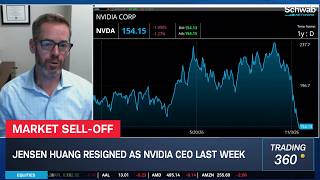 Jensen Huang Weighs Return as NVDA CEO; Risks & Rewards in 2027 CapEx Trade
-
 KG: "Shocked" by October Retail Sales; AI Chips Struggle as NVDA Drags
-
 NVDA Influence Beyond Tech: How Earnings Move VIX, Other Sectors
-
 The Big 3: SHOP, TMUS, S
-
 NVDA Earnings, Tighter AI Chip Restrictions to Test SPX Bulls
-
 How NVDA Earnings Will Move Wall Street; U.S. Tightens AI Chip Exports
Schwab Network, this episode and its artwork belong to their owners. Octagon is not affiliated with the show; this page is an independent summary.
