
Episode summary
Anti-Aging Expert: Stop Touching Receipts Immediately! The Fast Way To Shrink Visceral Fat!
 The Diary of a CEO
· · 2 hr 40 min · Hosts: Steven Bartlett · Guests: Rhonda Patrick
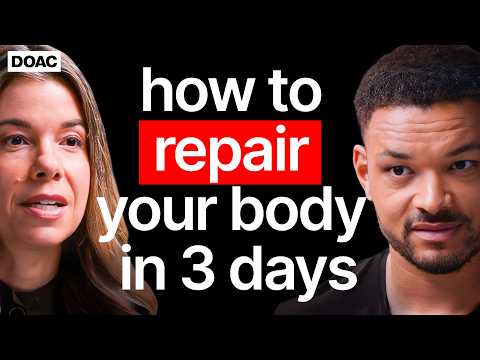
Summary
Rhonda Patrick argues that visceral fat is the most important fat to track because it sits around the organs, drives inflammation, and can double early-mortality risk. She says people can be lean on the scale and still have too much of it, which is why waist circumference or a DEXA scan can reveal risk that body weight misses. In her framing, visceral fat is tightly linked to insulin resistance, brain fog, fatigue, fatty liver, and higher cancer risk.
She says sleep loss, caloric excess, stress, alcohol, and low activity all push visceral fat higher, and that the effect can happen fast. She cites studies in which healthy young men sleeping four hours a night for two weeks gained 11% visceral fat without gaining weight, and another in which a few days of overeating ultraprocessed food produced visceral fat gain and fatty liver signs. Her practical advice is to stop eating at least three hours before bed, prioritize aerobic exercise, and protect sleep as a metabolic intervention.
Patrick also makes a strong case for intermittent fasting as a way to create a caloric deficit and trigger a “metabolic switch” into ketosis. She says fasted aerobic training can improve fat oxidation and mitochondrial adaptations, though she emphasizes listening to the body and eating before harder sessions or when fasted exercise feels bad.
A major second theme is environmental toxins. She argues that BPA, phthalates, and PFAS from plastic, packaging, and non-stick materials disrupt hormones, with particular concern for testosterone, ovarian aging, sperm quality, and fetal development. Her message is to reduce plastic exposure in daily habits rather than panic over one-off exposures.
Key takeaways
- Rhonda Patrick says visceral fat is metabolically active, can be hidden in lean people, and is associated with insulin resistance, inflammation, and higher cancer risk.
- Patrick says two weeks of four-hour sleep nights increased visceral fat by 11% in healthy young men without changing scale weight.
- Patrick recommends stopping food intake at least three hours before bed to reduce sleep disruption and metabolic stress.
- Patrick says aerobic exercise such as running, cycling, and swimming is more effective than weights alone for reducing visceral fat.
- Patrick argues that BPA, phthalates, and PFAS are major endocrine disruptors and recommends minimizing plastic bottles, cans, and non-stick cookware.
- Patrick says intermittent fasting helps mainly by reducing calories and creating a fasted state that supports ketosis and repair.
Notable quotes
“if you have this it's going to double your risk of early mortality”
“healthy young men, college age students. Okay, young. They gained 11% visceral fat after that two weeks, but not a pound on the scale”
“you want to stop eating 3 hours before bed. And three is really the magic number in multiple studies”
“I like to fast in the morning. And the reason I like to fast in the morning is for the exact reason you mentioned, and that is the ketosis”
“These are the three main I would say players in terms of disrupting endocrine function”
How the episode opens
We are being bombarded with disrupting chemicals. A lot of them, they're in art products. — Okay, let's go to my kitchen. Come with me. So, this is my fridge. — So, the first thing I notice is this, cuz that's like the worst.
Can I get a bin bag? — This is made from recycled electronics. — What about this? — This is a problem also. — And this? — Ding, ding, ding. This is great. — I'm going to do utensils next. — Heating it up. The plastic is getting into your food.
What about a receipt? — That's bad. that's covered with BPA and study in adolescent boys showed that it was associated with a 50% reduction in testosterone. And then this is one that people often miss. — The biomedical scientist and anti-aging doctor Rhonda Patrick is back.
This time she's talking about health optimization, maintaining peak performance — And the environmental toxins disrupting your body. — Dr. Rhonda Patrick, let's talk about something that I've never heard of before. Peak span. What the hell is peak span? So it's essentially being within 90% of your peak function. For example, muscle mass, bone density that kind of peaks around 25 years old and then they kind of steadily start to decline.
You're joking. — And the same goes for cognitive function. — So I'm on the way down.
Yeah. And I'm definitely on the way down. But we can do things in our life to help maintain that peak span.
Like if you exercise 5 hours a week, do some highintensity interval training in there and you can reverse heart aging by 20 years. And then sleep very very important for preventing your immune system from aging rapidly. And then another thing that you can do that's really important for brain aging is this is associated with a rapid decrease in Alzheimer's disease risk.
From the episode’s captions: roughly the first two minutes, lightly cleaned. Keep watching on YouTube →
Topics
- visceral fat
- sleep
- microplastics
- intermittent fasting
- glp-1 drugs
Watch the episode
Summary, takeaways and quote selection by Octagon. Quotes are short excerpts; the full conversation is in the episode.
More from The Diary of a CEO
-
 Top Neurologist: The Weekend Habit That Could Raise Your Dementia Risk!
-
 Katt Williams: They Tied Me To A Pole And Beat Me Bloody Every Week!
-
 Iran War Expert: "The 8 Weeks After Midterms Could Be The Most Dangerous!" | Prof Robert Pape
-
 James Talarico: Here Is How They Designed The System To Keep You Poor!
-
 WW3 Threat Expert: The Warning We Are Ignoring, The Only Way Out Is THIS! | Dr Sarah Paine
-
 Mark Cuban: The Brutal Truth About The Next Market Crash!
The Diary of a CEO, this episode and its artwork belong to DOAC. Octagon is not affiliated with the show; this page is an independent summary.
