
Episode summary
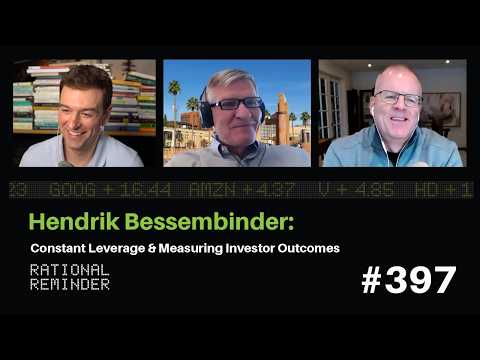
Hendrik Bessembinder: Constant Leverage & Measuring Investor Outcomes | Rational Reminder 397
 The Rational Reminder Podcast
· · Guests: Hendrik Bessembinder
Summary
Hendrik Bessembinder argues that “volatility decay” is an imprecise label for what happens in constant-leverage ETFs. The real issue is that volatility widens the gap between mean and median outcomes, while daily rebalancing can either help or hurt depending on whether the underlying series has reversals or continuations. In his view, investors should focus less on an inevitable drag and more on the interaction between volatility, serial correlation, and the mechanics of rebalancing.
His paper on leveraged single-stock ETFs finds meaningful underperformance versus a frictionless leveraged benchmark. For the 35 funds in his sample, long leveraged products underperformed by about 0.8% per month and short products by about 1% per month. He attributes the shortfall to two pieces: rebalancing effects and frictions such as fees, trading costs, and embedded borrowing rates in swap structures. He also notes that the simulated history of single-stock leverage would have produced many cases where a promised return fell below minus 100%.
The second half shifts to a broader critique of how finance measures investor outcomes. Bessembinder says arithmetic means, geometric means, and standard buy-and-hold returns do not capture how real investors experience returns over time, especially once cash flows matter. He is more positive on dollar-weighted returns and modified IRRs because they incorporate the timing of money in and money out, and he argues that academic finance should move toward measures like sustainable return that better match real spending needs.
Key takeaways
- Bessembinder says volatility is not automatically bad for constant-leverage ETFs; its effect depends on whether returns are followed by reversals or continuations.
- His sample of 35 leveraged single-stock ETFs underperformed a frictionless benchmark by about 0.8% per month for longs and 1% per month for shorts.
- He attributes the long-fund shortfall mostly to frictions, while the short-fund shortfall is driven more by rebalancing.
- Bessembinder argues arithmetic means and standard buy-and-hold returns miss the actual experience of long-term investors.
- He is more enthusiastic about dollar-weighted returns and modified IRRs because they incorporate real cash flows in and out of an investment.
Notable quotes
“volatility is going to reduce your batting average your your your win rate”
“the daily rebalance doesn't necessarily hurt you”
“they underperform if we look at a monthly horizon uh the long funds the levered long funds underperform the simple benchmark by uh 8/10en of a percent per month”
“the short funds underperform a simple benchmark by one the simple benchmark by 1% per month”
“I just don't think we have been serious uh about trying to measure long run investor outcomes”
How the episode opens
This is the Rational Reminder podcast, a weekly reality check on sensible investing and financial decision-making from two Canadians. We're hosted by me, Benjamin Felix, chief investment officer, and Cameron Pasmore, chief executive officer at PWL Capital. — Welcome to episode 397. Nice to be back with you, Ben. Been a while since I've been on the
While. Yeah, good to have you back.
I think it's actually my first time uh this year to be on and pretty exciting to be talking with today's return guest, Hank Bessim Bender, which is a name most listeners certainly are aware of. As I said, a returning guest, phenomenal guest, so well spoken, so thoughtful, and I don't want to kind of, you know, spill the candy here in the in the lobby, but because you're going to do a great intro, but wow, so many interesting things, and it kind of links back to your recent podcast and YouTube on ETF slop and kind of the things that are happening in the marketplace. So, with that, Ben, you have to cue this one up.
Yeah. So, we had Hank on back in episode 346. last time and that was actually with Mark and I uh interviewing
Hank. We talked about a bunch of his research then uh but he had a couple new papers out that I thought were really really interesting and as you mentioned I included one of them in the video that I did on ETF slop and that was he has a paper out on on uh levered single stock ETFs which I think are you know kind of ridiculous. I think Hank does a very good job uh delicately explaining when they could be useful for for someone if they really had a very very specific hedging or
Or uh view that they wanted to express in in the market.
From the episode’s captions: roughly the first two minutes, lightly cleaned. Keep watching on YouTube →
Topics
- leveraged etfs
- volatility decay
- performance measurement
- sustainable return
- investor outcomes
Watch the episode
Summary, takeaways and quote selection by Octagon. Quotes are short excerpts; the full conversation is in the episode.
More from The Rational Reminder Podcast
-
 Wealthy People Are Hiding in Plain Sight (ft. Owen Zidar) | Rational Reminder 428
-
 What to Know Before (and After) You Hire an Advisor (with Matthew Taylor) | Rational Reminder 427
-
 The Finances of Marriage | Rational Reminder 426
-
 The Ethics Problem in Financial Services (Dr. Moira Somers & Philippa Hann) | Rational Reminder 425
-
 50 Years of Evidence-Based Investing (with David Booth) | Rational Reminder 424
-
 The Future of AI in the Workplace | Special Episode (Mike Sullivan and Vinay Gidwaney)
The Rational Reminder Podcast, this episode and its artwork belong to Benjamin Felix, Cameron Passmore, and Dan Bortolotti. Octagon is not affiliated with the show; this page is an independent summary.
