
Episode summary
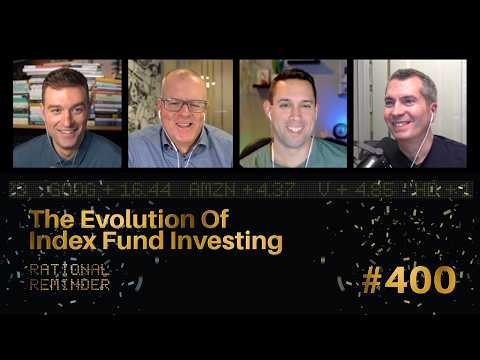
The Evolution of Index Fund Investing | Rational Reminder 400
 The Rational Reminder Podcast
· · 1 hr 37 min · Hosts: Benjamin Felix · Guests: Tim Edwards, Jim Rowley, Shelly Antoniewicz
Summary
The episode frames 50 years of index investing as a story of both market access and market structure. The hosts note that Vanguard launched the first retail index fund in 1976, and use the 400th episode to revisit what index investing has changed: costs, diversification, investor behavior, and possibly the way markets function. They also describe a New York Stock Exchange panel with Tim Edwards of S&P Dow Jones Indices, Jim Rowley of Vanguard, and Shelley Antoniewicz of the Investment Company Institute.
The pre-panel discussion argues that concentration in the S&P 500 is not a strong predictor of future returns. Tim Edwards’s paper shows that periods of high concentration can still be followed by strong index performance, because today’s biggest firms can fade and future winners can already be present as smaller holdings. The hosts connect that to the logic of cap weighting: holding the whole market lets investors own future winners without predicting them in advance.
The episode also pushes back on the idea that index funds are one homogeneous “passive” blob. Jim Rowley’s and Vanguard’s material emphasizes that index funds span many benchmarks, rules, rebalancing methods, and uses, while Shelly Antoniewicz highlights that index funds are widely owned by ordinary households for retirement and other long-term goals. The panel begins by debating what “passive” even means, how fund companies and index providers interact, and what evidence says about index funds’ effects on volatility, dispersion, and price discovery.
Key takeaways
- Tim Edwards argues that current S&P 500 concentration does not by itself imply poor future returns, because today’s leaders can become tomorrow’s laggards.
- The hosts say cap-weighted indexing naturally captures future winners as they grow, without requiring investors to identify them in advance.
- Jim Rowley and the hosts argue that “passive” is an imprecise label because index funds differ widely by benchmark, construction rules, and usage.
- Shelley Antoniewicz says index funds are mainly a mainstream retirement-savings tool for U.S. households, not just an institutional trading vehicle.
- Vanguard’s material claims index-fund growth has pushed down fees across both active and passive products, benefiting all investors.
- The panel begins from the view that evidence does not show index fund growth has meaningfully raised volatility or reduced dispersion in stock returns.
Notable quotes
“this year it's 2026, right? This marks 50 years since the first retail index fund was launched by Vanguard”
“at least statistically today's co cohort of the very largest companies is unlikely to represent the very best performing stocks in the future”
“if you can avoid some of that turnover comes a new opportunity for the investment committee”
“the panel's view is is generally that index funds have been a great innovation, which we would all agree with, and that index funds are not causing a lot of the issues that are often attributed to them”
“there isn't a single unified conclusion about how index or index funds or index investing affects the financial markets”
How the episode opens
This is the Rational Reminder podcast, a weekly reality check on sensible investing and financial decision-making from four Canadians. We are hosted by me, Benjamin Felix, chief investment officer, Dan Bordotti, portfolio manager, Ben Wilson, head of M&A, and Cameron Pasmore, CEO, all of PWL Capital.
Can you imagine? This is our 400th episode and it's so great to be here with you guys. Welcome everybody to this episode. 400. Can you imagine? Almost eight years ago, Ben, we just sat down in that room and started recording and here we are still. I mean, you guys are doing way more the lifting now clearly. But pretty cool to be here with you guys.
Yeah. I still remember being back in the office when you guys first were talking about this idea and said, "If this could be valuable for 10 or 20 clients to get more information and allow us to scale the business to get Ben out of meetings, it'll be a win." And it's just amazing how far it's come since then.
And did it overlap with your podcast, Dan? — Yeah, I think so. I think I was still doing the Couch Potato Podcast for I don't know a year or two after you guys started and then I just — Yeah moved away from it and then was really happy to get invited back to to get behind the mic again. It's been
A great experience and just such a big audience to be able to uh to reach this time around and uh and it's great to have all of the different approaches that the four of us have had and the other co-hosts. It's everybody brings something a little bit different and uh I think the mix has worked really well.
From the episode’s captions: roughly the first two minutes, lightly cleaned. Keep watching on YouTube →
Topics
- index investing history
- passive investing myths
- index fund mechanics
- market concentration
- price discovery
Companies and tickers mentioned
- Vanguard
- S&P Dow Jones Indices
- Investment Company Institute
Watch the episode
Watch “The Evolution of Index Fund Investing | Rational Reminder 400” on YouTube
Summary, takeaways and quote selection by Octagon. Quotes are short excerpts; the full conversation is in the episode.
More from The Rational Reminder Podcast
-
 Wealthy People Are Hiding in Plain Sight (ft. Owen Zidar) | Rational Reminder 428
-
 What to Know Before (and After) You Hire an Advisor (with Matthew Taylor) | Rational Reminder 427
-
 The Finances of Marriage | Rational Reminder 426
-
 The Ethics Problem in Financial Services (Dr. Moira Somers & Philippa Hann) | Rational Reminder 425
-
 50 Years of Evidence-Based Investing (with David Booth) | Rational Reminder 424
-
 The Future of AI in the Workplace | Special Episode (Mike Sullivan and Vinay Gidwaney)
The Rational Reminder Podcast, this episode and its artwork belong to Benjamin Felix, Cameron Passmore, and Dan Bortolotti. Octagon is not affiliated with the show; this page is an independent summary.
