
Episode summary
Trump Tariff Turmoil, Private Credit Risk Grows, & AI’s Software Fears | The Weekly Wrap
 The Real Eisman Playbook
· · 25 min · Hosts: Steve Eisman
Summary
Steve Eisman argues that the week’s biggest macro development was the Supreme Court striking down Trump’s tariffs, followed by a quick policy pivot that may leave tariff revenue roughly unchanged but keeps markets uncertain. He says the market’s relatively muted reaction reflects how investors have learned not to catastrophize every tariff shock, even if the new plan is messy.
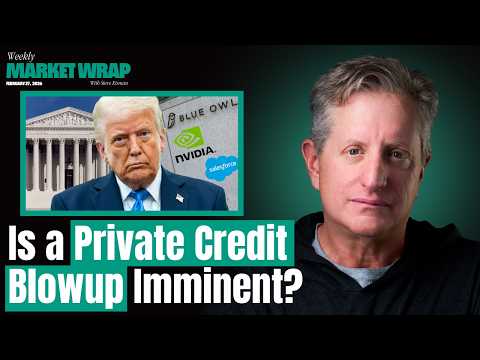
The sharper warning is about private credit and Blue Owl. Eisman says the private credit market has grown to $1.8 trillion, is increasingly sold to retail investors and insurers, and is especially exposed to software loans. He highlights Blue Owl freezing redemptions, selling loans near par, and transacting with Kuvari Insurance, an entity it controls, as a sign that risk is being pushed into more leveraged vehicles backed by policyholder money.
He also says AI is creating real fear in software and adjacent sectors even as Nvidia posts exceptional results. Nvidia’s revenue growth is strong, but Eisman says the stock’s subdued reaction shows investors still doubt AI’s payoff. He views Salesforce as another software name under pressure from AI overhang, while Circle, First Solar, Home Depot, Lowe’s, and Warner Bros. each illustrate different parts of a market still grappling with rates, policy, and demand.
Key takeaways
- Eisman says the tariff reversal may be messy, but Treasury’s plan could leave 2026 tariff revenue roughly unchanged.
- He warns that Blue Owl’s actions show private credit risks are spreading from institutional buyers to retail investors and insurance balance sheets.
- Eisman says private credit’s exposure to software loans is dangerous because AI disruption could push defaults as high as 15%, in one UBS estimate.
- He argues Nvidia’s numbers were excellent, but the stock’s weak reaction shows the market still doubts the durability of AI capex.
- He says Salesforce’s lighter 2027 revenue guidance is especially weak in a market already worried about AI-driven software disruption.
Notable quotes
“The private credit market has exploded into a $1.8 trillion market. Huge. Part of the problem is that private credit is overexposed to software”
“Nvidia reported powerful numbers. How could it not? And yet, the skeptical narrative about AI retains its power”
“One bad day about tariffs is not going to tip the economy into a recession”
“There are some estimates that over 20% of the entire private credit market is composed of loans to software buyout transactions”
“Nvidia's numbers had to be great. And they were. revenue beat, EPS beat, guidance beat by a lot”
How the episode opens
Nvidia reported powerful numbers. How could it not? And yet, the skeptical narrative about AI retains its power.
And the Blue Owl news from last week, in my view, was particularly bad. The private credit market has exploded into a $1.8 trillion market. Huge.
Part of the problem is that private credit is overexposed to software. In a recent report, private credit could see default rates surge to 15% because of AI disruption. Such a level would be disastrous.
Hi, this is Steve Eisman and this is the weekly rap for the week ending Friday, February 27, 2026, but recorded on Thursday night, February 26. Before this I start the rap, I'm going to do something I don't normally do and flag the episode we will release this coming Monday, March 2nd. I do a deep dive with Tom Gober, an expert in what is going on with private equity increasingly dominating the life insurance sector and the incredible risks involved.
This is truly worth checking out. On this week's rap, I discuss one, tariff turmoil. Two, I go into more depth on Blue Owl, private credit and private credit's exposure to the software sector, and I also touch on Blue Owl's control of a life insurance company.
Three, AI creates more fear in software and other sectors as well. Four, earnings results of Nvidia, Salesforce, First Solar, and others. And five, I answer two viewer questions.
the first as to why the market did not react more negatively to Friday's tariff news and the second as to what tools institutional investors have that retail investors do not. So let's get started. On Friday of last week, the Supreme Court struck down President Trump's tariffs which he imposed under the International Emergency Economic Powers Act, the IPA.
Over the weekend, President Trump responded with a new temporary 15% tariff under section 122 of the 1974 trade act and a plan to start several new section 301 trade investigations covering most major trading partners that would allow him to reimpose the tariffs under other laws.
From the episode’s captions: roughly the first two minutes, lightly cleaned. Keep watching on YouTube →
Topics
- supreme court tariffs
- private credit risk
- ai software fears
- weekly earnings
- retail investor resources
Companies and tickers mentioned
- OWL
- NVDA
- CRM
- HD
- LOW
- FSLR
- Blue Owl
- NVIDIA
- Salesforce
- Home Depot
- Lowe's
- First Solar
- Circle
- Warner Bros
Watch the episode
Summary, takeaways and quote selection by Octagon. Quotes are short excerpts; the full conversation is in the episode.
More from The Real Eisman Playbook
-
 The AI Debate is No Longer Boom vs Bust: Why It’s Time to Go Back to Stock Picking | The Weekly Wrap
-
 The Midterms Have Changed the AI Narrative: S&P Down 4.4%, Nasdaq Down 5.5% | The Weekly Wrap
-
 Why Young Americans Feel Locked Out with the Lemonade Stand Podcast | The Real Eisman Playbook Ep 82
-
 Anthropic’s Growth is Slowing: Is AI Capex Next? | The Weekly Wrap
-
 Inflation, The Deficit & Why the Dollar Stays King with Benn Steil | The Real Eisman Playbook Ep 81
-
 AI Narrative Switched, Debt Yields Spike | The Weekly Wrap
The Real Eisman Playbook, this episode and its artwork belong to Steve Eisman. Octagon is not affiliated with the show; this page is an independent summary.
