
Episode summary
Roth Conversions, Trusts and Tax Strategy: Planning Beyond the Silos
Summary
Jamie Hopkins argues that retirement income, tax planning and estate planning should not be treated as separate specialty conversations, because the client’s actual outcome depends on how all the pieces interact. He says advisors often work with a CPA, attorney, trust officer and insurance professional, but fail to coordinate their recommendations, leaving clients with disconnected plans instead of one coherent strategy.
His framework starts with asking broader questions about the client’s life and who else is advising them, then gathering the relevant documents and coordinating the moving parts. He emphasizes that the advisor is often best positioned to connect those relationships over time, especially when assets or circumstances change, rather than assuming lawyers or other specialists will do that work.
On tax strategy, Hopkins is strongly bullish on Roth accounts, saying the post-SECURE Act environment makes them especially valuable for heirs and for clients expecting higher future tax rates. For a single move that can improve lifetime tax efficiency and legacy outcomes, he points to income shifting, often through trusts, especially when high-income assets can be moved to lower-tax beneficiaries or to state-favored trust structures such as Delaware or Nevada trusts.
Key takeaways
- Hopkins says the main planning failure is treating retirement income, tax planning and estate planning as silos instead of one coordinated client strategy.
- He recommends starting with a broad question about the client’s life and existing advisors to uncover uncoordinated plans and missing documents.
- Hopkins calls Roth accounts the best retirement vehicle in existence right now because they are more tax advantaged for owners and heirs, especially under the SECURE Act.
- His top lifetime-tax move is income shifting, often through trusts, when a client has assets or income they are willing to transfer.
- He cites Delaware and Nevada trusts as examples of structures that can help reduce state income tax drag on accumulated gains.
Notable quotes
“these often get put into silos and then not coordinated with the other side”
“ask the client about it. And then it's figuring out right what partners might you need to execute some of this”
“are you willing to transfer any assets to anybody right now”
“I think that that matters a lot and if you are expecting tax rates to rise in the future”
“So, you see a popularity of Delaware, Nevada trust because they can hold the assets and the beneficiaries aren't subject to state income taxes on the buildup gain”
How the episode opens
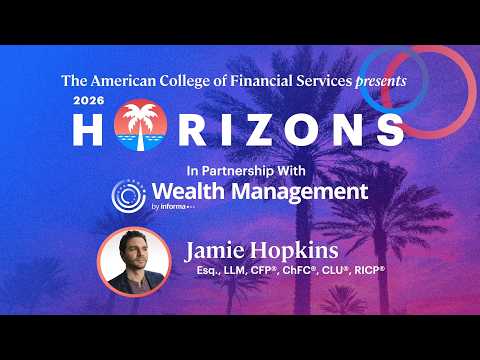
What happens when retirement planning, taxes, estate planning all become separate conversations? To break it all down for us, I'm joined by Jamie Hopkins. Jamie, thanks so much for joining me. — Hey, it's great to see you. — You, too. I know we've done a lot of these and every time I get to talk to you, I certainly always learn something. But I want to talk about your session here at the Horizon's event because it's all about aligning retirement income and tax strategy and estate strategy. But what goes wrong when these are all treated separately?
Yeah. Well, I was noticing even when the agenda was getting put together, this is where this one came from is it was like, oh, retirement income, tax planning, estate efficiencies, and they're actually all very separate. And you get specialists that come out and talk about each one.
And that's normal. It's okay to be a specialist. It's a good thing.
But the problem when it comes to clients or even our planning is these often get put into silos and then not coordinated with the other side. So what you'll see is somebody will have a CPA, they'll have an adviser, they'll also have an estate attorney, sometimes a trust officer, an insurance professional, and these things are not all coordinated together. And I think that's a bit of the conversation.
I'll go through some of the coordination of how do you pull these together.
So let's actually talk about that a little bit. What's your framework for integrating an income plan, a tax plan, estate plan into one actual cohesive strategy? — So the first thing you have to do is start by actually asking the clients about their whole life. What you see is people get really focused on client comes in, you review their investments, they leave and you didn't ask like did you also just meet with your CPA this April and they came up with some strategy for you or an attorney and you find that often these people are not communicating.
From the episode’s captions: roughly the first two minutes, lightly cleaned. Keep watching on YouTube →
Topics
- reth conversions
- trust planning
- tax strategy
- retirement income
- estate planning coordination
Watch the episode
Watch “Roth Conversions, Trusts and Tax Strategy: Planning Beyond the Silos” on YouTube
Summary, takeaways and quote selection by Octagon. Quotes are short excerpts; the full conversation is in the episode.
More from WealthManagement.com
-
 401(k) Real Talk Episode 216: November 11, 2026
-
 The Planning Opportunities Hidden in High-Net-Worth Conversations
-
 Wealth Management Invest: Expanding Access to Private Markets with Blackstone’s Farhad Karim
-
 401(k) Real Talk Episode 215: November 4, 2026
-
 How Advisors Can Use AI Without Losing the Human Relationship with Rron Rexha
-
 Celebrity Estates: Dolly Parton and Estate Planning Without Children
WealthManagement.com, this episode and its artwork belong to their owners. Octagon is not affiliated with the show; this page is an independent summary.
