
Episode summary
Wealth Management Invest: Unpacking Autocallable ETFs with Matt Kaufman
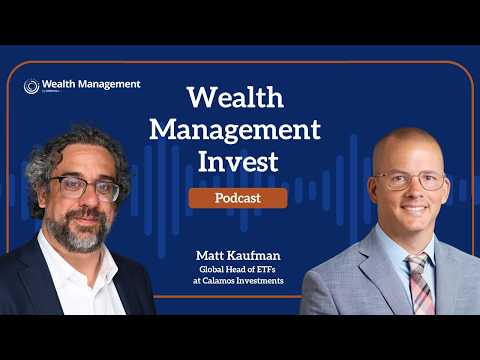
Summary
Matt Kaufman argues that autocallable ETFs bring a structured-note strategy into a wrapper that is more accessible, diversified and operationally simpler for advisers. He says the market for derivative income has expanded sharply, with covered call ETFs and structured notes both reflecting strong demand for equity-linked income, but that autocallables can offer more stable payments and less NAV decay than traditional covered calls.
He explains the mechanics by comparing an autocallable to a bond tied to equity performance: coupons keep paying so long as the underlying index stays above a downside barrier, and principal is intended to return at par if the note is called or matures above its threshold. Calamos’ income ETFs, he says, use a laddered portfolio of notes with coupon and principal barriers around minus 40%, designed to smooth outcomes across many vintages.
Kaufman also describes the growth-focused CAG strategy, which uses an autocallable structure with a memory feature and an at-the-money annual test. If the index is down in year one, the coupon is carried forward, potentially creating a much larger payout later. Across the lineup, he says the firm is aiming for high, stable and tax-efficient income or, in the growth fund, amplified long-term upside without the decay associated with leveraged ETFs.
Key takeaways
- Kaufman says Calamos’ first autocallable income ETF approached $1 billion in assets in about a year, suggesting strong adviser demand.
- He argues the ETF wrapper improves on individual notes by adding diversification, liquidity, transparency and reduced counterparty risk.
- Kaufman says the income funds target high, stable and tax-efficient distributions, with most income treated as return of capital rather than ordinary income.
- He says CAG uses a memory feature so missed coupons can accumulate, potentially turning a negative first year into a much larger later payout.
- Kaufman contrasts autocallables with covered calls, saying autocallables can avoid the NAV decay that comes from repeatedly selling upside after market declines.
Notable quotes
“We are witnessing a revolution I might say in how investors think about income”
“it's a strategy that's relegated to structured notes because it's hard to do an auto call feature and terms of an option that just can't be done in the listed markets”
“So that's how an individual note works”
“So you have remarkable diversification by doing this inside of an ETF wrapper and lading it all out”
“The goal for our initial two products for KAI C AIE and C AIQ which is on a NASDAQ 100 framework is to deliver high stable and tax efficient income”
How the episode opens
Are you a series 7 licensed financial professional looking for more out of your career? Like a stable environment where you'll get the support and resources you need to do your best work and focus on the client. Fidelity is currently hiring remotely and in our branches. Join a financial services leader that cares about the people on both ends of the call, the client and the employee. Visit series7.fidelitycareers.com and explore opportunities today. Fidelity is an equal opportunity employer.
Hello and welcome back to the Wealth Management Invest podcast. I'm your host, David Bodimemer, editorial director, Wealth Management. Uh, happy to have another exciting conversation.
I'm really excited to catch up with someone I've spoken to many times over the years, both at, you know, conferences for stories, but excited to really talk about this innovative product that they've brought into the market over the past year. So I, you know, so I'm going to let him introduce himself a little bit and tell tell us about his firm, but it's Matt Kaufman, global head of ETFs at Calamos. Matt, great to catch up with you again.
Hey David, thanks for having me. Good to be here. — So as I said, um, why don't you just, you know, give the audience for folks who may not be familiar just a little bit about yourself and a little bit about Calamos.
Well, sure. Appreciate that. Yeah. So I personally been in the ETF industry for about 23 years. I started my career at PowersShares building out the smart beta ETF space. After PowersShares sold to Invesco, I went to an actuarial consulting firm, which you know makes about as much sense to me saying it out loud today as it did doing it back then.
From the episode’s captions: roughly the first two minutes, lightly cleaned. Keep watching on YouTube →
Topics
- autocallable etfs
- structured note market
- income strategies
- tax-efficient distributions
- covered call vs autocallable
Companies and tickers mentioned
- Calamos Investments
Watch the episode
Watch “Wealth Management Invest: Unpacking Autocallable ETFs with Matt Kaufman” on YouTube
Summary, takeaways and quote selection by Octagon. Quotes are short excerpts; the full conversation is in the episode.
More from WealthManagement.com
-
 The WealthStack Podcast: AI, Video and the New Rules of Client Engagement with David Moricca
-
 401(k) Real Talk Episode 216: November 11, 2026
-
 The Planning Opportunities Hidden in High-Net-Worth Conversations
-
 Wealth Management Invest: Expanding Access to Private Markets with Blackstone’s Farhad Karim
-
 401(k) Real Talk Episode 215: November 4, 2026
-
 How Advisors Can Use AI Without Losing the Human Relationship with Rron Rexha
WealthManagement.com, this episode and its artwork belong to their owners. Octagon is not affiliated with the show; this page is an independent summary.
