
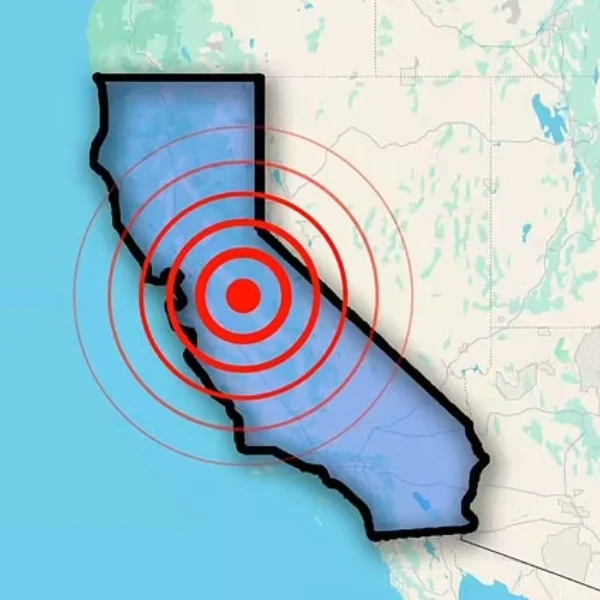
Will there be an at least 8.0 magnitude earthquake in California before 2028?
Yes refers to: Before 2028
Short Answer
1. Market Behavior & Drivers
- UCERF3 estimates a 7% statewide chance of M8.0+ earthquake over 30 years.
- The chance of M8.0+ before 2028 is significantly smaller than 7%.
- UCERF3 provides long-term forecasts, giving estimates over several decades.
- California faults are monitored in real-time for stress changes and deformation.
- Seismologists consider foreshocks potential precursory signs, not standalone predictors.
Who Wins and Why
| Outcome | Market | Model | Why |
|---|---|---|---|
| Before 2028 | 16.0% | 7.6% | California's location on active fault lines makes major earthquakes a persistent, albeit rare, risk. |
Current Context
2. Price Chart
Historical Price (Probability)
3. Market Data
Contract Snapshot
This market resolves to "Yes" if an earthquake of at least 8.0 magnitude with an epicenter in California or its territorial waters occurs before December 31, 2028, as verified by USGS; otherwise, it resolves to "No." The market closes early if the event occurs, or by December 30, 2028, at 11:59 PM EST if the event does not happen. Insider trading by individuals with material, non-public information or those employed by Source Agencies is prohibited.
Available Contracts
Market options and current pricing
| Outcome bucket | Yes (price) | No (price) | Last trade probability |
|---|---|---|---|
| Before 2028 | $0.20 | $0.90 | 16% |
Market Discussion
Probabilistic models from the U.S. Geological Survey (USGS) estimate approximately a 7.0% chance of an 8.0 magnitude earthquake in California over the next 30 years, with a 2019 estimate suggesting a "few percent" chance within a 10-year window [1][2][3][4][5][6]. Experts consistently state that precise earthquake prediction is currently impossible, and only probabilistic forecasts exist, which indicate low odds for such an event before 2028, aligning with pricing on prediction markets [4][6][7][8][9].
4. Trust Index
Order book is critically thin.
Primary risk· Trade quality
Includes the cost to trade: a $10,000 order can't be filled here because the order book is too thin.
Weighted blend with hard caps — a critically weak safety pillar, or a severe trading anomaly, caps the total regardless of the rest. Full methodology · About the Trust Index
5. According to the paleoseismic record, what is the average recurrence interval for M8.0+ ruptures on the San Andreas fault, and how does the current period compare to that historical baseline?
| Mean Recurrence Wrightwood | ~105 years [1][2][3] |
|---|---|
| Mean Recurrence Pallett Creek | ~145 years [1][2][3] |
| Years since Fort Tejon (as of 2026-05-06) | ~169 years [4] |
Sources (4)
- 1gsatv14n9_04.inddrock.geosociety.org
- 2AAPG Datapages/Archivesarchives.datapages.com
- 3Paleoseismic event dating and the conditional probability of large earthquakes on the southern San Andreas fault, Californiapubs.usgs.gov
- 4San Andreas Fault: Complete Guide to California's Most Famous Fault Line | EarthquakeTrackerearthquaketracker.org
6. How does the M8.0+ rupture potential before 2028 compare between the southern San Andreas Fault and the Cascadia Subduction Zone?
| So. San Andreas Fault M>=8.0 probability (30 years) | about 7% [1][2] |
|---|---|
| Cascadia Subduction Zone M>=8 rupture probability (50 years, PNAS) | 15% [3] |
| Cascadia Subduction Zone M>=8.0 probability (50 years, USGS) | up to ~37% [4][5] |
Sources (5)
- 1Third Uniform California Earthquake Rupture Forecast (UCERF3) | Southern California Earthquake Centerscec.org
- 2UCERF3en.wikipedia.org
- 3Increased flood exposure in the Pacific Northwest following earthquake-driven subsidence and sea-level rise | PNASpnas.org
- 4Cascadia subduction zoneen.wikipedia.org
- 5Earthquake probabilities and hazards in the U.S. Pacific Northwest | U.S. Geological Surveyusgs.gov
7. What specific seismic precursors, such as foreshock sequences or aseismic slip, would seismologists from the USGS or Caltech consider critical indicators of an impending M8.0+ event?
| Percentage of M4+ mainshocks with foreshocks | 72% (Caltech, 2008–2017 data) [1] |
|---|---|
| Median foreshock sequence duration | 16.6 days (Caltech, 2008–2017 data) [1] |
| Long-duration earthquake swarms with ultra-slow patterns | 53% (Caltech-linked research, 2008–2020 data) [2] |
Sources (6)
- 1Pervasive Foreshock Activity Across Southern Californiaresolver.caltech.edu
- 2Evidence for Latent Crustal Fluid Injection Transients in Southern California From Long-Duration Earthquake Swarmsresolver.caltech.edu
- 3Foreshocks, aftershocks - what's the difference? | U.S. Geological Surveyusgs.gov
- 4Intermediate-term, pre-earthquake phenomena in California, 1975-1986, and preliminary forecast of seismicity for the next decadeusgs.gov
- 5Experimental studies of aseismic slip, earthquake occurrence and hazard | U.S. Geological Surveyusgs.gov
- 6Locally and remotely triggered aseismic slip on the central San Jacinto Fault near Anza, CA, from joint inversion of seismicity and strainmeter dataresolver.caltech.edu
8. What real-time monitoring data from sources like the USGS is available to assess stress changes or crustal deformation on California's major fault systems?
| GPS data frequency | Daily and near real-time [1][2] |
|---|---|
| Creepmeter precision | Micron-precision measurements [3] |
| Creepmeter data frequency | Every 10 minutes [3] |
Sources (12)
- 1usgs.govearthquake.usgs.gov
- 2usgs.gov
- 3colorado.educires1.colorado.edu
- 4usgs.govearthquake.usgs.gov
- 5carleton.eduserc.carleton.edu
- 6colorado.educires1.colorado.edu
- 7usgs.gov
- 8geoscienceworld.orgpubs.geoscienceworld.org
- 9scec.orgfiles.scec.org
- 10usgs.govearthquake.usgs.gov
- 11usgs.govearthquake.usgs.gov
- 12mdpi.com
9. What are the primary assumptions and limitations of the USGS's UCERF3 model when forecasting an M8.0+ event specifically before 2028?
| Model forecasting M8.0+ events before 2028 | UCERF3 [1][2][3][4] |
|---|---|
| Alternative logic-tree branches for uncertainty | 1,440 [3][4] |
| Total forecast combinations | 5,760 [1][2] |
Sources (6)
- 1Long‐term time‐dependent probabilities for the third Uniform California Earthquake Rupture Forecast (UCERF3) | U.S. Geological Surveyusgs.gov
- 2Long‐term time‐dependent probabilities for the third Uniform California Earthquake Rupture Forecast (UCERF3)pubs.er.usgs.gov
- 3Uniform California earthquake rupture forecast, version 3 (UCERF3): the time-independent model | U.S. Geological Surveyusgs.gov
- 4Uniform California earthquake rupture forecast, version 3 (UCERF3): the time-independent modelpubs.usgs.gov
- 5https://pubs.usgs.gov/fs/2015/3009/pdf/fs2015-3009.pdfpubs.usgs.gov
- 6A spatiotemporal clustering model for the Third Uniform California Earthquake Rupture Forecast (UCERF3‐ETAS): Toward an operational earthquake forecast | U.S. Geological Surveyusgs.gov
10. What Could Change the Odds
Key Catalysts
Key Dates & Catalysts
- Expiration: January 07, 2029
- Closes: December 31, 2028
