
Episode summary
SpaceX Stock: Why Musk’s $8 Billion Spectrum Buy Hit AT&T and Verizon
Summary
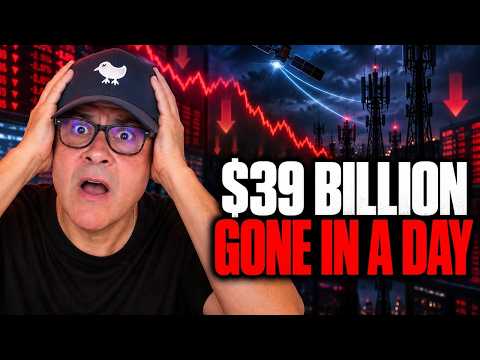
SpaceX’s reported $8 billion purchase of low-band 800 MHz wireless spectrum licenses sparked a one-day selloff in telecom stocks, with AT&T down 9.8%, Verizon down 8.8%, T-Mobile down 13.3%, and roughly $39 billion in combined market value erased. The host argues the market is reacting to the fear that Musk could eventually launch a national carrier, even if the immediate move is only about buying scarce spectrum.
The case for Musk, as the host sees it, is a first-principles strategy: acquire the scarce input directly, then build a new network rather than buying an incumbent with old towers, legacy costs, and weak growth. The host says the FCC’s recent ruling matters because owning the licenses outright could reduce SpaceX’s need for terrestrial carrier partnerships.
He also thinks the move may pressure Apple, whose satellite phone features rely on Globalstar, and fit Musk’s broader pattern of trying to build an entire stack from satellites to spectrum and possibly a device. Still, the host says he would prefer a partnership model over building a full consumer network because margins are better when SpaceX stays an add-on rather than moving into low-margin mass-market service.
Key takeaways
- The host says SpaceX’s $8 billion spectrum buy erased about $39 billion from AT&T, Verizon and T-Mobile in a single day.
- He argues Musk’s pattern is to buy scarce inputs like spectrum and build the business himself rather than acquire incumbents.
- The host says the FCC ruling last week was important because SpaceX may no longer need carrier licensing deals to use the spectrum.
- He believes the move could also pressure Apple, since Apple’s satellite phone features currently run through Globalstar.
- The host warns that a direct consumer wireless push could shrink margins, even if it expands revenue.
- He prefers a partnership model because it would let SpaceX earn higher returns with less capital tied up.
Notable quotes
“if you own T-Mobile or Verizon or AT&T, you didn't have a good day on Friday”
“Those stocks saw their market value wiped down by $39 billion in a day”
“he's followed this pattern whenever he has started a business or grown a business, it's buy the scarce raw input and build it himself”
“by owning these licenses outright, it no longer needs that, which is why the FCC ruled last week that SpaceX does not need carrier licensing deals anymore”
“you see somebody trying to create their whole stack, you know, satellites, spectrum, and eventually, maybe even the device”
How the episode opens
Good morning. This is Dylan Jovine, behind the markets. Happy Tuesday.
Today is Tuesday, October 13th. Today I'd like to talk about a lot of requests I got this week. A lot of folks wrote in asking what I thought about my take, what my take was on Musk spending $8 billion for SpaceX to buy low-band 800 MHz wireless spectrum licenses.
And I'll say this, the first thing I will say is if you own T-Mobile or Verizon or AT&T, you didn't have a good day on Friday. Those stocks saw their market value wiped down by $39 billion in a day. Just because Musk bought these licenses, everybody is afraid that he's going to launch a national carrier.
And you know, AT&T was down 9.8%. Verizon was down 8.8%. T-Mobile was down 13.3% just on news that SpaceX bought this.
It's kind of crazy. Crazy, really. And you know, these are widows and orphans, basically.
Who do you think about who owned AT&T, Verizon, and T-Mobile? I mean, these are businesses that are basically managed decline phase of their life cycle. Very low growth, approximate the growth of the US economy, dealing with a lot of churn.
And uh you basically what you do in a company like this is you invest as little as you can in really new stuff, and you extract cash flow from these, which is why a lot of them have high dividend rates. But you know, that's basically the nature of this. It's kind of like Toys "R" Us was before it went out of business, Kmart.
You know, it's basically you bleed them out, you bleed out the asset. You make sure that stuff still runs well, but they're really not uh you know, jazzed for growth. So, what's going on?
From the episode’s captions: roughly the first two minutes, lightly cleaned. Keep watching on YouTube →
Topics
- spacex spectrum acquisition
- wireless carriers market impact
- fcc spectrum ruling
- musk vertical integration strategy
- satellite phone competition
Companies and tickers mentioned
- T
- VZ
- TMUS
- AAPL
- SBUX
- CMG
- SpaceX
- AT&T
- Verizon
- T-Mobile
- Apple
- Globalstar
- xAI
- Starbucks
- Chipotle
Watch the episode
Watch “SpaceX Stock: Why Musk’s $8 Billion Spectrum Buy Hit AT&T and Verizon” on YouTube
Summary, takeaways and quote selection by Octagon. Quotes are short excerpts; the full conversation is in the episode.
More from Behind The Markets Podcast
-
 Nvidia CEO Out: 4 Reasons I’m Not Panicking About Nvidia
-
 The Mag 7 Sell-Off: My 3 Secrets to Picking Stocks
-
 Morgan Stanley’s AI Winners List Is Full of Bank Stocks
-
 Anthropic IPO: Why I’m Not Rushing to Buy at $1 Trillion
-
 Chip Stocks Sell-Off: Why the AI Build-Out Just Went From 3 to 5 Years
-
 Midterm Election Results: The Stock Market’s Winners and Losers
Behind The Markets Podcast, this episode and its artwork belong to their owners. Octagon is not affiliated with the show; this page is an independent summary.
