
Episode summary
Beijing Adviser Says US Talks Cement China as ‘Equal Partner’
 Bloomberg Surveillance
· · 5 min · Guests: Henrietta Treyz, David Daokui Li
Summary
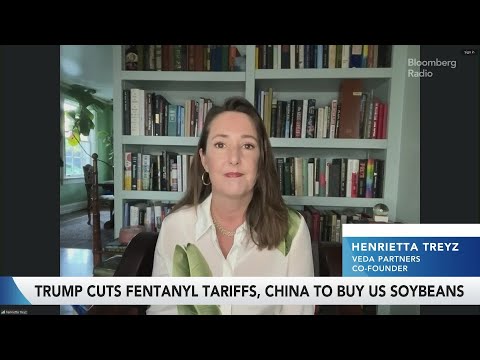
The guest argues that the Xi-Trump meeting and the resulting trade truce are more important for politics and farm-state economics than for fixing the underlying U.S.-China dispute. She says the first read is that China’s agricultural market share has been “gone” for the foreseeable future, with soybean demand shifting to Brazil and Argentina, and that U.S. producers should look for other export outlets for soy, sorghum, wheat, corn, and cattle.
She contrasts the earlier Trump-era soybean agreement with the newer one, saying Bob Lighthizer secured $56 billion in soybean sales over two years in 2020 and 2021, while the current deal negotiated by Secretary Bassett is only $34 billion over four years. That gap, she says, is why soybean farmers see the agreement as underwhelming and why the market share story is effectively a mirage.
The guest also says the deal points toward a U.S. farm bailout of at least $12 billion, because the promised Chinese purchases would not be enough to keep farmers afloat. She argues that reopening the government could help unlock that aid, but only if Congress returns and gives the president the authority to send money to farmers.
On the shutdown, she says the Senate recess around Veterans Day is the most likely catalyst for action, since senators want to leave Washington. She adds that China’s pattern of delaying and missing soy commitments means farmers still lack the certainty they want, because the agreement sets no specific dates, tonnage, or break-bulk commitments.
Key takeaways
- The guest says the U.S. has already lost China’s agricultural market share to Brazil and Argentina, and she does not expect it to come back.
- She contrasts a $56 billion two-year soybean deal in 2020-2021 with a new $34 billion four-year deal, calling the latest version much weaker.
- The guest argues farmers will need a bailout of at least $12 billion if China’s purchases only total $12 billion this year.
- She says a Senate recess for Veterans Day could help end the shutdown because senators want to go home.
- The guest says the deal gives farmers little certainty because it lacks specific dates, tonnage, and other hard commitments.
Notable quotes
“the entire thing has been a mirage”
“the US market share in agricultural trade to China has not just dropped off”
“the first read through I get is that as a result of these trade wars”
“we're going to need at least a $12 billion influx of cash for farmers”
“There's no specific dates, There's no metric tonnage, there's no break bulk commitments”
How the episode opens
Yeah. The president she meeting was the big one. Everybody's determination is going to be focused on different things.
But in my opinion and from the perspective of D.C., everybody sort of retreated to their corners and that's going to be helpful for the next year. I think it has a lot of read through to how D.C. is going to operate for the next couple of months and with how the Supreme Court is going to rule on these type of cases.
But I thought it was really helpful to think about the president's first term and his last trade deal agreement with the Chinese versus this term in 2020, when Bob Lighthizer was the USTR and he was the main negotiator with China, he was able to negotiate sales and soybeans to China of $56 billion over two years 2020 and 2021. Now, if you fast forward to this past week, Secretary Bassett, the lead negotiator with China, he was able to negotiate just a $34 billion deal with China for soy over four years. So the first read through I get is that as a result of these trade wars, the US market share in agricultural trade to China has not just dropped off, the entire thing has been a mirage.
And it's really hurt the United States, the farm belt and likely not to come back. So it was really a comprehensive conclusion that the market share is gone, it is eroded, it's gone to Brazil and Argentina, and that is what the US can count on with China for the foreseeable future. So that means do you really have to migrate to finding other alternative outlets for our soy, sorghum, wheat, corned beef, cattle, all that stuff.
And there are trade agreements with other nations are even more important now.
From the episode’s captions: roughly the first two minutes, lightly cleaned. Keep watching on YouTube →
Topics
- us-china trade truce
- china-us equal partnership
- us agriculture impact
- geopolitical security talks
- financial and technological conflicts
Companies and tickers mentioned
- Veda Partners
Watch the episode
Watch “Beijing Adviser Says US Talks Cement China as ‘Equal Partner’” on YouTube
Summary, takeaways and quote selection by Octagon. Quotes are short excerpts; the full conversation is in the episode.
More from Bloomberg Surveillance
-
 Stocks Rise as Inflation Data Ease Fed-Hike Worry | Bloomberg Surveillance
-
 Bloomberg Surveillance TV: November 13th, 2026 | Bloomberg Surveillance
-
 Bloomberg Surveillance TV: November 12th, 2026 | Bloomberg Surveillance
-
 Jensen Huang Ousted by Nvidia Board as CEO | Bloomberg Surveillance
-
 Bloomberg Surveillance TV: November 11th, 2026 | Bloomberg Surveillance
-
 AI Stocks Rebound as Fed Hike Bets Return | Bloomberg Surveillance
Bloomberg Surveillance, this episode and its artwork belong to Bloomberg. Octagon is not affiliated with the show; this page is an independent summary.
