
Episode summary
Affirm: The Next American Express (Audio)
 Business Breakdowns
· · 1 hr 18 min · Guests: Fraser Christie
Summary
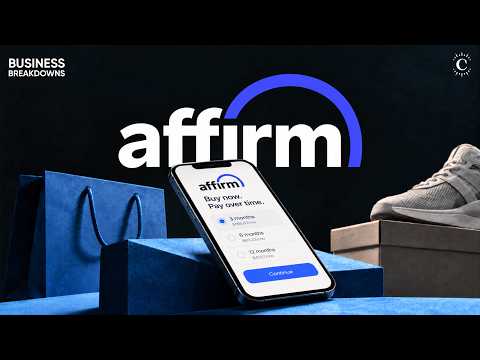
Affirm is presented as a payment network built for e-commerce, not just a consumer lender. Fraser Christie argues that the company’s real edge comes from transaction-by-transaction underwriting, merchant integrations, and a flywheel that gets stronger as more shoppers and merchants adopt the product. That structure resembles American Express more than a traditional installment-loan business, because Affirm combines checkout infrastructure with credit and keeps the consumer experience fixed, transparent, and paid down to zero.
Christie walks through how a typical Affirm transaction works, how the company earns money from merchant fees and consumer interest, and why its longer-dated, interest-bearing loans are more profitable than the shorter Pay in X offers. He says roughly 70% of GMV comes from interest-bearing products, with the business generating about a 4% gross profit on GMV overall and around $50 billion in GMV while growing over 30% a year.
The conversation also frames Affirm’s competitive position versus Klarna and Afterpay, its progress with the Affirm Card, and the potential upside from AI and agentic commerce. Christie says the company’s technical culture, disciplined cost structure, and diversified funding base helped it survive the 2022 rate shock and emerge with a stronger business model and clearer network effects.
Key takeaways
- Fraser Christie says Affirm should be valued like a payment network, because its merchant integrations and consumer flywheel resemble American Express more than a pure lender.
- He says about 70% of GMV comes from interest-bearing loans, which are more profitable than Pay in X products and help drive roughly a 4% gross profit on GMV.
- Christie says the company processes more than $50 billion of GMV and is still growing over 30% a year, despite being much larger than a few years ago.
- He argues that transaction-level underwriting, powered by AI and richer data, gives Affirm better credit outcomes than traditional credit-card models.
- Christie says the Affirm Card expands the network beyond integrated merchants and already accounts for about 20% of GMV, while still preserving strong economics.
- He says rate shocks mainly create a short air pocket, not a broken business, because Affirm’s loan book turns quickly and its funding sources are diversified.
Notable quotes
“a firm is better understood as a payment network than a traditional lender”
“The average purchase price for an affirm transaction is about $250”
“The biggest one for us is Max talks about this framework he has in his head of starting businesses of the problem to be solved has to be hard, valuable and fun”
“a firm today processes over 50 billion of GMBB still growing over 30% a year”
How the episode opens
Today we are breaking down a firm. The buy now pay later company founded by PayPal co-founder Max Levchin. A firm now processes more than 50 billion GMV and is growing over 30% a year.
One of the most interesting ideas we explore is that a firm is better understood as a payment network than a traditional lender. It has powerful network effects, sophisticated credit underwriting and a long runway for growth as e-commerce takes share of retail and buy now pay later takes share of e-commerce. Joining me today is Fraser Christie, founder and CIO of Sandstone Global Investment.
Fraser has studied a firm closely for years and this conversation will give you a much greater appreciation for the business and the founder behind it. I hope you enjoy this breakdown of a firm. So, I wanted to start the conversation speaking about Max.
From what I understand, he actually has a very interesting path to being a founder. I think a lot of people know him from his days at PayPal and the PayPal mafia, but they probably don't appreciate his full story and background. I know you've been able to spend time with him over the past couple of years and really get to know who he is as a person.
So maybe just share with us his background and more just about his uniqueness that he brings to the company. Max's biography deserves its own podcast and a book as well because he's lived a pretty extraordinary life. But I mean even going back to pre PayPal because I think it gives you a sense of the grit.
Max was born in Ukraine to a family of physicists and scientists. They left Kiev when Max was about 10 after the Chernobyl nuclear disaster. He tells this story of arriving in Crimea and he set off a Geiger counter because he had a radioactive thorn in one of his shoes and they spent 5 years there with his grandparents and then moved to Chicago right before the fall of the Soviet Union.
From the episode’s captions: roughly the first two minutes, lightly cleaned. Keep watching on YouTube →
Topics
- affirm business model
- payment network and network effects
- transaction-level underwriting
- interest rate environment
- ai and agentic commerce
Companies and tickers mentioned
- AFRM
- PYPL
- Affirm
- Sandstone Global Investment
- PayPal
- Klarna
Watch the episode
Watch “Affirm: The Next American Express (Audio)” on YouTube
Summary, takeaways and quote selection by Octagon. Quotes are short excerpts; the full conversation is in the episode.
More from Business Breakdowns
-
 Cloudflare: Leading Cybersecurity [Business Breakdownes Ep 241]Cloudflare Final
-
 How Investors Are Using AI [Business Breakdowns: Episode 240]
-
 GE Aerospace: Full Throttle [Business Breakdowns Episode 235]
-
 Agilent: Back To The Lab - [Business Breakdowns, EP.223]
-
 Agilent: Back To The Lab - [Business Breakdowns, EP.223]
-
 Compass: Real Estate Revolution - [Business Breakdowns, EP.226]
Business Breakdowns, this episode and its artwork belong to Colossus | Investing & Business Podcasts. Octagon is not affiliated with the show; this page is an independent summary.
