
Episode summary
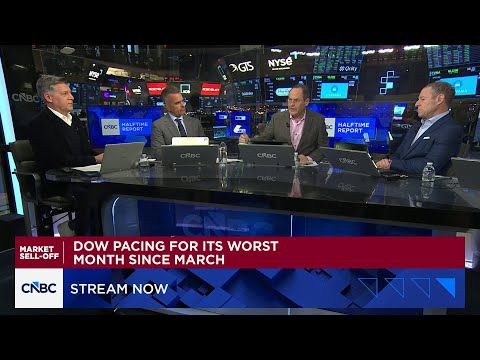
Stocks sharply lower: The Investment Committee shares its strategy
 CNBC Halftime Report
· · Hosts: Scott Wapner, Rob, Steve Weiss, Bill Baruch, Joe Terranova, Morgan Brennan
Summary
The committee argued that the market’s selloff is being driven less by earnings and more by financing stress, especially in the AI and data-center complex. One side pointed to sharply higher borrowing costs, blown-out credit spreads and distressed debt pricing at names like CoreWeave and Oracle as proof that the cycle is changing and that stocks are often the first to signal the end of a boom before estimates are cut.
The opposing view was that some of those debt readings reflect secondary-market sentiment rather than actual funding terms, and that the real issue is uncertainty around contracts, capital structure and whether lenders will keep providing liquidity. The group agreed that without seeing the underlying agreements, it is hard to know how much downside protection or embedded escape clauses exist for hyperscalers and their suppliers.
On the trading side, the discussion turned defensive. One panelist said the market is prioritizing liquidity, making it harder for neo-cloud companies to raise capital, while another said the broader AI trade will not stabilize until there is follow-through and a new catalyst. The committee also noted that semis like Micron, Marvell, KLA, Lam Research, AMD and Broadcom have already fallen sharply from 52-week highs even as demand commentary has not shown clear deterioration.
Key takeaways
- One panelist argued that rising yields and stressed credit in CoreWeave and Oracle show the AI spending cycle is getting harder to finance.
- Another panelist said the debt moves are mostly sentiment in secondary markets, not proof that those companies are issuing at those levels.
- The committee said stocks usually anticipate the end of a cycle before analysts and managements do, which is why one panelist has already sold Micron and CAT and lightened up.
- The market is rotating more defensive, with one panelist citing the JOE T ETF shifting toward consumer staples.
- The group agreed that the AI trade needs stability and follow-through before buyers can confidently return.
- Semis have already repriced sharply, but the panel said they still have not heard clear evidence of demand problems in the AI build-out.
Notable quotes
“BORROWING COSTS ARE GOING UP. YIELDS ARE GOING UP, NOT TREASURIES. SOME OF THE CREDITS OF SOME OF THE NAMES THAT WE LOOK AT THE EQUITIES AND WE OBSESS OVER”
“THE FACTS HAVE CHANGED AND THEY'VE CHANGED DRAMATICALLY. WHEN YOU SEE THE COST OF MAINTAINING THE SPENDING CYCLE FOR THESE COMPANIES, IT'S ASTRONOMICAL”
“STOCK PRICES ARE USUALLY THE FIRST TO MOVE BEFORE THE ESTIMATES GET CUT”
“FOR WHATEVER REASON, THE MARKET RIGHT NOW IS PRIORITIZING LIQUIDITY”
“I'M REALLY TRADING EQUITY FUTURES RIGHT NOW BECAUSE I'M TRYING TO ALLOW THE MARKET THROUGH ITS PRICE ACTION, TO TELEGRAPH TO ME THAT THE ALL CLEAR SIGNAL IS IN PLACE”
Topics
- credit spreads
- bond yields
- equities selloff
- financing rates
- semiconductor outlook
Companies and tickers mentioned
- ORCL
- MU
- CAT
- NVDA
- Oracle
- Micron Technology
- Caterpillar
- Nvidia
Watch the episode
Watch “Stocks sharply lower: The Investment Committee shares its strategy” on YouTube
Summary, takeaways and quote selection by Octagon. Quotes are short excerpts; the full conversation is in the episode.
More from CNBC Halftime Report
-
 Navigating a falling market: The Investment Committee's strategy
-
 The Investment Committee discusses the state of the AI trade following Nvidia's earnings
-
 The Investment Committee's Nvidia strategy: Kevin Simpson trims, Jim Lebenthal holds
-
 The Investment Committee reacts to Nvidia's stock after Jensen Huang's resignation
-
 The Investment Committee debates the tech bounce
-
 How should investors trade Nvidia now: The Investment Committee weighs in
CNBC Halftime Report, this episode and its artwork belong to CNBC. Octagon is not affiliated with the show; this page is an independent summary.
