
Episode summary
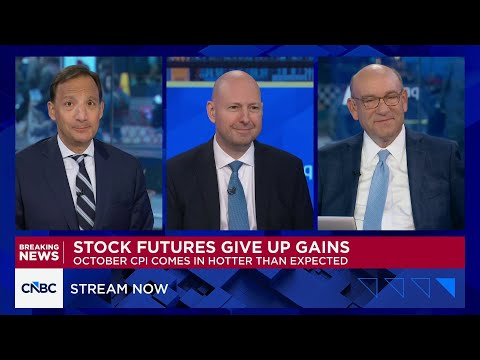
Experts react to the October CPI report
Summary
The discussion centered on an October CPI report that came in hotter than expected and immediately pushed Treasury yields and Fed-rate odds higher. The guests argued that the print matters less as a single data point than as another sign that inflation may not be settling back to the Fed’s 2% target as smoothly as hoped, especially with food, services, and some pipeline costs still firm. One guest emphasized that residual seasonality may make the fall look artificially soft and the early-year readings look hotter, while the other argued that sticky refined-product prices and food pass-through could keep inflation uncomfortable even if crude oil eases.
The market reaction was a big part of the story: futures weakened, and rate expectations shifted toward a more aggressive Fed path, including a much higher probability of a second hike in January. The guests said that if inflation stays hot, the real debate becomes whether the Fed stays on a once-a-quarter pace or moves to meeting-by-meeting hikes. They also warned that higher rates, slower earnings growth, and uncertainty around AI capital spending could pressure equity multiples next year. One guest said the AI trade remains transformational, but the sustainability of the capex boom and the pricing power of AI are still open questions.
Key takeaways
- The guests said the CPI print was hot enough to raise the odds of a more aggressive Fed path, with market pricing moving toward a January hike.
- One guest argued residual seasonality could make January and February inflation look hotter even if the government eventually adjusts for it.
- Both guests pointed to sticky food and refined-product prices as reasons inflation may stay firm even if crude oil declines.
- One guest said higher short- and long-term rates, plus slowing earnings growth, make it hard to get bullish on equity multiples.
- The guests said AI capex remains a major market theme, but its sustainability and pricing power are still uncertain.
Notable quotes
“THESE ARE SUPPOSED TO BE LIKE THE NEXT THREE PRINTS, INCLUDING THE ONE WE JUST GOT TODAY, ARE SUPPOSED TO BE THE BEST PRINTS WE GET OF THE YEAR”
“THE REAL ISSUE WITH THIS REPORT AND THE REPORTS THAT WE'RE GOING TO GET BETWEEN NOW AND THE JANUARY FOMC MEETING IS HOW MANY MORE OF THESE REPORTS ARE WE GOING TO GET”
“I DON'T REALLY BUY THAT. BUT I ALSO THINK EVEN FOR THE HYPERSCALERS WHO ARE HITTING THE BOND MARKETS PRETTY REGULARLY RIGHT NOW, THEIR INTEREST RATE SENSITIVE”
“I DON'T THINK ANYONE KNOWS. AND I HAVE TO SAY THAT COULD GET ME INTO A BAR FIGHT IN, YOU KNOW, HALF THE COUNTRY”
“WE'RE VERY BULLISH ON THE AI CAPEX SPEND”
How the episode opens
From housing on inflation. Looks like that has gone away. And owners equivalent rent up 0.3%. That's what I have for now. I'll dig into the numbers. But back to you, becky and andrew. — All right steve, thank you. Right now we want to bring in Jason Trennert, who is chairman and ceo of Baird strategies, and Matthew Hornbach, who is global head of macro strategy at Morgan Stanley.
Becky, let me let me interrupt real quick just to tell you that the two year note is moving again. It was we went in at 462. We're at 466 right now, the ten year at 492. We went in at 490. And I'll check those fed probabilities. They were already at 100% for december. And we were toying again with a march hike. It had been at 67%. And I'll check. I'll check on that in just a second.
Okay. We're going to continue to watch this and see how the market reacts to this. But jason and matt, obviously this is a little hotter than had been anticipated. What do you make of that? Matt? We'll start with you.
Yeah. I mean these are supposed to be like the next three prints, including the one we just got today, are supposed to be the best prints we get of the year. The residual seasonality that the bureau of labor statistics has not been able to sort of correct for, suggest that these should be the best numbers we get of the year.
The fact that they are looking like they're not going to be the best numbers that we get may very well have implications for the fed.
It's having implications for the equity markets now, too. It looks like the s&p futures have turned negative after being basically flat through most of the morning.
From the episode’s captions: roughly the first two minutes, lightly cleaned. Keep watching on YouTube →
Topics
- october cpi
- fed rate outlook
- inflation impact
- macro strategy
- economic outlook
Companies and tickers mentioned
- MS
- Baird
- Strategas
- Morgan Stanley
Watch the episode
Watch “Experts react to the October CPI report” on YouTube
Summary, takeaways and quote selection by Octagon. Quotes are short excerpts; the full conversation is in the episode.
More from CNBC Squawk Box
-
 Rep. John Moolenaar on investigating Nvidia's Jensen Huang: CCP influence raises multiple concerns
-
 Ron Baron on his Musk investments: Can make 'hundreds of billions of dollars' over the next 10 years
-
 Tech selloff looks like a normal correction, says JPMorgan's Jack Caffrey
-
 Ed Yardeni on his 7,900 S&P 500 year-end target: 'Santa is coming'
-
 Kalshi CEO Tarek Mansour on the midterms, future of regulation and insider trading concerns
-
 Compute scarcity favors Big Tech after midterms, says The Information's Jessica Lessin
CNBC Squawk Box, this episode and its artwork belong to their owners. Octagon is not affiliated with the show; this page is an independent summary.
