
Episode summary
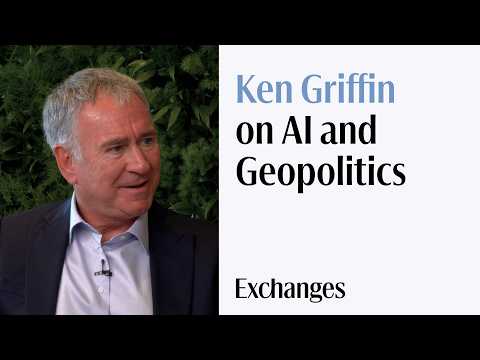
Citadel's Ken Griffin on AI, US-China Tensions, and US Data Centers
 Exchanges (Goldman Sachs)
· · Guests: Ken Griffin
Summary
Ken Griffin says Citadel’s early return-to-office push was a leadership choice aimed at preserving apprenticeship, mentorship, and human capital, and he argues remote work has harmed young workers more than AI has. He also points to Citadel’s role in pandemic response, saying the firm helped move quickly on FDA approvals and supported Operation Warp Speed, which he says saved roughly half a million American lives and a few trillion dollars in GDP.
On markets, Griffin argues the S&P can make new highs even during war because the U.S. has been partly shielded from the energy shock, China has sharply reduced oil demand, and oil has not spiked to the level many expected. He says investors should see AI as part of a broader technology revolution, not the whole story, and that agentic AI is already compressing weeks of research work into a few hours while increasing Citadel’s productivity without cutting headcount.
He is bullish on the entrepreneurial effects of AI, saying it will lower barriers for startups and erode corporate moats. At the same time, he warns that compute is scarce and expensive, that China is a major technology competitor, and that Taiwan represents an extreme systemic risk because a chip disruption could quickly trigger a severe U.S. economic contraction. He closes by arguing the U.S. needs more nuclear power and more domestic data centers, paired with the power generation to support them.
Key takeaways
- Ken Griffin says remote work has hurt the development of young talent more than AI has, and he credits Citadel’s return-to-office policy with protecting human capital.
- Griffin says agentic AI can compress six to eight weeks of academic-paper replication into two to three hours, but Citadel is not using that productivity gain to cut headcount.
- He argues AI will help create a golden age of entrepreneurship by making it cheaper and faster to launch new businesses and challenge incumbents.
- Griffin says compute is now a scarce input with rising prices, and large market-making firms are spending hundreds of millions of dollars on it.
- He warns that a Taiwan shock could cut U.S. GDP by 8% in six months, creating a severe global economic crisis.
- Griffin says the U.S. should build data centers domestically and pair them with new power generation, including more nuclear energy and small modular reactors.
Notable quotes
“the competitive moats of our society, within our corporate society, are all being filled and at breathtaking rates”
“we're likely to see a golden age of entrepreneurial activity. Like entrepreneurs will be able to launch new businesses at breathtaking speeds”
“there's no reduction to headcount at Citadel on the back of this breakthrough, right”
“the price of compute has certainly gone up per unit of compute beyond where people would have reasonably projected it two or three years ago”
“if US loses access to Taiwanese semiconductor chips, our GDP falls by 8% in six months”
How the episode opens
You'll never manage a portfolio for every possible tail event. But you should stay very focused on, like, what is the worst-case scenario? Can I tolerate that loss?
And monitor and maintain your exposures such that that loss is a tolerable loss. It may be an extreme loss. But it's still tolerable.
Welcome to another episode of Goldman Sachs Exchanges - Great Investors. I'm Raj Mahajan. I recently got the chance to catch up with Ken Griffin, the founder and CEO of Citadel at Goldman Sachs' Apex Symposium.
Ken and I discussed the implications of AI, his approach to hedging portfolios, and the competitive landscape for the hedge fund industry. We hope you enjoy this conversation. Welcome back to Goldman Sachs, Ken.
It is great to be here today. This is our third public conversation in the past seven years. I know you well enough to know you think way beyond the numbers.
And you're a student of leadership. So, the first question I want to ask you is beyond the numbers, for the past seven years, what are you most proud of as a leader in running Citadel? So, two things jump out with that question.
The first is we were extremely early to bring everybody back to work. And in some sense, it was almost counter cultural to demand your team to come back to an office five days a week. And yet, I think that was an incredibly important part, not only to the success that you spoke of, but more importantly, of continuing to develop our human capital.
I think as a country, the amount of human talent that has been underdeveloped because of working remotely has had a significant damaging impact on our economy. And recently, the Fed published a paper where they looked at factors that have caused reduced employment amongst those under the age of 30.
From the episode’s captions: roughly the first two minutes, lightly cleaned. Keep watching on YouTube →
Topics
- agentic ai
- us-china tensions
- us data centers
- ai productivity
- corporate moats
Companies and tickers mentioned
- Citadel
Watch the episode
Watch “Citadel's Ken Griffin on AI, US-China Tensions, and US Data Centers” on YouTube
Summary, takeaways and quote selection by Octagon. Quotes are short excerpts; the full conversation is in the episode.
More from Exchanges (Goldman Sachs)
-
 Playing for Scale: The Future of Sports Investing
-
 John Waldron on GDP Growth, AI, and the M&A Outlook
-
 Brookfield’s Connor Teskey on the Real Bottleneck in the AI Buildout
-
 Goldman Sachs Chairman and CEO David Solomon on AI: Implementation, Accountability, and Jobs
-
 Why Oil Prices Are Surging Despite Recovering Supply
-
 Where Chinese Exports Are Gaining the Most Market Share
Exchanges (Goldman Sachs), this episode and its artwork belong to Goldman Sachs. Octagon is not affiliated with the show; this page is an independent summary.
