
Episode summary
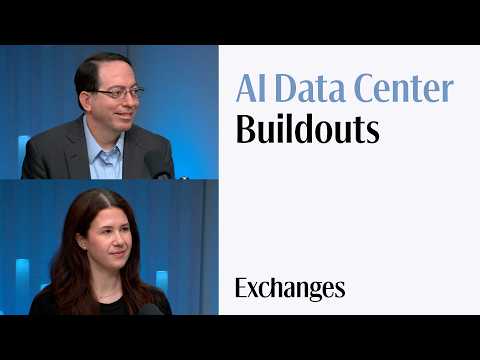
The Outlook for Data Center Power Demand as AI Token Use Grows
 Exchanges (Goldman Sachs)
· · Hosts: Allison Nathan, George Lee · Guests: Brian Singer, Carly Davenport
Summary
Data center power demand tied to AI is rising faster than earlier expected, but the episode argued the bigger story is how supply will be sourced and where the bottlenecks now sit. The guest said Goldman Sachs Research raised U.S. power demand growth to 3.5% CAGR through 2030, with data center power demand in 2030 now seen at about 108 gigawatts, up from about 83 gigawatts. Globally, the guest expects data center power demand to be up about 170% from 2025 levels by 2030, and said AI’s power pull over the seven years through the end of the decade is like adding the power consumption of Japan.
The discussion focused on a supply chain constrained by price, permitting, policy pushback, turbines, transformers, skilled labor, and cooling limits. The guest described a shift toward more natural gas in the near term, renewables plus storage, then nuclear later, while the host emphasized that efficiency gains have not offset demand because token usage and compute are still expanding.
Regionally, the guest said PJM should remain the largest U.S. data center market through 2030, while MISO is expected to overtake ERCOT for second place. On the interconnection side, queue delays of two, three, five, or seven years are pushing more projects behind the meter, though the guest framed that as a bridge rather than a long-term solution.
Key takeaways
- The guest said Goldman Sachs now sees U.S. power demand growing at 3.5% CAGR through 2030, up from 3.2%, driven mainly by data centers.
- The guest expects global data center power demand to rise about 170% from 2025 levels by 2030, and likened AI’s added load to the power use of Japan.
- The guest said PJM should stay the largest U.S. data center market through 2030, while MISO is likely to overtake ERCOT for second place.
- The guest said interconnection queues can run two, three, five, or seven years, making behind-the-meter generation an increasingly important bridge solution.
- The host and guest said public pushback and permitting, not just megawatts, may be the steepest constraint on new data center power supply.
Notable quotes
“we recently raised our forecast up to a 3.5% CAGR through 2030. And that was up from our prior forecast of about 3.2% CAGR through 2030”
“we see data center power demand in 2030 up about 170% from 2025 levels”
“It's adding the power equivalent of the whole country of Japan, which is the number five power consuming country”
“there are three sub-Ps within that. And Allison, I think you referenced it a bit. There's permitting. There's pushback. And there's populism”
“You could be sitting in the queue from anywhere - two, three, five, seven years depending on which regional grid in the U.S. you're trying to connect to”
How the episode opens
Now put in perspective, kind of what is AI doing from a power demand perspective? It's adding the power equivalent of the whole country of Japan, which is the number five power consuming country. So, this is really significant.
The last time we sat down to talk about AI and power, the debate was whether the grid could handle it. That question has now been answered in basically the least comforting way possible: partly, unevenly, and expensively. Welcome back to AI Exchanges.
I'm Allison Nathan, and I'm here together with George Lee, the co-head of the Goldman Sachs Global Institute. Together, we're co-hosting a series of episodes exploring the rise of AI and everything it could mean for companies, investors, and economies. George, great to see you again.
Great to be here. So, George, let's first set the table for people who have followed this series. When we first covered this topic, the shorthand was basically that AI would drive a step change in data set or power demand after nearly two decades of essentially flat electricity load.
But since then, demand forecasts have gone up again, even as we've discussed many times, models have become more efficient. The binding constraint has migrated away from megawatts and towards what I think of as all the Ts. We have turbines, transformers, transmission, and tradespeople.
So, new constraints entering the picture, and the politics have arrived. So, we have regulators, ratepayers, and neighbors now really having a seat at the table and having a lot to say about this topic. So, before we bring in the experts, George, what's the single biggest thing that's changed in your mind on this topic?
Well, I think one thing that kind of syncs with my expectations is the demand cycle continues. And what's fascinating is to watch as you described, the supply chain gets stretched all the way back from models, but to all of the physical affordances, really almost all the way back to the base elements.
From the episode’s captions: roughly the first two minutes, lightly cleaned. Keep watching on YouTube →
Topics
- data center power demand
- ai energy use
- power grid bottlenecks
- regional us power markets
- community pushback on datacenters
Companies and tickers mentioned
- GS
- Goldman Sachs
Watch the episode
Watch “The Outlook for Data Center Power Demand as AI Token Use Grows” on YouTube
Summary, takeaways and quote selection by Octagon. Quotes are short excerpts; the full conversation is in the episode.
More from Exchanges (Goldman Sachs)
-
 Playing for Scale: The Future of Sports Investing
-
 John Waldron on GDP Growth, AI, and the M&A Outlook
-
 Brookfield’s Connor Teskey on the Real Bottleneck in the AI Buildout
-
 Goldman Sachs Chairman and CEO David Solomon on AI: Implementation, Accountability, and Jobs
-
 Why Oil Prices Are Surging Despite Recovering Supply
-
 Where Chinese Exports Are Gaining the Most Market Share
Exchanges (Goldman Sachs), this episode and its artwork belong to Goldman Sachs. Octagon is not affiliated with the show; this page is an independent summary.
