
Episode summary
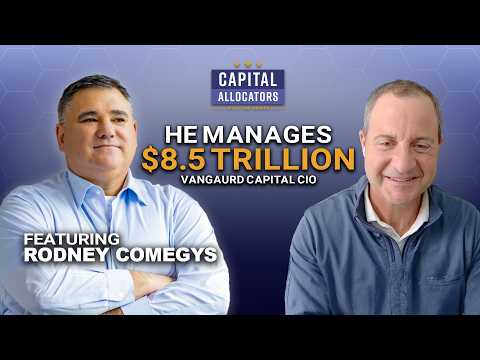
Rodney Comegys - The Mechanics of Indexing at Vanguard (EP.498)
 Investment Management Operations
· · 47 min · Hosts: Ted Seides · Guests: Rodney Comegys
Summary
Rodney Comegys argued that indexing is fundamentally about capturing broad market returns, not about chasing narrow slices of the market. He said the simplest version is a total-market approach, but investors also need global equities and bonds because the S&P 500 is too concentrated to serve as either a benchmark or a portfolio on its own. He framed Vanguard’s role as keeping products broad, liquid, and low cost rather than chasing “hot or nichy” ideas.
He described Vanguard’s implementation as a daily operational exercise in accuracy, trading, and tax awareness. Comegys said the firm’s teams must track the index closely while also looking for small sources of value, such as better execution on corporate actions, secondary offerings, and securities lending. He emphasized that those decisions are made in a tightly controlled way, with tracking error first and only tiny deviations from the benchmark.
Comegys also addressed common indexing debates, including the rise of mega-cap concentration, the shrinking public market, and the role of private assets. He said concentrated U.S. indexes are not enough for diversification, that new public companies should enter index funds quickly once float and trading are established, and that Vanguard sees private investing as something to add only if it can be done at low cost and with high-quality managers. He closed by saying AI should improve price discovery, operations, and eventually investor personalization.
Key takeaways
- Rodney Comegys said the S&P 500 is too concentrated to be an investor’s full benchmark or portfolio, and diversification requires global stocks, small caps, and bonds.
- He said Vanguard’s index teams try to add a little value only through controlled methods like corporate actions, secondary offerings, and securities lending.
- He said most index “innovation” is really marketing, while the real frontier is running portfolios more efficiently with better operations and AI.
- Comegys said new public companies should enter index funds quickly after float and trading are established, usually by day three or day five.
- He said private assets belong in portfolios only if they can be accessed at low cost with high-quality managers.
- He expects AI to improve price discovery, customer service, and personalized advice over time.
Notable quotes
“The S&P 500 should not be your benchmark nor your portfolio”
“if you're going to do different index, you want to outperform. You don't want to leave money on the table”
“Tracking error first is the best way to put it”
“The minute a company comes public, it belongs in an index fund”
“We own on average about 8% of every company in America”
How the episode opens
There's the original concept of indexing, which is capture as much of the world's investment universe as possible and you put it into a total market fund. For those, you're just trying to get from the largest security in the US to the smallest one that you can invest in. What you're looking for there is all the securities that are equities and then you're thinking, are they liquid enough and available enough for us to invest in?
Then you include them all. That's the simplest version of indexing and we do that all around the globe. 30% of the S&P 500 is made up by seven companies.
The S&P 500 should not be your benchmark nor your portfolio. If you do that, you're exposed only to US large cap companies. 500 securities.
Any investor wants diversification needs to add small cap securities in a total market solution. You need global securities. By the time you're done with that, you've increased your universe about 50%.
You've taken that exposure down by about half by global market cap weighting the globe and you need add in bonds. I'm Ted Sides and this is Capital Allocators. My guest on today's show is Rodney Kamajis, the chief investment officer of Vanguard Capital Management and its head of global equity indexing where he oversees $8.5 trillion in index assets across domestic, international, and multiasset strategies.
Rodney joined Vanguard 27 years ago and has worked across operations, customer service, risk management, and investing. Our conversation covers the philosophy and mechanics behind running one of the world's largest index fund operators. We discuss Vanguard's ownership structure, values, product selection, and mechanics of delivering an index fund.
We then turn to common issues around indexing, including concentration in US equities, corporate governance, private assets, and AI. Before we get going, this week marks the 9th anniversary of capital allocators.
From the episode’s captions: roughly the first two minutes, lightly cleaned. Keep watching on YouTube →
Topics
- indexing mechanics
- index fund operations
- vanguard ownership structure
- u.s. equity concentration
- ai and corporate governance
Companies and tickers mentioned
- Vanguard Capital Management
- Vanguard
- Ascension
Watch the episode
Watch “Rodney Comegys - The Mechanics of Indexing at Vanguard (EP.498)” on YouTube
Summary, takeaways and quote selection by Octagon. Quotes are short excerpts; the full conversation is in the episode.
More from Investment Management Operations
-
 Charlie Rose: Real Estate Credit Over Yield at Invesco's $85B Platform
-
 Daylian Cain on the Theory of the Pie
-
 Pat Dorsey on Assessing Management and Avoiding Blow-Ups
-
 Michelle Knudsen, NYU – How Decision Rights Are Split Between Committee and Team
-
 Luis Laboy: Why Every Market Is Now an Emerging Market | Hewlett Foundation
-
 Frank Danieli – Roadmap for Private Credit from Australia
Investment Management Operations, this episode and its artwork belong to Ted Seides – Allocator and Asset Management Expert. Octagon is not affiliated with the show; this page is an independent summary.
