
Episode summary
Christina Skinner on the Financial Stability Oversight Council and Central Bank Independence
 Macro Musings
· · 59 min · Hosts: David Beckworth · Guests: Christina Skinner

Summary
Christina Skinner argues that the Financial Stability Oversight Council should be understood less as a designation machine and more as a coordinating body that helps the U.S. financial system support growth, resilience, and economic security. She says FSOC was built after the 2008 crisis to give Treasury a bird’s-eye view across banking, markets, and other regulators, but under Secretary Bessent it has been reoriented toward a broader concept of stability that includes the real economy.
A central theme is that economic growth and financial stability are complements, not trade-offs. Skinner says her team created new workstreams on market resilience, household resilience, AI, and crisis preparedness, including household balance-sheet data work, AI coordination across regulators, and tabletop exercises for cyber and geopolitical shocks. She argues that regulators should think more explicitly about costs, benefits, and unintended consequences, rather than defaulting to a purely precautionary approach.
The conversation also turns to her forthcoming book, Central Bank Independence 2.0. Skinner argues that central bank independence was originally justified to protect monetary policy from political interference, but has expanded too far into supervision, payments, emergency lending, and balance-sheet policy. Her view is that those functions need clearer democratic accountability and, in some cases, executive oversight.
Key takeaways
- Skinner says FSOC’s comparative advantage is coordination, not simply pursuing nonbank designations.
- She argues that growth and financial stability are complementary because stronger household and business balance sheets create more shock absorption.
- She says FSOC built new workstreams on market resilience, household resilience, AI, and crisis preparedness, including two tabletop exercises.
- Skinner contends that AI should be governed to preserve U.S. leadership, not treated only as a financial-stability threat.
- Her book argues that central bank independence should be narrowed back toward monetary policy, with more accountability for supervision, payments, and emergency lending.
Notable quotes
“the United States macroprudential authority”
“growth and stability, economic growth and financial stability, are not competing objectives”
“The question isn't do you support Central Bank independence, but the question really should be independence to do what”
“there are different versions of independent because you can't have a one-size-fits-all for every single economy and society”
“the question for me is is not so much whether central banks should be doing these things, but rather whether we have the right accountability mechanism in place”
How the episode opens
Our guest today is Kristina Skinner. Kristina is a legal and financial scholar at the University of Pennsylvania, a former Bank of England official, and just recently stepped down from Treasury as a Deputy Assistant Secretary of the Fsoc office. She joins us today to talk about financial stability and Fsoc. Kristina, welcome back to the podcast.
Well, thank you so much for having me back. I love coming on the show. I love our conversations and at some point and maybe we'll get to the fact that you came to visit me at Treasury and were a guest speaker for me. So, you returned the favor at least one time.
Hey, it's great and it's great to actually do this in person because up until now we've always done it over Zoom um remotely. So, it's great to be in person and we're on your home turf. We're actually recording here at Wharton.
So, this is your place. Now, you just recently returned to Wharton. You've been at the US Department of Treasury.
You worked with Secretary Bessant. And as you mentioned, you actually invited me there to to one of your um meetings with your the deputies.
Committee, yeah.
And and you you put me in what I'll call the okay corral of stablecoin discussions. But, it was a lot of fun. Um I had a good time talking about stablecoins and you know, Kristina, what was interesting is when I presented to your group, there were a lot of bank regulators who were very sympathetic to the banking industry and they they were firing away as you can remember.
They had a hard time processing some of the points I was making. So, they were skeptical of stablecoins from their perspective. Two weeks later, I go to a Bitcoin conference where I was able to I was asked to talk about stablecoins and I was attacked probably just as fiercely from them as well because that's the sell.
From the episode’s captions: roughly the first two minutes, lightly cleaned. Keep watching on YouTube →
Topics
- financial stability oversight council
- central bank independence
- ai and financial regulation
- democratic accountability
- growth vs financial stability
Watch the episode
Summary, takeaways and quote selection by Octagon. Quotes are short excerpts; the full conversation is in the episode.
More from Macro Musings
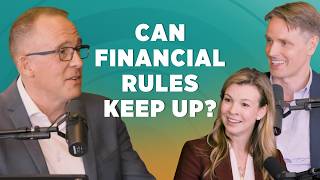

Macro Musings, this episode and its artwork belong to Mercatus Center at George Mason University. Octagon is not affiliated with the show; this page is an independent summary.
